
Date:

Relief road provides glimpse into past Roman and Iron Age communities, settlements and landscapes in the area.

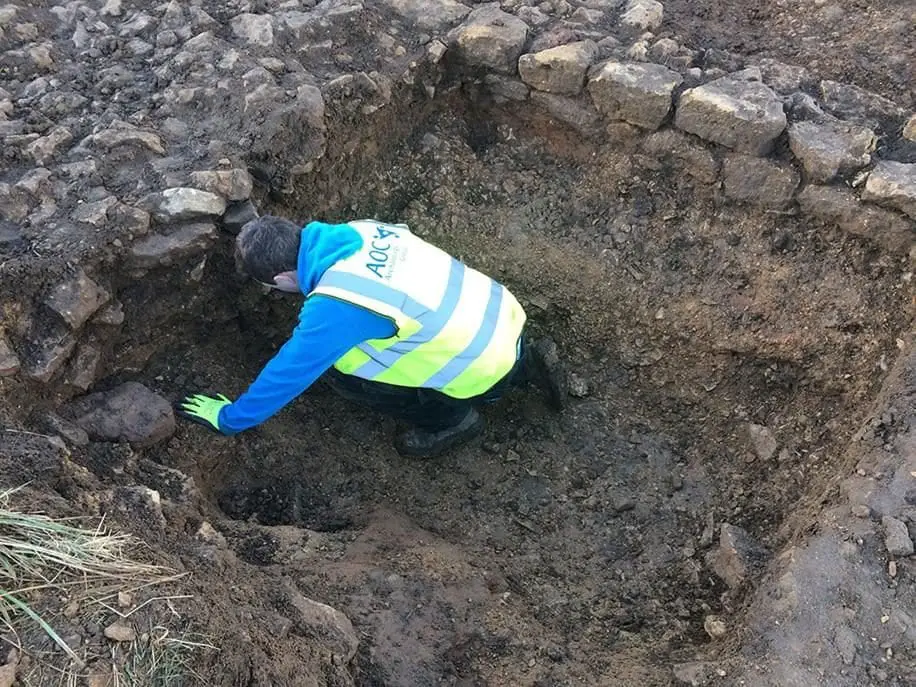
Preliminary works for a relief road in Lincolnshire have provided a fascinating glimpse into past Roman and Iron Age communities, settlements and landscapes in the area.

Since November, a team of more than 15 archaeologists has been carrying out investigations to ensure that any remains affected by the new road are protected or recorded.

- Advertisement -

Catherine Edwards, Project Manager for AOC Archaeology – the firm contracted to research the site’s archaeology – said:

“This is a very interesting and mysterious site that has really allowed us to sink our teeth in so that we can learn more about what was happening in this area of Grantham centuries ago, particularly during Roman times.

“The archaeology we’ve been finding includes lots of linear ditches, quarry pits, kilns, coins and a cemetery, but we’re also finding unexpected remains like a stone wall near to a metalled / roughly paved surface with an earlier ditch underneath.

“Previous to starting on-site back three months ago, research work was carried out including a geophysical survey and archaeological trenching. From there, we began targeting and excavating areas that the research flagged up so that we can truly understand the archaeological record of the site and how it fits into Grantham’s rich history.

- Advertisement -

“A full understanding will have to wait until all the results are processed and reported on. Despite being nearly done on-site, there’s still a lot more work to be done behind the scenes before we have the full picture – but what has been unearthed so far suggests it will be well worth the effort and very enlighthening.”

A full report containing details of what has been discovered will be issued in this summer.

Cllr Richard Davies, Executive Member for Highways and Transport, said: “When building a new road, it’s not just about just about digging holes and putting in tarmac. Before this can happen, it is very important to undertake work to protect the heritage of the area and look at the archaeology underground before we start building.

“It’s really important that whenever you’re building a big piece of infrastructure like Grantham Southern Relief Road, that work is done to find out what’s gone on here for thousands of years for future generations to learn from and understand.”

Lincolnshire County Council


- Advertisement -

Stay Updated: Follow us on iOS, Android, Google News, Facebook, Instagram, Twitter, Threads, TikTok, LinkedIn, and our newsletter

spot_img
Mark Milligan
Mark Milligan
Mark Milligan is a multi-award-winning journalist and the Managing Editor at HeritageDaily. His background is in archaeology and computer science, having written over 8,000 articles across several online publications. Mark is a member of the Association of British Science Writers (ABSW), the World Federation of Science Journalists, and in 2023 was the recipient of the British Citizen Award for Education, the BCA Medal of Honour, and the UK Prime Minister's Points of Light Award.
spot_img
spot_img

Mobile Application

spot_img

Related Articles

184 cuneiform tablets discovered in Hittite royal archive

Archaeologists excavating the ancient city of Kayalıpınar in Türkiye have discovered a Hittite royal archive containing 184 cuneiform tablets and fragments.

3,000-year-old bronze sword discovered in submerged settlement in Italy

Underwater archaeologists have discovered a 3,000-year-old bronze sword during excavations of a submerged Bronze Age settlement in Lake Mezzano, Italy.

Underwater archaeologists discover seal ring depicting the Lighthouse of Alexandria

Underwater archaeologists excavating the Eastern Harbour of Alexandria have discovered a bronze seal ring depicting the Lighthouse of Alexandria.

Rare early medieval boat burial discovered in Poland

Archaeologists from the Institute of Archaeology and Ethnology of the Polish Academy of Sciences (IAE PAN) have discovered a rare early medieval boat burial during excavations at Chodlik in eastern Poland.

Melting ice reveals 6,000-year-old artefacts in Norwegian mountains

Melting ice in Norway’s highest mountains is revealing archaeological remains dating back as far as 6,000 years, providing new insights into prehistoric activity at high elevations.

Ice Age spearheads reveal how early Americans adapted to new landscapes

An analysis of around 500 stone spearheads has revealed how Ice Age hunter-gatherers adapted to unfamiliar landscapes in the Tennessee River Valley.

Pre-Hispanic frog pendants shed light on ancient Maya trade networks

Archaeologists in Mexico are studying a collection of pre-Hispanic shell pendants that could provide new insights into ancient Maya trade networks, ritual practices and technological knowledge.

Bronze hand cannon offers rare evidence of early Korean firearms

Archaeologists in South Korea have authenticated a bronze hand cannon dating to the late Goryeo or early Joseon period, providing rare evidence for the early development of firearms on the Korean Peninsula.


