
A specialist planning lawyer has met with campaigners to discuss the prospect of legal action against development affecting the setting of Old Oswestry hillfort.
The meeting comes as Shropshire’s local plan, known as SAMDev, nears the end of its examination by Inspector Claire Sherratt. The plan includes a large housing estate within an archaeologically busy zone of the hillfort’s hinterland which was pivotal to its military connections with the nearby World War I/II Park Hall training camp.
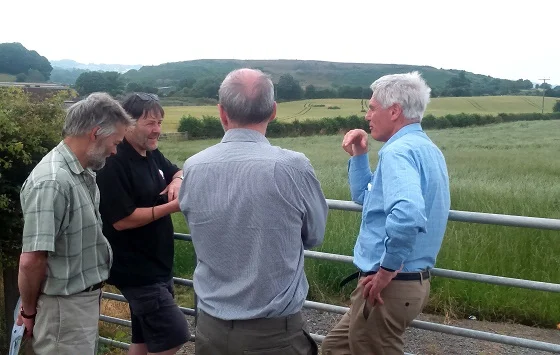
Members of HOOOH (Hands Off Old Oswestry Hillfort) discussed issues over the progression of OSW004 in SAMDev with their guest during a tour of the hillfort. They also surveyed the greenfield site from the B4580 Whittington Road, a key corridor for views of the hillfort, to consider the visual and landscape impacts of development.
The Inspector has kept the 117 house estate in SAMDev subject to ‘masterplanning’ conditions agreed between Historic England (formerly English Heritage) and Shropshire Council in a ‘Statement of Common Ground’.
The agreement, which was reached outside public consultation, has been widely challenged in responses to the Inspector’s modifications including by longstanding campaign supporter, RESCUE (The British Archaeological Trust).
The heritage preservation group points out that the planning conditions for delivery of OSW004 ‘are both contradictory and inconsistent with the sensitivity of the site, lying as it does within the immediate setting of Old Oswestry Hillfort in which the present rural environment is critical.’
HOOOH understands that the Inspector will be submitting her examination report and final plan over the summer ahead of its adoption by Shropshire Council.
HOOOH member, Neil Phillips, said: “This latest visit is part of professional advice we are taking in preparation for a judicial review should OSW004 remain in the plan for council adoption.”
The government is currently urging local authorities to prioritise brownfield development, incentivising it in the June budget, rather than remove good agricultural land like OSW004 from production.
Tim Malim, HOOOH’s heritage planning adviser, said: “A growing number of councils, such as Powys, Herefordshire, Cheshire East, East Devon, Aylesbury Vale, Norwich, Canterbury City, and Uttlesford, to name but a few, have had to revisit their local plans after they were found unsound or legally challenged, causing considerable extra cost and delay.
“Does Shropshire Council really want to risk this for the sake of 117 houses which will devalue one of the County’s most iconic landmarks and are strongly opposed by an influential national lobby?”
In addition to RESCUE, other major organisations have voiced their opposition to OSW004 including the Campaign to Protect Rural England (CPRE), The Prehistoric Society and The Society of Antiquaries of London. Prominent figures have added their weight such as MP Tim Loughton, Professor Sir Barrington Cunliffe CBE, and Professor Lord Renfrew of Kaimsthorn who is Chair of the All Party Parliamentary Archaeology Group (APPAG).
“We urge Shropshire Council to see common sense,” said Mr Malim.
https://www.facebook.com/OldOswestryHillfort
http://oldoswestryhillfort.co.uk/