
Date:

New archaeological find could shed light on late-Roman Britain

A unique archaeological find uncovered near the site of a Roman villa in Dorset could help to shed light on the rural elite of late-Roman Britain

The skeletal remains are thought to be unique as they are buried near the site of a Roman villa, making it likely that the five skeletons belonged to the owners and occupants of the villa – the first time in Britain that the graves of villa owners have been found in such close proximity to the villa itself.

- Advertisement -

Five skeletons were found; two adult males, two adult females and an elderly female – with researchers postulating that they could be the remains of three generations of the same family, who all owned the villa.  The bones are thought to date from the mid-4th Century (around 350 AD).
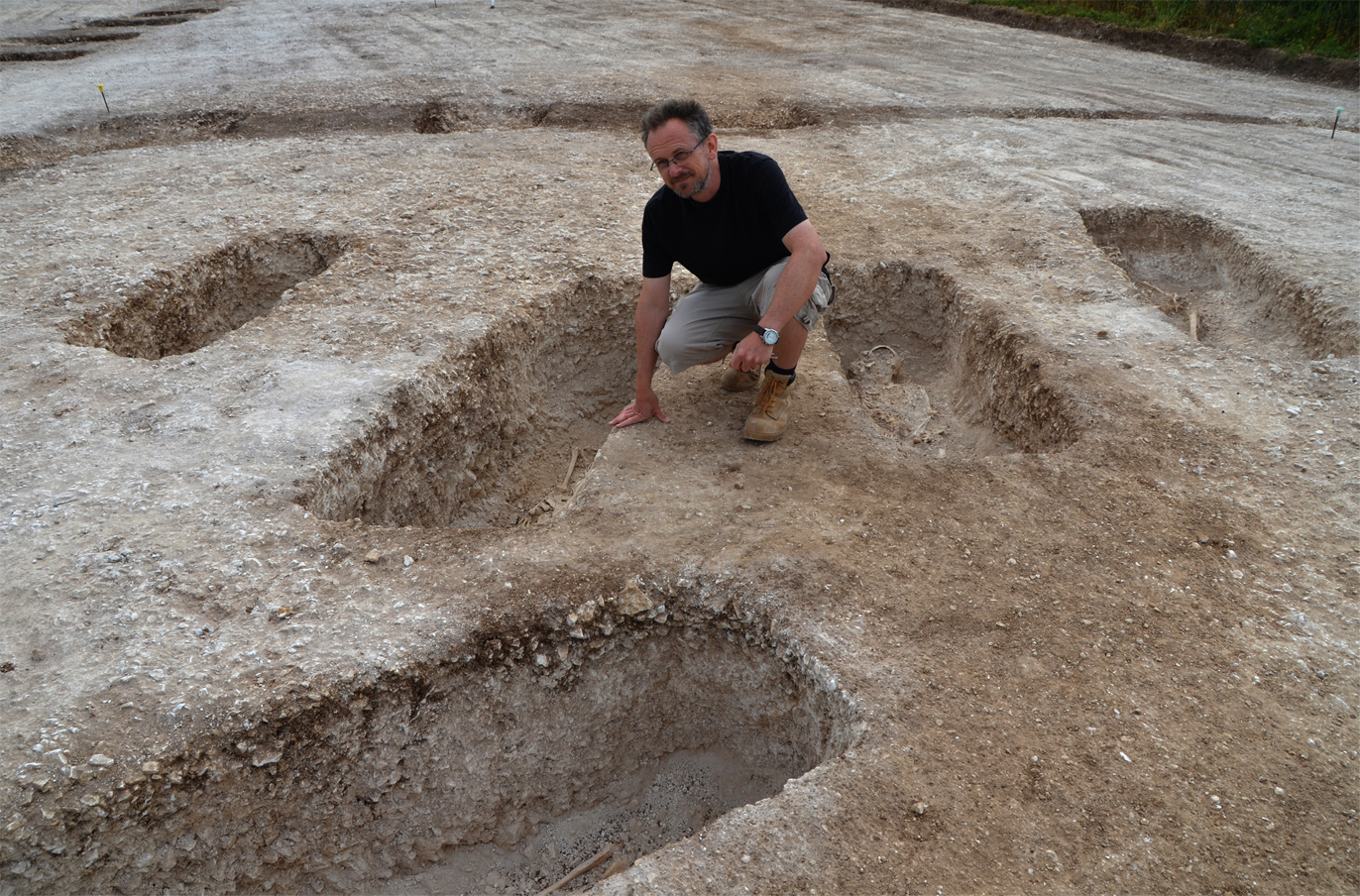
A unique archaeological find uncovered near the site of a Roman villa in Dorset could help to shed light on the rural elite of late-Roman Britain : Bournemouth University

Miles Russell, a Senior Lecturer in Archaeology at Bournemouth University and one of the archaeologists leading the dig, said, “The discovery is of great significance as it is the only time where evidence of a villa and the villa’s occupants have been found in the same location in Britain. This could provide us with significant information, never retrieved before, about the state of health of the villa owners, their ancestry and where they came from.”

Miles continued, “One of the big questions in South West is whether the villas in the South West were owned by Britons who have become Roman or owned by people from another part of the Empire who have come to exploit an under-developed rural area. All villas in this region in the South West are late-Roman – and our findings should tell us more about what life was like in this period of history. This is what what can be assessed when the bones are analysed.”

The discovery was made by staff and students from Bournemouth University, who are working on the Durotriges Big Dig project in North Dorset.

- Advertisement -

The villa itself was excavated last year by students working on the project, and the latest find is the final step in excavating this particular area of rich archaeological significance.

Paul Cheetham, Senior Lecturer in Archaeological Sciences and co-director of the project, added, “We are looking at the rural elite of late-Roman Britain, living through the economic collapse that took place during this period. These remains will shed light on the final stages of the golden age of Roman Britain.”

Bournemouth University

- Advertisement -

Stay Updated: Follow us on iOS, Android, Google News, Facebook, Instagram, Twitter, Threads, TikTok, LinkedIn, and our newsletter

spot_img
Mark Milligan
Mark Milligan
Mark Milligan is a multi-award-winning journalist and the Managing Editor at HeritageDaily. His background is in archaeology and computer science, having written over 8,000 articles across several online publications. Mark is a member of the Association of British Science Writers (ABSW), the World Federation of Science Journalists, and in 2023 was the recipient of the British Citizen Award for Education, the BCA Medal of Honour, and the UK Prime Minister's Points of Light Award.
spot_img
spot_img

Mobile Application

spot_img

Related Articles

Tang Dynasty noblewoman buried with gold hair ornaments

Archaeologists in northwest China have identified an elaborately furnished tomb belonging to a young Tang Dynasty noblewoman, providing significant evidence for the extent of China’s engagement with trans-Eurasian exchange networks during the late seventh century.

Near-complete bronze carnyx among Iron Age hoard discovery

A remarkable hoard of Iron Age metalwork dating back approximately 2,000 years has been uncovered in West Norfolk, shedding new light on the ceremonial and martial traditions of Britain’s Celtic communities.

Protective “Solomon’s Knot” mosaic uncovered in ancient Smyrna

Archaeologists have uncovered a rare mosaic room in the ancient city of Smyrna, featuring a central “Solomon’s Knot” motif believed to have served as a protective symbol against evil and misfortune during Late Antiquity.

Study identifies urban metropolis at X’baatún

Significant progress is being made in the recognition and documentation of X’baatún, a little-known Maya archaeological site located within Oxwatz Park in the ejido of Tekal de Venegas, Yucatán.

LiDAR reveals lost ancient landscape in Andean Chocó

Deep beneath the dense rainforest of the Andean Chocó, north-west of Quito, an ancient pre-Hispanic landscape is emerging using LiDAR (Light Detection and Ranging).

Pristine medieval gold ring discovered in Tønsberg

For most archaeologists, the chance to unearth a pristine artefact from the medieval period is a once-in-a-lifetime event.

Ancient purification bath found beneath Western Wall Plaza

A rock-cut mikveh from the late Second Temple period has been uncovered during excavations beneath Jerusalem’s Western Wall Plaza.

Rare Roman-Era enamelled fibula found near Grudziądz

A rare, enamelled fibula unearthed near Grudziądz is being hailed as only the second discovery of its kind in Poland.