Date:

Ancient Egyptian tomb uncovered with mummified crocodiles

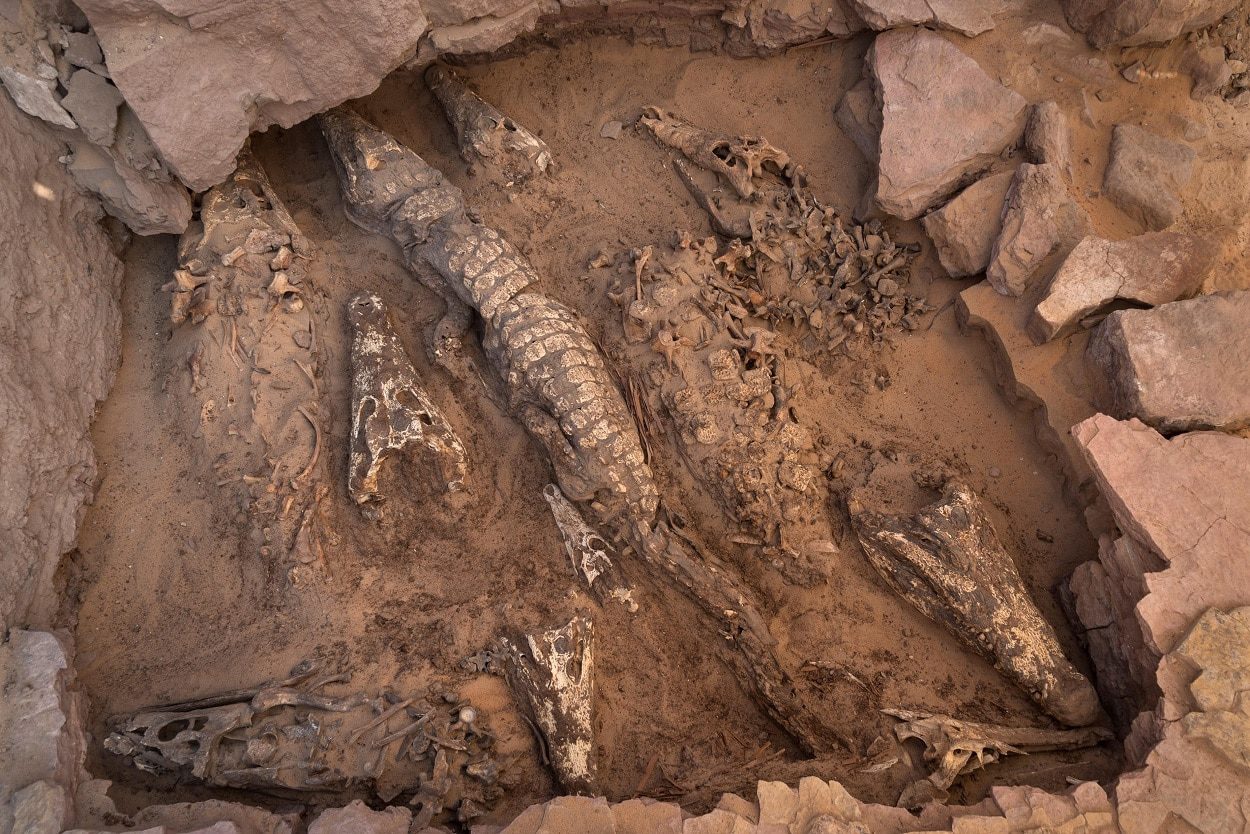
Archaeologists excavating at Qubbat al-Hawā in southern Egypt, have uncovered a tomb containing the remains of mummified crocodiles.

Qubbat al-Hawā is located opposite Aswan on the western bank of the Nile, serving as the resting place of nobles and priests mainly from the Old and Middle Kingdoms of Ancient Egypt.

- Advertisement -

The necropolis was active from the Fourth Dynasty until the Roman Period, where archaeologists have previously uncovered over 100 tombs.

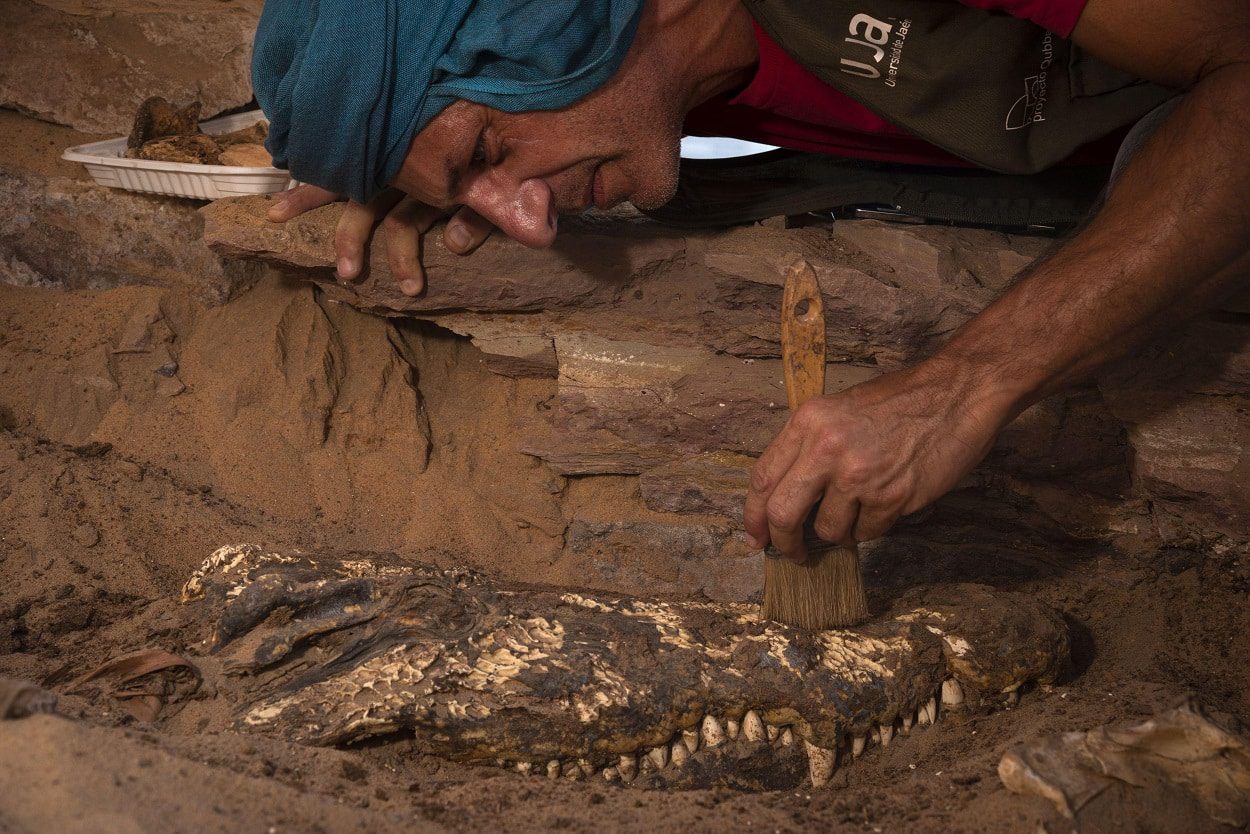
The latest tomb was discovered by archaeologists from the University of Jaén, where they found the remains of five partially complete mummified crocodile skeletons and five mummified crocodile skulls, dating from the pre-Ptolemaic era before 304 BC.
croc2
Image Credit : Patricia Mora Riudavets

Crocodiles were used during rituals for the Ancient Egyptian god, Sobek, who was associated with the Nile crocodile or the West African crocodile, and is represented either in its form or as a human with a crocodile head.

Sobek was also associated with pharaonic power, fertility, and military prowess, but served additionally as a protective deity with apotropaic qualities, invoked especially for protection against the dangers presented by the Nile.

- Advertisement -

Bea De Cupere, an archaeozoologist from the Royal Belgian Institute of Natural Sciences (RBINS) said: “More than 20 burial sites with crocodile mummies are known in Egypt, but to find 10 well-preserved crocodile mummies together in an undisturbed tomb is extraordinary. Of most mummies collected by museums in the late 19th and early 20th centuries, often hatchlings, we don’t know exactly where they come from.”
croc3
Image Credit : Patricia Mora Riudavets
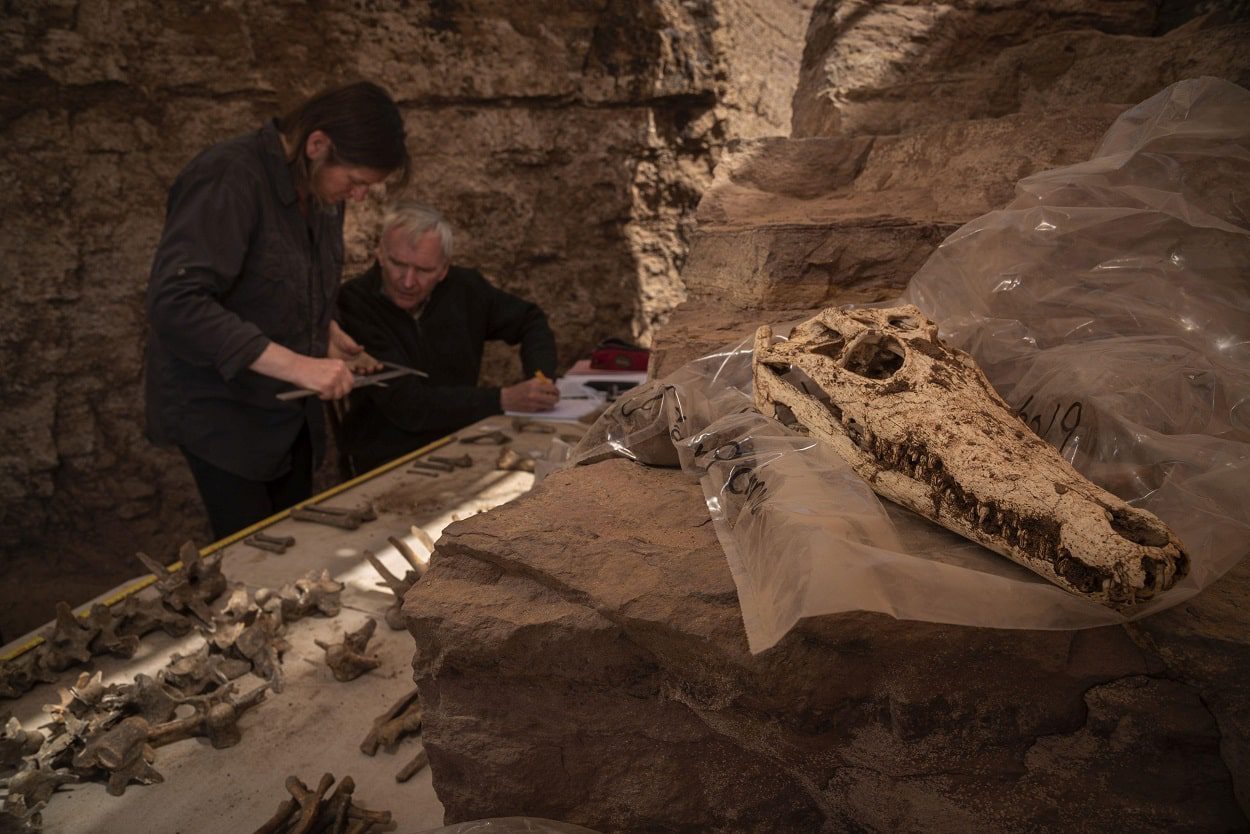
The results of the excavation, now published in the journal PLOS ONE, states that the crocodiles from the tomb measure between 1.8 metres to 3.5 metres in length, belonging to the Nile crocodile and the West African crocodile.

“The crocodiles were first buried elsewhere, possibly in sand pits,” says De Cupere. “This allowed the crocodiles to dry out naturally. Then the remains were unearthed, wrapped and moved to the tomb in Qubbat al-Hawā. Body parts must have been lost during wrapping and transport.”

One of the crocodiles still contained gastroliths, stones in the intestines that help crocodiles stay balanced in the water, suggesting that the crocodile was not cut open to remove the intestines during the mummification process.


RBINS

https://doi.org/10.1371/journal.pone.0279137

Header Image Credit : Patricia Mora Riudavets


- Advertisement -

Stay Updated: Follow us on iOS, Android, Google News, Facebook, Instagram, Twitter, Threads, TikTok, LinkedIn, and our newsletter

spot_img
Mark Milligan
Mark Milligan
Mark Milligan is a multi-award-winning journalist and the Managing Editor at HeritageDaily. His background is in archaeology and computer science, having written over 8,000 articles across several online publications. Mark is a member of the Association of British Science Writers (ABSW), the World Federation of Science Journalists, and in 2023 was the recipient of the British Citizen Award for Education, the BCA Medal of Honour, and the UK Prime Minister's Points of Light Award.
spot_img
spot_img

Mobile Application

spot_img

Related Articles

Inscriptions reveal the lives behind the ancient temples of the Middle East

Stone temples rising from the deserts of the ancient Near East were meant to embody the power of the gods.

World’s oldest poison arrows discovered

Even in the deep Stone Age, humans possessed biochemical knowledge that appears extraordinary by modern standards.

Tang Dynasty noblewoman buried with gold hair ornaments

Archaeologists in northwest China have identified an elaborately furnished tomb belonging to a young Tang Dynasty noblewoman, providing significant evidence for the extent of China’s engagement with trans-Eurasian exchange networks during the late seventh century.

Near-complete bronze carnyx among Iron Age hoard discovery

A remarkable hoard of Iron Age metalwork dating back approximately 2,000 years has been uncovered in West Norfolk, shedding new light on the ceremonial and martial traditions of Britain’s Celtic communities.

Protective “Solomon’s Knot” mosaic uncovered in ancient Smyrna

Archaeologists have uncovered a rare mosaic room in the ancient city of Smyrna, featuring a central “Solomon’s Knot” motif believed to have served as a protective symbol against evil and misfortune during Late Antiquity.

Study identifies urban metropolis at X’baatún

Significant progress is being made in the recognition and documentation of X’baatún, a little-known Maya archaeological site located within Oxwatz Park in the ejido of Tekal de Venegas, Yucatán.

LiDAR reveals lost ancient landscape in Andean Chocó

Deep beneath the dense rainforest of the Andean Chocó, north-west of Quito, an ancient pre-Hispanic landscape is emerging using LiDAR (Light Detection and Ranging).

Pristine medieval gold ring discovered in Tønsberg

For most archaeologists, the chance to unearth a pristine artefact from the medieval period is a once-in-a-lifetime event.