
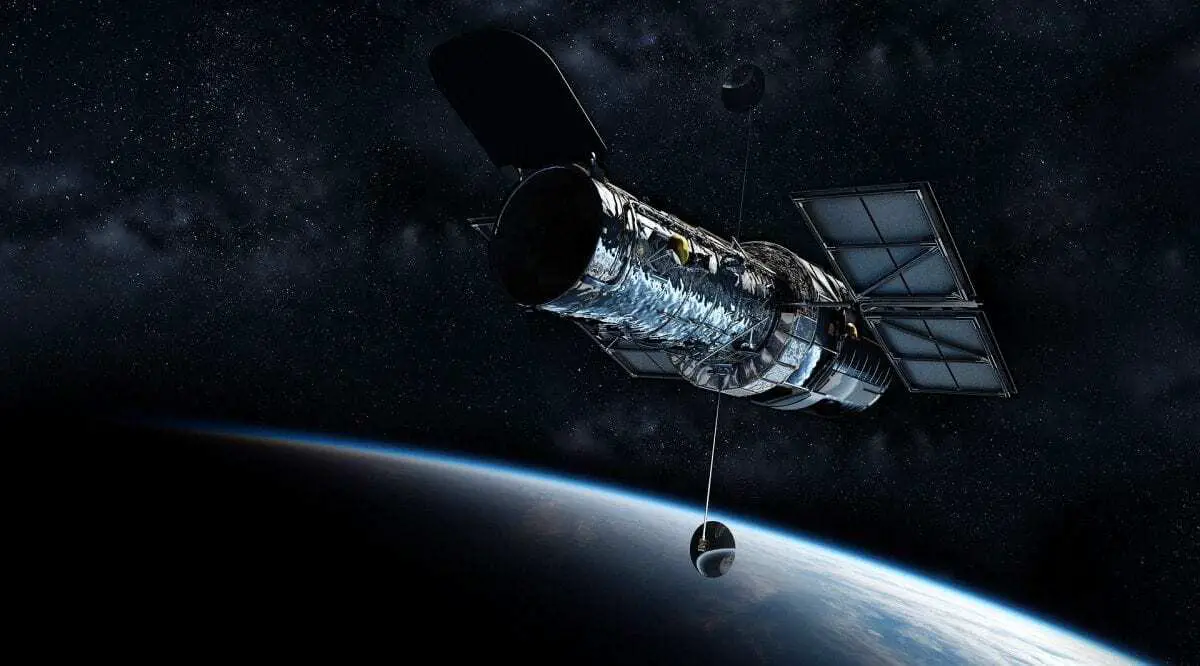
Using the unique capabilities of NASA’s Hubble Space Telescope, a team of astronomers led by Virginia Tech’s Nahum Arav has discovered the most energetic outflows ever witnessed in the universe.
The outflows emanate from quasars and tear across interstellar space similar to tsunamis on Earth, wreaking havoc on the galaxies in which the quasars reside. Quasars are the brilliant, compact cores of distant galaxies that can shine 1,000 times brighter than their host galaxies of hundreds of millions of stars. Their central engines are supermassive black holes that are engorged with infalling dust, gas, and stars, said Arav, a professor in the Department of Physics, part of the Virginia Tech College of Science.
Quasars are created when a black hole devours matter, thus emitting intense radiation. Driven by the blistering radiation pressure from the black hole, concussive blasts push material away from the galaxy’s center into outflows that accelerate to breathtaking velocities that are a few percent of the speed of light, Arav said.
“These outflows are crucial for the understanding of galaxies’ formation,” Arav said. “They are pushing hundreds of solar masses of material each year. The amount of mechanical energy that these outflows carry is up to several hundreds of times higher than the luminosity of the entire Milky Way galaxy.”

The findings appear in the March issue of Astrophysical Journal Supplements. Arav’s research team includes post-doctorate researcher Timothy Miller and doctoral student Xinfeng Xu, both from Virginia Tech, as well as Gerard Kriss and Rachel Plesha of the Space Telescope Science Institute in Baltimore, Maryland.
The quasar winds disseminate across the galaxy’s disc, violently sweeping material that otherwise would have formed new stars. Radiation pushes the gas and dust for far greater distances than scientists previously thought, creating a galaxy-wide event, according to the study.
As this cosmic tsunami slams into interstellar material, its temperature spikes to billions of degrees, where material glows largely in X-rays, but also widely across the light spectrum. Anyone witnessing this event would see a fantastic show of fireworks. “You’ll get lots of radiation first in X-rays and gamma rays, and afterwards it will percolate to visible and infrared light,” Arav said. “You’d get a huge light show, like Christmas trees all over the galaxy.”
Numerical simulation of galaxy evolution suggest that such outflows can explain some important cosmological puzzles, such as why astronomers observe so few large galaxies in the universe and why there is a relationship between the mass of the galaxy and the mass of its central black hole. This study show that such powerful quasar outflows should be prevalent in the early universe.
“Both theoreticians and observers have known for decades that there is some physical process that shuts off star formation in massive galaxies, but the nature of that process has been a mystery. Putting the observed outflows into our simulations solves these outstanding problems in galactic evolution,” said Jeremiah P. Ostriker, an eminent cosmologist at Columbia and Princeton universities. (Ostriker was not involved with this study.)
Aside from measuring the most energetic quasars ever observed, the team also discovered another outflow accelerating faster than any other. The outflow increased from nearly 43 million miles per hour to roughly 46 million miles per hour in a three-year period. The scientists believe its acceleration will continue to increase as time passes.
“There were so many discoveries in the data that I felt like a kid in a candy store,” Miller added.
Astronomers were able to clock the breakneck speed of gas being accelerated by the quasar wind by looking at spectral “fingerprints” of light from the glowing gas. The Hubble ultraviolet data shows that these absorption features were shifted in the spectrum because of the fast motion of the gas across space. This is due to the Doppler effect, where the motion of an object compresses or stretches wavelengths of light depending on whether it is approaching or receding from us. Only Hubble has the ultraviolet sensitivity to obtain the necessary observations leading to this discovery, according to NASA.
Header Image – Public Domain




