
Date:

Bone knife from Morocco is oldest specialized tool associated with Aterian culture

A single bone artefact found in a Moroccan cave is the oldest well-dated specialized bone tool associated with the Aterian culture of the Middle Stone Age, according to a study by Abdeljalil Bouzouggar of the Institut National des Sciences de l’Archéologie et du Patrimoine in Morocco and colleagues.

The make and manufacture of the tool are distinct from similarly-aged sub-Saharan artefacts, suggesting a unique technological industry in North Africa.

- Advertisement -

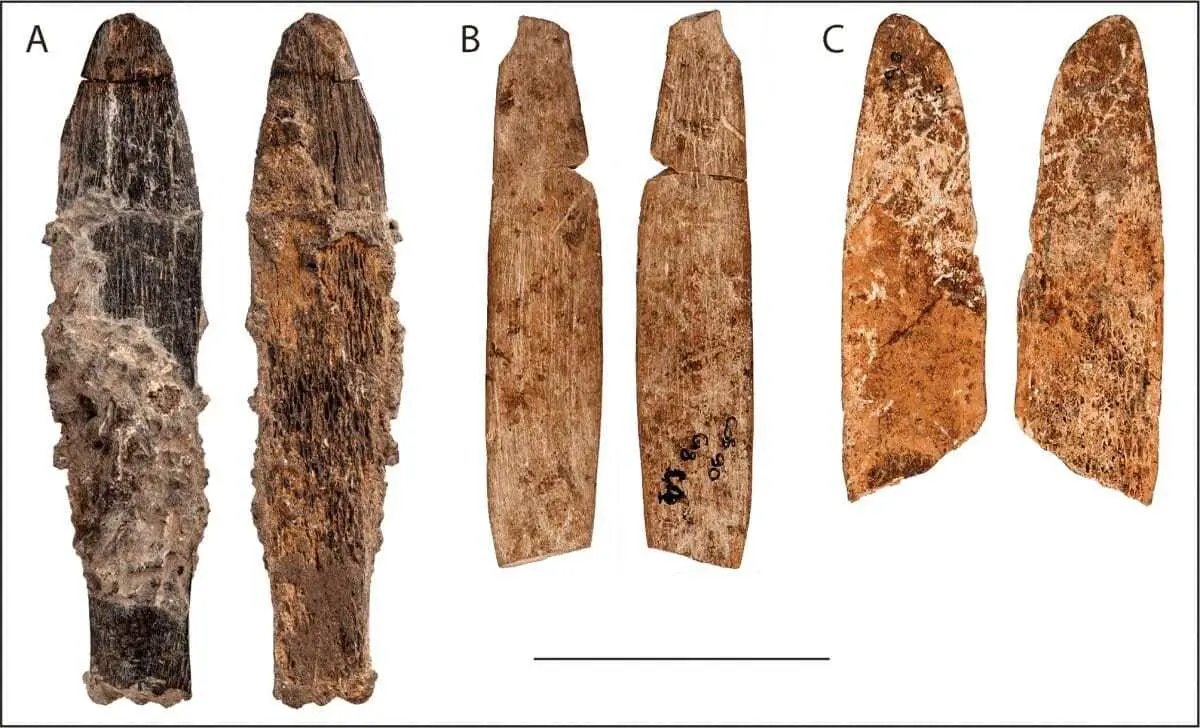
The tool was recovered in 2012 from Dar-es Soltan 1 cave, located about 260km inland from the Atlantic coast of Morocco. Upon close examination, Bouzouggar and colleagues were able to identify the origins of the bone as a large mammal rib with evidence of having been shaped and sharpened into a 122mm-long knife through a complex series of modifications.

The layer containing the bone knife has been dated to approximately 90,000 years ago, approximately 55,000 years after the first appearance of the Aterian culture.

This tool and the technology used to create it are distinct from bone tools of similar age in southern Africa but similar to two tools known from the El Mnasra cave site in Morocco which is also of similar age, suggesting a unique North African Aterian bone technology.

Specialized bone tools are considered a sign of cognitive complexity but have been poorly-understood with the Aterian technological complex, so this finding represents a new insight into the development of modern human cognition. The authors also suggest that this new technology may have come about in response to changing resources around 90,000 years ago but note that more study will be required to support this.

- Advertisement -

Silvia Bello, a co-author, adds: “Aterians were capable of a complex and controlled sequence of actions involved in the manufacture of specialised bone knives. Such distinctive bone technology implies the emergence of an independent modern techno-complex unique to the north Africa around 100,000 years ago.”

PLOS

Header Image – Middle Stone Age bone knives from Dar es-Soltan 1 and El Mnasra. (A) Dar es-Soltan 1 bone knife; El Mnasra (B) refit of E9-233 with E9-229 and (C) D11-T194. Cortical and trabecular surfaces. Scale = 50 mm. (Relief map modified from Wikimedia Creative Commons).

- Advertisement -

Stay Updated: Follow us on iOS, Android, Google News, Facebook, Instagram, Twitter, Threads, TikTok, LinkedIn, and our newsletter

spot_img
Mark Milligan
Mark Milligan
Mark Milligan is a multi-award-winning journalist and the Managing Editor at HeritageDaily. His background is in archaeology and computer science, having written over 8,000 articles across several online publications. Mark is a member of the Association of British Science Writers (ABSW), the World Federation of Science Journalists, and in 2023 was the recipient of the British Citizen Award for Education, the BCA Medal of Honour, and the UK Prime Minister's Points of Light Award.
spot_img
spot_img

Mobile Application

spot_img

Related Articles

Geophysical survey reveals possible hidden chambers in Italy’s “Cave of Venuses”

A geophysical survey of the Grotta delle Veneri (Cave of Venuses) in southern Italy has identified possible hidden cavities that may connect to the existing prehistoric cave system.

184 cuneiform tablets discovered in Hittite royal archive

Archaeologists excavating the ancient city of Kayalıpınar in Türkiye have discovered a Hittite royal archive containing 184 cuneiform tablets and fragments.

3,000-year-old bronze sword discovered in submerged settlement in Italy

Underwater archaeologists have discovered a 3,000-year-old bronze sword during excavations of a submerged Bronze Age settlement in Lake Mezzano, Italy.

Underwater archaeologists discover seal ring depicting the Lighthouse of Alexandria

Underwater archaeologists excavating the Eastern Harbour of Alexandria have discovered a bronze seal ring depicting the Lighthouse of Alexandria.

Rare early medieval boat burial discovered in Poland

Archaeologists from the Institute of Archaeology and Ethnology of the Polish Academy of Sciences (IAE PAN) have discovered a rare early medieval boat burial during excavations at Chodlik in eastern Poland.

Melting ice reveals 6,000-year-old artefacts in Norwegian mountains

Melting ice in Norway’s highest mountains is revealing archaeological remains dating back as far as 6,000 years, providing new insights into prehistoric activity at high elevations.

Ice Age spearheads reveal how early Americans adapted to new landscapes

An analysis of around 500 stone spearheads has revealed how Ice Age hunter-gatherers adapted to unfamiliar landscapes in the Tennessee River Valley.

Pre-Hispanic frog pendants shed light on ancient Maya trade networks

Archaeologists in Mexico are studying a collection of pre-Hispanic shell pendants that could provide new insights into ancient Maya trade networks, ritual practices and technological knowledge.


