
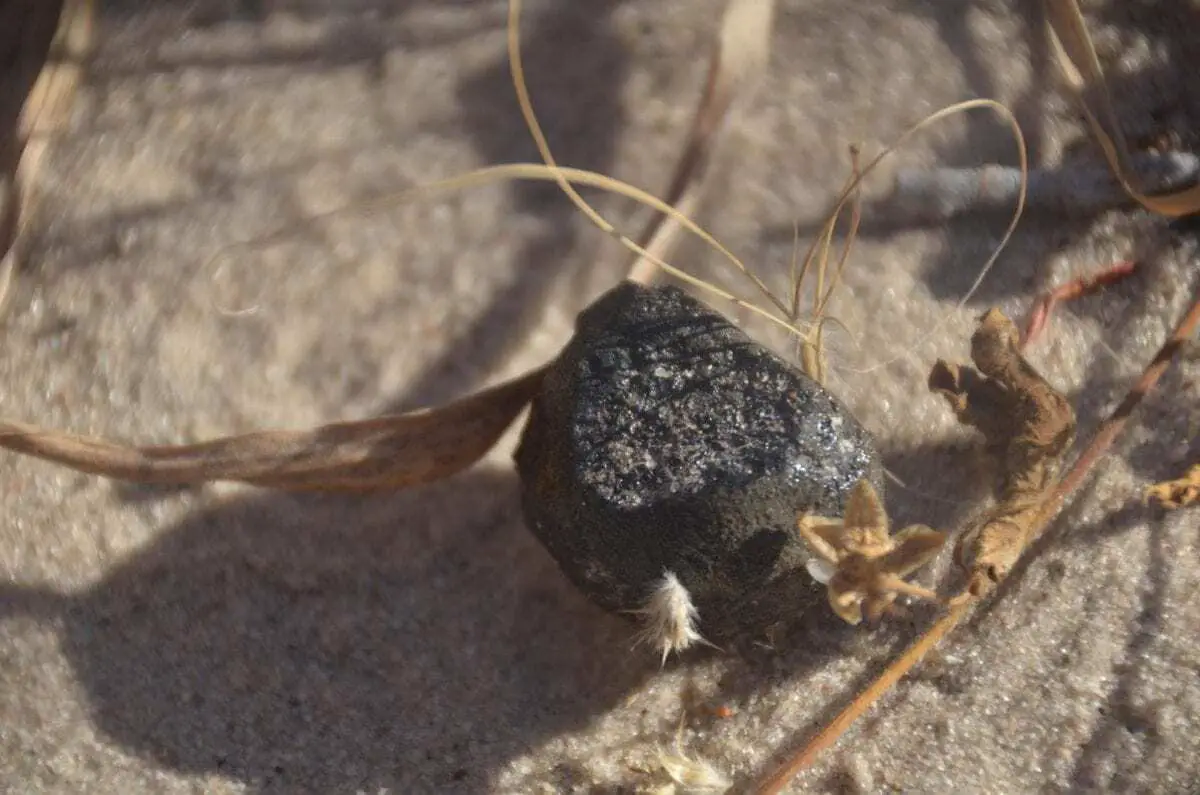
A team of experts from Botswana, South Africa, Finland and the United States of America recovered a fresh meteorite in Botswana’s Central Kalahari Game Reserve (CKGR).
The meteorite is one of the fragments of asteroid 2018 LA which collided with Earth on June 2, 2018 and turned into a meteor fireball that detonated over Botswana a few seconds after entering the atmosphere. The incident was witnessed by a number of spectators in Botswana and neighbouring countries and was captured on numerous security cameras.
Asteroid 2018 LA was detected in space eight hours before hitting Earth. It was detected by the Catalina Sky Survey, operated by the University of Arizona and sponsored by NASA as part of its Planetary Defence mission. This is the third time in history that an asteroid inbound to hit Earth was detected early and only the second time that fragments were recovered. After disruption, the asteroid fragments were blown by the wind while falling down, scattering over a wide area. Calculations of the landing area were done independently by a US-based group headed by Peter Jenniskens, a subject expert of the NASA-sponsored SETI Institute in California, as well as Esko Lyytinen and Jarmo Moilanen of the Finnish Fireball Network (FFN).
The first meteorite was found after five days of walking and scouring around by a team of geoscientists from Botswana International University of Science and Technology (BUIST), Botswana Geoscience Institute (BGI) and University of Botswana’s Okavango Research Institute (ORI). The Department of Wildlife and National Parks granted access and deployed park rangers for protection and participation in the search. The importance of the find is two-fold: It has enormous scientific value and it allows to better calibrate the so-called “Earth Defense” against impacting asteroids.
Jenniskens, who traveled to Botswana to assist in the search, teamed up with Oliver Moses (from ORI), to gather security surveillance videos in Rakops and Maun, to get better constraints on the position and altitude of the fireball’s explosion. Professor Alexander Proyer, from BIUST, led the joint expedition while Mohutsiwa Gabadirwe, BGI senior curator, coordinated access to the protected fall area in the game reserve. Professor Roger Gibson, Head of School at the School of Geosciences at the University of the Witwatersrand in Johannesburg, South Africa, also assisted in locating the fall area. The meteorite was eventually spotted by BIUST geologist Lesedi Seitshiro. The search for more fragments of the meteorite continues. Dr Fulvio Franchi of BIUST, is leading the follow-up search team joined by Tomas Kohout of the FFN and the University of Helsinki.
Meteorites are protected under Botswana law and samples will be curated by the Botswana National Museum and investigated further by a research consortium of scientists coordinated by Botswana Geoscience Institute (BGI).
Helsingin yliopisto (University of Helsinki)
Header Image – Botswana meteorite. Picture by Peter Jenniskens




