
1 – Cairo Citadel
The Saladin Citadel of Cairo is a medieval Islamic fortification in Cairo, Egypt. The Citadel was fortified by the Ayyubid ruler Salah al-Din (Saladin) between 1176 and 1183 AD to protect it from the Crusaders. Only a few years after defeating the Fatimid Caliphate, Saladin set out to build a wall that would surround both Cairo and Fustat.
Built on a promontory beneath the Muqattam Hills, a setting that made it difficult to attack, the efficacy of the Citadel’s location is further demonstrated by the fact that it remained the heart of Egyptian government until the 19th century.

2 – Fasil Ghebbi
Fasil Ghebbi is the remains of a fortress-city within Gondar, Ethiopia. It was founded in the 17th and 18th centuries by Emperor Fasilides (Fasil) and was the home of Ethiopia’s emperors. Its unique architecture shows diverse influences including Nubianstyles. Fasil Ghebbi covers an area of about 70,000 square meters.
The complex of buildings includes Fasilides’ castle, Iyasu I’s palace, Dawit III’s Hall, a banqueting hall, stables, Empress Mentewab’s castle, a chancellery, library and three churches: Asasame Qeddus Mikael, Elfign Giyorgis and Gemjabet Mariyam. The site was inscribed as a UNESCO World Heritage Site in 1979.

3 – Citadel of Qaitbay
The Citadel of Qaitbay (or the Fort of Qaitbay) is a 15th-century defensive fortress located on the Mediterranean sea coast, in Alexandria, Egypt. It was established in 1477 AD by Sultan Al-Ashraf Sayf al-Din Qa’it Bay.
The Qaitbay Citadel in Alexandria is considered one of the most important defensive strongholds, not only in Egypt, but also along the Mediterranean Sea coast. It was erected on the exact site of the famous Lighthouse of Alexandria, which was one of the Seven Wonders of the Ancient World.

4 – Kunta Kinteh Island
Kunta Kinteh Island, formerly James Island, is an island in the Gambia River, 30 km from the river mouth and near Juffureh in Gambia.
The first European settlers on the island came from Duchy of Courland and Semigallia, a vassal state of the Polish–Lithuanian Commonwealth. In 1651, the settlers built a fort that they named Jacob Fort after Jacob Kettler, the Duke of Courland, and used it as a trade base. The Dutch briefly held the fort from 1659 until the English captured it in 1661; the Dutch formally ceded the fort to the English in 1664 who renamed it James Island and the fort Fort James.
As an important historical site in the West African slave trade, it is now listed as a UNESCO World Heritage Site. Ruins of several of the British administrative buildings (including a single cell, apparently used to house the most troublesome captives), a small jetty and a number of skeletal baobab trees remain.

5 – Elmina Castle
Elmina Castle was erected by the Portuguese in 1482 as São Jorge da Mina (St. George of the Mine) Castle, also known simply as Mina or Feitoria da Mina in present-day Elmina, Ghana (formerly the Gold Coast).
First established as a trade settlement, the castle later became one of the most important stops on the route of the Atlantic slave trade. The Dutch seized the fort from the Portuguese in 1637, and took over all the Portuguese Gold Coast in 1642.
The slave trade continued under the Dutch until 1814; in 1872 the Dutch Gold Coast, including the fort, became a possession of the British Empire. Today Elmina Castle is a popular historical site and is recognised by UNESCO as a World Heritage Site.

6 – Ribat – Monastir
Ribat is an Arabic term for a small fortification built along a frontier during the first years of the Muslim conquest of North Africa to house military volunteers, called the murabitun. These fortifications later served to protect commercial routes, and as centers for isolated Muslim communities.
Monastir was founded on the ruins of the Punic–Roman city of Ruspina. The city features a well preserved Ribat that was used to scan the sea for hostile ships as a defence against the attacks of the Byzantine fleet.

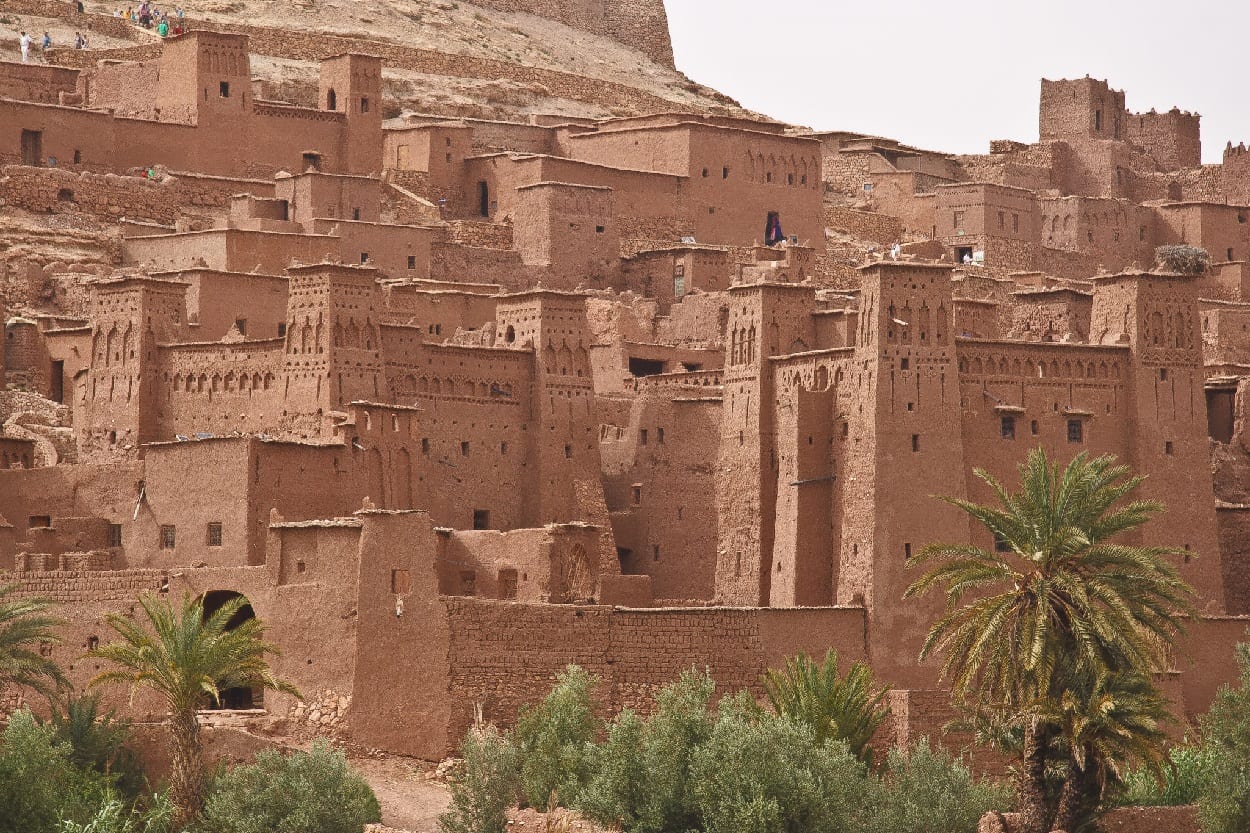
7 – Aït Benhaddou
Aït Benhaddou is a fortified city, or palace (ksar), along the former caravan route between the Sahara and Marrakech in present-day Morocco.
This giant fortification which is made up of six forts (Kasbahs) and nearly fifty palaces which are individual forts, is of earthen clay architecture used in many examples of Moroccan architecture.
Aït Benhaddou has been a UNESCO World Heritage Site since 1987.
8 – Murzuk
Murzuk is a fortified oasis town and the capital of the Murzuq District in the Fezzan region of southwest Libya. It lies on the northern edge of the Murzuq Desert, an extremely arid region of ergs or great sand dunes which is part of the greater Sahara Desert.
Murzuk developed around an oasis which served as a stop on the north-south trade route across the Sahara Desert. Under Ottoman rule (1578 – 1912) Murzuk was at times the capital of Fezzan, and enjoyed a long period of prosperity. The town had a major fort, and was termed the “Paris of the Sahara”. The Ottoman army usually maintained a garrison there, but local control remained in the hands of the Sultan of Fezzan.

9 – Fort Santa Cruz
Fort Santa Cruz, Oran, is one of the three forts in Oran, the second largest port city of Algeria; the other two forts are Fort de la Moune at the western end of the port and Fort St. Philippe, a replacement of the old castle of the Saints known in Spanish as Castillo de los Santos, at the centre of Oran.
Fort Santa Cruz was built between 1577 and 1604 by the Spaniards on the Pic d’Aidour above Gulf of Oran in the Mediterranean Sea, at an elevation of above 400 metres (1,312 ft).
The fort city under Spanish rule continued to grow, requiring enlargement of the city walls. In spite of the improved fortifications, the city was the object of repeated attacks. Notable in this regard was when Moroccan Sharif Moulay Ismail tried to force his way past the defenses in 1707, only to see his army decimated. In 1831, the French occupied Oran and the fort.

10 – Old Fort of Zanzibar
The Old Fort, also known as the Arab Fort is a fortification located in Stone Town, Zanzibar.
It was built in the late 17th century by the Omanis to defend the island from the Portuguese, and is known to have actually been used to repel at least one attack from the Portuguese and their Mazrui allies.
The fort is essentially a square of high, brown walls with merlons, protecting an inner courtyard. In the courtyard there are some remnants of earlier buildings, including those of a Portuguese church and another Omani fortification.