
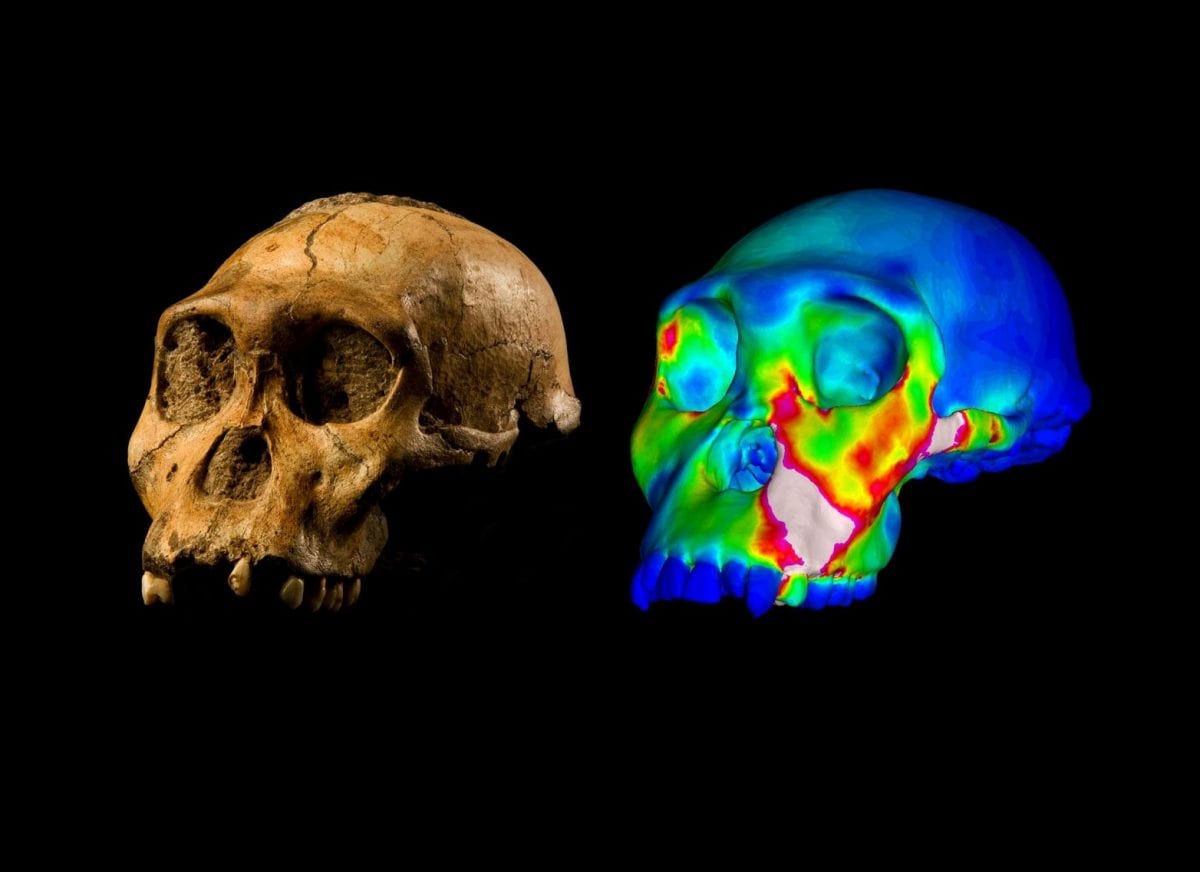
Research published in 2012 garnered international attention by suggesting that a possible early human ancestor had lived on a diverse woodland diet including hard foods mixed in with tree bark, fruit, leaves and other plant products.
But new research by an international team of researchers now shows that Australopithecus sediba didn’t have the jaw and tooth structure necessary to exist on a steady diet of hard foods.
“Most australopiths had amazing adaptations in their jaws, teeth and faces that allowed them to process foods that were difficult to chew or crack open. Among other things, they were able to efficiently bite down on foods with very high forces,” said team leader David Strait, PhD, professor of anthropology in Arts & Sciences at Washington University in St. Louis.
“Australopithecus sediba is thought by some researchers to lie near the ancestry of Homo, the group to which our species belongs,” said Justin Ledogar, PhD, Strait’s former graduate student and now a researcher at the University of New England in Australia. “Tet we find thatA. sediba had an important limitation on its ability to bite powerfully; if it had bitten as hard as possible on its molar teeth using the full force of its chewing muscles, it would have dislocated its jaw.”
The study, published Feb. 8 in the journal Nature Communications, describes biomechanical testing of a computer-based model of an Australopithecus sediba skull. The model is based on a fossil skull recovered in 2008 from Malapa, a cave near Johannesburg, South Africa. The biomechanical methods used in the study are similar to those used by engineers to test whether or not planes, cars, machine parts or other mechanical devices are strong enough to avoid breaking during use.
Australopithecus sediba, a diminutive pre-human species that lived about two million years ago in southern Africa, has been heralded as a possible ancestor or close relative of Homo. Australopiths appear in the fossil record about four million years ago, and although they have some human traits like the ability to walk upright on two legs, most of them lack other characteristically human features like a large brain, flat faces with small jaws and teeth, and advanced tool-use.
Humans in the genus Homo are almost certainly descended from an australopith ancestor, and A. sediba is a candidate to be either that ancestor or something similar to it.
Some of the researchers who described A. sediba are also authors on the biomechanical study, including Lee Berger, PhD, and Kristian Carlson, PhD, of the University of the Witwatersrand, and Darryl de Ruiter, PhD, of Texas A&M University. Amanda Smith, PhD, a postdoctoral fellow in physical anthropology at Washington University, also participated in the research.
The new study does not directly address whether Australopithecus sediba is indeed a close evolutionary relative of early Homo, but it does provide further evidence that dietary changes were shaping the evolutionary paths of early humans.
“Humans also have this limitation on biting forcefully and we suspect that early Homo had it as well, yet the other australopiths that we have examined are not nearly as limited in this regard,” Ledogar said. “This means that whereas some australopith populations were evolving adaptations to maximize their ability to bite powerfully, others (including A. sediba) were evolving in the opposite direction.”
“Some of these ultimately gave rise to Homo,” Strait said. “Thus, a key to understanding the origin of our genus is to realize that ecological factors must have disrupted the feeding behaviors and diets of australopiths. Diet is likely to have played a key role in the origin ofHomo.”
Strait, a paleoanthropologist who has written about the ecological adaptations and evolutionary relationships of early humans, as well as the origin and evolution of bipedalism, said this study offers a good example of how the tools of engineering can be used to answer evolutionary questions. In this case, they help us to better understand what the facial skeleton can tell us about the diet and lifestyles of humans and other primates.
“Our study provides a really nice demonstration of the difference between reconstructing the behaviors of extinct animals and understanding their adaptations.” Strait said. “Examination of the microscopic damage on the surfaces of the teeth of A. sediba has led to the conclusion that the two individuals known from this species must have eaten hard foods shortly before they died. This gives us information about their feeding behavior. Yet, an ability to bite powerfully is needed in order to eat hard foods like nuts or seeds. This tells us that even though A. sediba may have been able to eat some hard foods, it is very unlikely to have been adapted to eat hard foods.”
The bottom line, Strait said, is that the consumption of hard foods is very unlikely to have led natural selection to favor the evolution of a feeding system that was limited in its ability to bite powerfully. This means that the foods that were important to the survival of A. sedibaprobably could have been eaten relatively easily without high forces.
WASHINGTON UNIVERSITY IN ST. LOUIS




