The manufacture of stone-tipped spears is a skill likely to have been learned by being passed from generation to generation through social or group learning.
Attaching a stone tip on to a wooden spear shaft was a significant innovation for early modern humans living around 500,000 years ago. However, it was also a costly behavior in terms of time and effort to collect, prepare and assemble the spear. Stone tips break more frequently than wooden spears, requiring more frequent replacement and upkeep, and the fragility of a broken point could necessitate multiple thrusts to an angry animal. So, why did early hunters begin to use stone-tipped spears?
To learn if there was a “wounding” advantage between using a wooden spear or a stone-tipped spear, ASU postdoctoral researcher Jayne Wilkins, doctoral student Benjamin Schoville and coauthor Kyle Brown from the University of Cape Town, conducted controlled experiments using tipped and untipped spear replications, a calibrated crossbow and ballistics gelatin. The experiments looked at the size and shape of the “wound,” penetration depth and damage done by extraction of the spear. Wilkins and Schoville are affiliated with the Institute of Human Origins, a research center of the ASU College of Liberal Arts and Sciences in the School of Human Evolution and Social Change.
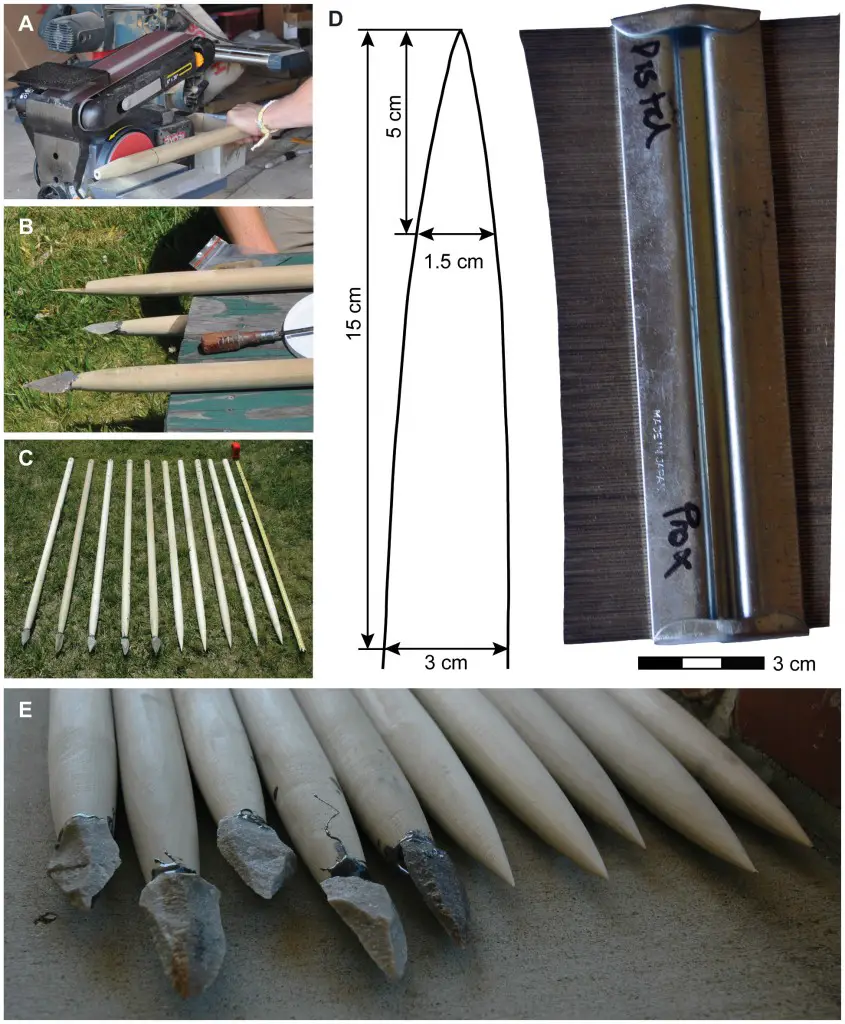
A. Using disc sander to shape distal end of spear. B. L-notch used for hafting stone tools to half of the spears. C. Two sets of spears were manufactured, 5 tipped, 5 untipped. D. The shape of the distal end was constant between all 10 spears; a contour gauge was used to ensure consistency. E. Commercial epoxy was used as the binding agent to attach the quartzite stone tips. Plos One
Their experiments found that although tipped spears did not penetrate deeper than the untipped spears as is commonly thought, the tipped spears create wider wound cavities. These wider wound cavities would have caused more debilitating tissue damage to internal organs of animals, making hunts more successful. This is one explanation for an evolutionary advantage for tipped a spear with a stone, an innovation that may have significantly impacted the evolution of human life-history.
“Putting a fragile stone tip on a spear is risky,” said Schoville, “but we show that there are serious rewards in terms of both the size and shape of the wound created that made this innovation extremely worthwhile during our evolution.”
The authors also posit that the manufacture of the stone-tipped spears may represent the origin of new cognitive and social development in our human ancestors. Working memory (the ability to hold attention to multiple tasks in order to collect, prepare and combine different kinds of raw materials into a weapon), and constructive memory (the ability to imagine and plan for future tasks), were mental capacities required for tipped spear construction. In addition, since a stone-tipped spear is a skill likely to have been learned by being passed from generation to generation through social or group learning, stone-tipped technology is evidence of the evolutionary impact of “cumulative culture.”
The flip side of this greater human cooperation is where groups and individuals are more likely to cooperate when others have very lethal weapons—a situation still in play today.