
Archaeologists excavating the Grønhaug Viking ship burial in Norway have uncovered an earlier stone monument beneath the grave, which is believed to represent a burial mound dating from the Bronze Age.
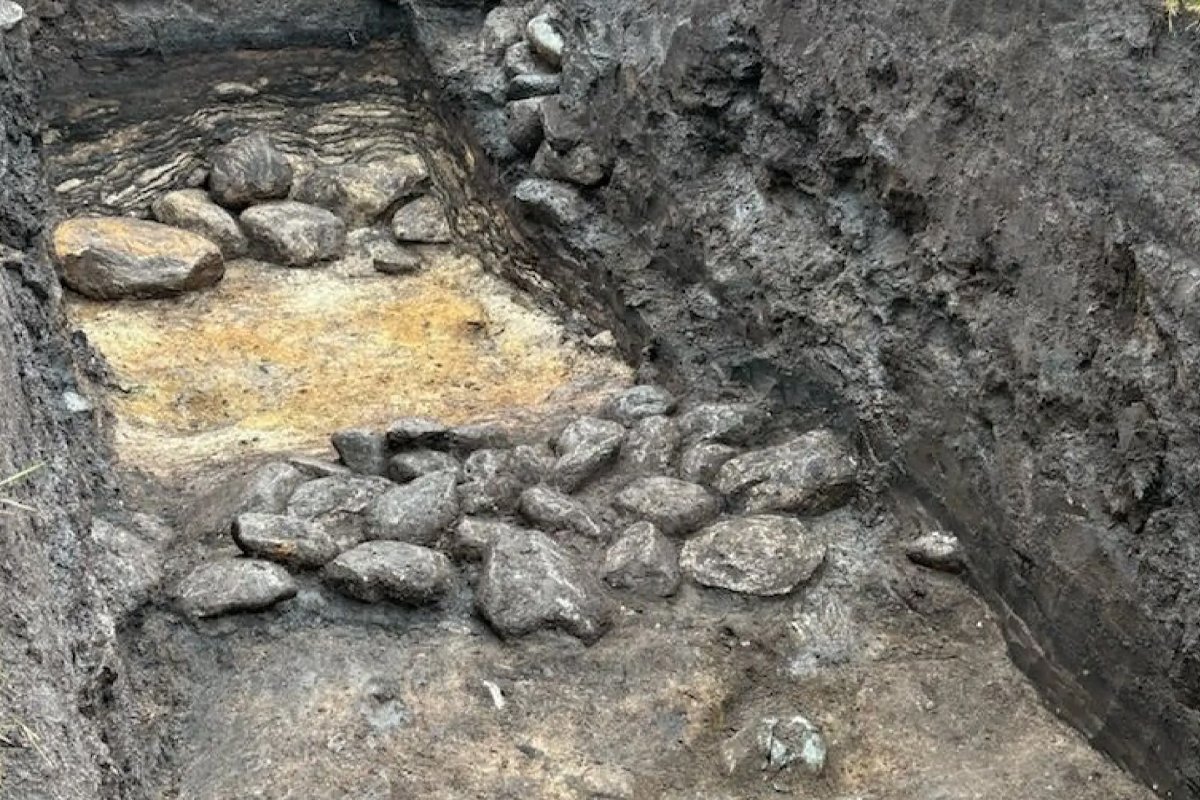
The structure consists of a man-made stone cairn covered by several layers of soil and turf, with large stones forming a kerb around its base.
Based on its construction and comparisons with other prehistoric burial mounds in the surrounding landscape, archaeologists believe the monument probably dates from the Bronze Age.
The Viking ship grave was later constructed directly above it, with the earlier mound effectively forming a platform beneath Grønhaug.
Earlier monument beneath Grønhaug
The discovery establishes a direct physical relationship between the two monuments, demonstrating that the Viking ship grave was built over an existing prehistoric structure.
However, this does not necessarily mean that the location was selected because of the older monument’s age or cultural significance.
The underlying cairn has only recently been exposed and samples will now be analysed to establish a more precise chronology.
If dating confirms a Bronze Age origin, the discovery would demonstrate that the Viking ship grave was constructed over a funerary monument already centuries old.
Dating the Grønhaug ship
The chronology of the Grønhaug ship burial has been debated for several decades.
Earlier studies dated the vessel to around AD 780, potentially placing the burial shortly before the conventional beginning of the Viking Age.
More recent assessments of dendrochronological and radiocarbon evidence instead indicate a date around AD 864, placing the ship within the Viking period.
Researchers hope material recovered during the latest investigation will help refine the dating of both the ship burial and the earlier monument beneath it.
Establishing the chronology of the underlying cairn will also clarify how much time separated the construction of the two monuments.
Reuse of an ancient burial site
The stratigraphy shows that the Viking mound was constructed directly over the earlier monument, but why this location was chosen remains uncertain.
One possibility is that the older mound remained visible in the landscape and was deliberately incorporated into the later burial.
If so, its reuse may have reflected the significance attached to an ancient funerary location. However, there is currently no evidence demonstrating that the Viking builders regarded the monument as ancestral or selected it for ritual or political reasons.
A more practical explanation, in which the existing mound simply provided a suitable platform for the ship grave, also remains possible.
Further analysis of the cairn and its construction sequence will be needed before researchers can determine whether the positioning of Grønhaug carried any wider significance.
Excavation of the Grønhaug burial mound
The investigation is being led by Marie Ødegaard and Håkon Reiersen of the University of Stavanger’s Museum of Archaeology.
The excavation was commissioned by the Norwegian Directorate for Cultural Heritage in collaboration with Rogaland County Municipality and forms part of wider work connected with Norwegian Viking sites being considered for possible inclusion on the UNESCO World Heritage List.
Instead of digging up the whole burial mound archaeologists have only dug a small trench roughly along the line of an earlier excavation (Haakon Schetelig 1902), with a small extension into deposits that were undisturbed.
The purpose of the investigation is to look at how Grønhaug was constructed and how well archaeological material survives in the mound.
The surprisingly good preservation of organic remains (and the discovery of the possible earlier mound beneath the Viking grave) will provide new material for establishing chronology and development of the site.
Sources : Arkeologist Museum – University of Stavanger
