
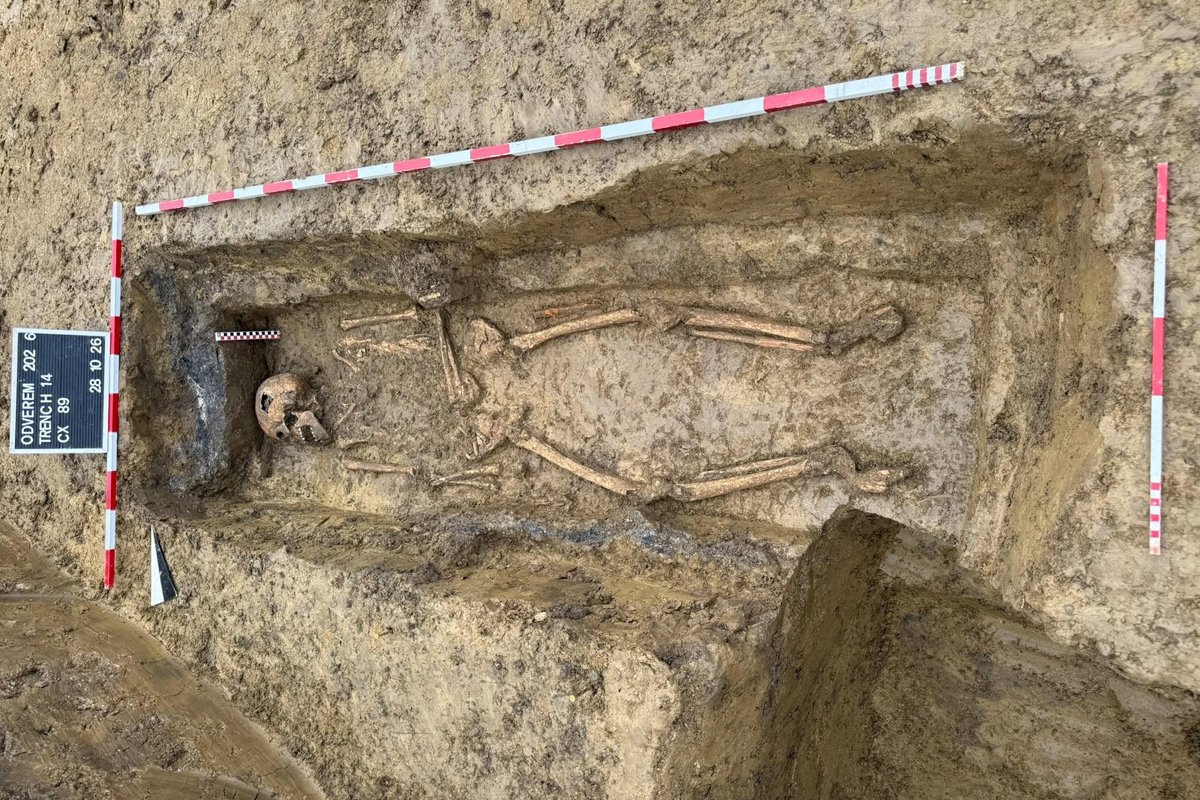
Archaeologists have excavated more than 100 graves from an Avar-period cemetery in Transylvania, revealing horse burials, weapons and jewellery dating from the 7th and 8th centuries AD.
The cemetery is located at Vadverem/Odverem in the Magyarlapád area, close to the salt mine at Kisakna.
Archaeological investigations have been taking place across the Magyarlapád area for the past five years, with researchers spending three weeks during the latest field season excavating the Avar cemetery.
The project is led by the Hungarian National Museum and also provides archaeological field training for students from ELTE and the University of Cluj-Napoca.
Horse burials and weapons
Among the more than 100 graves excavated so far, archaeologists have identified numerous horse burials containing equipment associated with horses.
Male burials containing spears have also been uncovered, while women and children were interred with personal ornaments including pearl necklaces and earrings.
The presence of horses and weapons raises questions about the community’s place within the wider Avar-period societies of the Carpathian Basin.
The Avar period in the region dates broadly from the late 6th to early 9th centuries AD, with the Vadverem cemetery being attributed specifically to the 7th and 8th centuries.
Despite the relatively high number of graves containing horses and weapons, one type of object normally associated with Avar male burials is notably uncommon at the site.
Metal belts characteristic of Avar-period male graves have only rarely been identified among the excavated burials.
Who was buried at Vadverem?
The unusual combination of grave goods is one of the principal questions being investigated by the research team.
Archaeologists are examining who the people buried at Vadverem were and how they were connected with other Avar-period communities across the Carpathian Basin.
Comparisons with cemeteries containing large numbers of horses and weapons may help establish whether the community shared similar funerary traditions or occupied a different social and economic position.
The scarcity of metal belts may also prove important in understanding the identity and burial customs of the population.
At present, however, the evidence does not provide a definitive explanation for why these objects occur less frequently at Vadverem.
Possible connection with salt
Another focus of the research is the cemetery’s proximity to the salt resources around Kisakna.
Salt was an important natural resource, and researchers are investigating whether its availability influenced the settlement, economy or social organisation of the community associated with the cemetery.
The geographical connection is currently a research question rather than evidence that those buried at Vadverem were directly involved in salt extraction or trade.
Further study of the graves and their contents may help determine whether the community had links to the nearby resource.
Five years of archaeological research
Field investigations in the Magyarlapád area have now continued for five years, gradually revealing more information about the region during the Avar period.
With more than 100 graves already excavated, the Vadverem cemetery provides a substantial body of evidence for studying burial practices, social organisation and connections between communities in the Carpathian Basin during the 7th and 8th centuries.
Future research will focus on establishing who was buried at the site, how the community related to other Avar-period populations, and whether the nearby salt deposits played any role in its development.
Sources : ELTE BTK Institute of Archaeology
