
Date:

Hidden tunnel complex from Bar Kokhba Revolt found near Sea of Galilee

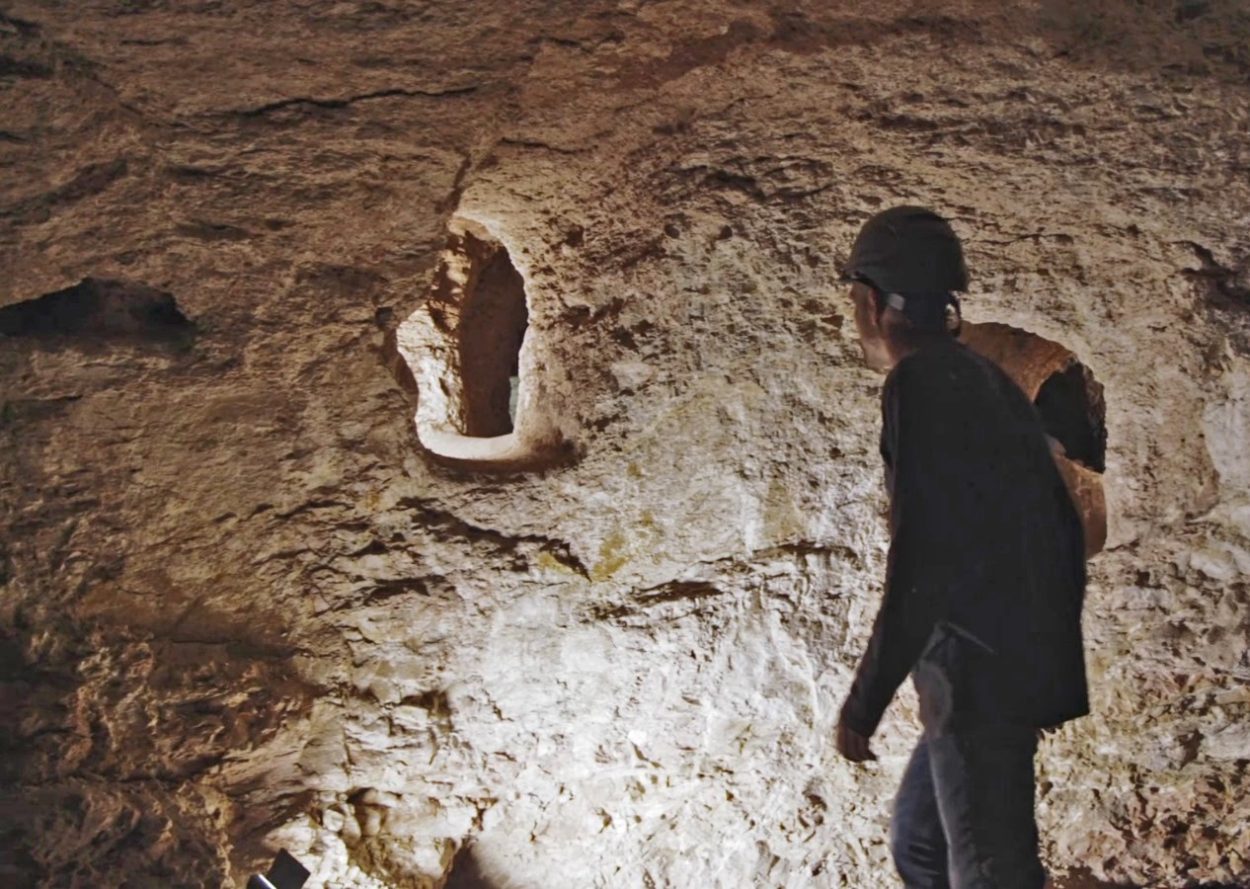
In a press statement issued by the Israel Antiquities Authority, IAA archaeologists, working with soldiers and civilians, have uncovered a hidden tunnel complex from the Bar Kokhba Revolt period at Huqoq, Israel.

The Bar Kokhba Revolt was a large-scale uprising by the Jews of Judea against the Roman Empire in AD 132. The revolt was led by Simon bar Kokhbam, which was the last of three major Jewish–Roman wars.

- Advertisement -

The tunnel complex was found at Huqoq near the Sea of Galilee and was revealed to originally be a water cistern from the Second Temple. During the Bar Kokhba Revolt, the inhabitants of Huqoq dug a series of tunnels from the cistern that connected to eight underground chambers and a mikveh.

According to the researchers, the tunnel system was likely used by rebel forces to escape the Roman army, as several narrow tunnels are located beneath ancient homesteads at Huqoq.

The team also found hundreds of broken clay and glass dishes, an impressive ring with a mount for a precious stone, and numerous fragments of ceramics.

“The tunnel complex provides a glance at a difficult period for the Jewish population in Huqoq and the Galilee region in general,” say excavation directors Uri Berger of the Israel Antiquities Authority and Prof. Yinon Shivtiel of the Zefat Academic College.

- Advertisement -
Image Credit : IAA

“It is a story of residents who, even after losing their freedom, and after many hard years of revolts, came out of hiding in the tunnels and established a thriving village with one of the most impressive synagogues in the area.”

“It is not certain that the complex was used for hiding and escaping during the Second Revolt, but it does appear to have been prepared for this purpose. We hope future excavations will bring us closer to the answer.”

Header Image Credit : IAA

Sources : IAA

- Advertisement -

Stay Updated: Follow us on iOS, Android, Google News, Facebook, Instagram, Twitter, Threads, TikTok, LinkedIn, and our newsletter

spot_img
Mark Milligan
Mark Milligan
Mark Milligan is a multi-award-winning journalist and the Managing Editor at HeritageDaily. His background is in archaeology and computer science, having written over 8,000 articles across several online publications. Mark is a member of the Association of British Science Writers (ABSW), the World Federation of Science Journalists, and in 2023 was the recipient of the British Citizen Award for Education, the BCA Medal of Honour, and the UK Prime Minister's Points of Light Award.
spot_img
spot_img

Mobile Application

spot_img

Related Articles

Bronze hand cannon offers rare evidence of early Korean firearms

Archaeologists in South Korea have authenticated a bronze hand cannon dating to the late Goryeo or early Joseon period, providing rare evidence for the early development of firearms on the Korean Peninsula.

Evidence of 15th-century fortified windmill unearthed in Poland

More than 300 archaeological features discovered on Windmill Hill in Puck could include rare fortifications linked to the Thirteen Years’ War

10,500-year-old wooden structures discovered beneath German lake

Rare Mesolithic timbers found 20 metres underwater could reveal previously unknown construction by Stone Age hunter-gatherers

Ancient auroch skull found impaled on wooden stake

Unique discovery of an aurochs skull impaled on a wooden stake may be linked to one of northern Germany’s oldest known burials

Rare medieval heating system uncovered beneath former Swiss monastery

Archaeologists in Basel have uncovered an exceptionally rare medieval heating system hidden beneath the remains of a former monastery for centuries.

Archaeologists to investigate possible Inca ceremonial geoglyph in the Andes

Archaeologists are preparing to investigate a possible Inca ceremonial geoglyph discovered at an altitude of approximately 3,000 metres in the Andes of Argentina.

2,100-year-old luxury tableware discovered in ancient shipwreck off Türkiye

Underwater archaeologists have discovered thousands of luxury ceramic vessels in a 2,100-year-old shipwreck off the Mediterranean coast of Türkiye.

Archaeologists uncover extensive Bronze Age settlement on Hungary’s Somló Hill

Archaeologists from the Hungarian National Museum have uncovered evidence of an extensive Bronze Age settlement on Somló Hill, revealing a sophisticated community that flourished more than 3,000 years ago.


