
In Wonderland, Alice drank a potion to shrink herself. In nature, some animal species shrink to escape the attention of human hunters, a process that takes from decades to millennia.
To begin to understand the genetics of shrinking, scientists working at the Smithsonian Tropical Research Institute (STRI) in Panama successfully extracted DNA from marine shells. Their new technique will not only shed light on how animals from lizards to lemurs shrink, it will reveal many other stories hidden in shells.
“Humans are unique as predators,” said Alexis Sullivan, doctoral student at Penn State University who did the field research as a short-term fellow at STRI. “Most other animals go for smaller, younger, older or injured prey that are easy to catch, but humans often take the largest individual to feed many mouths or to display as a trophy.”
This preference for the biggest means the smaller individuals tend to survive and reproduce, which over time leads to the evolution of smaller individuals in the population. Sullivan’s father was a hunter, and she remembers being intrigued as a child when he would choose to spare the lives of the largest bucks to keep this from happening in the local deer population.
When she joined George Perry’s lab at Penn State, they wrote a paper that reviewed ‘the deep history of human entanglement’ with animals and plants, and how these organisms have physically changed because of human behaviors. Sullivan hoped to write her dissertation about lemurs, which have become almost 10% smaller in only 1,000 years, presumably as a result of human hunting. But because lemurs are primates, endangered, and live in Madagascar, the logistics, not to mention the cost, of sampling modern and ancient lemur DNA were daunting.
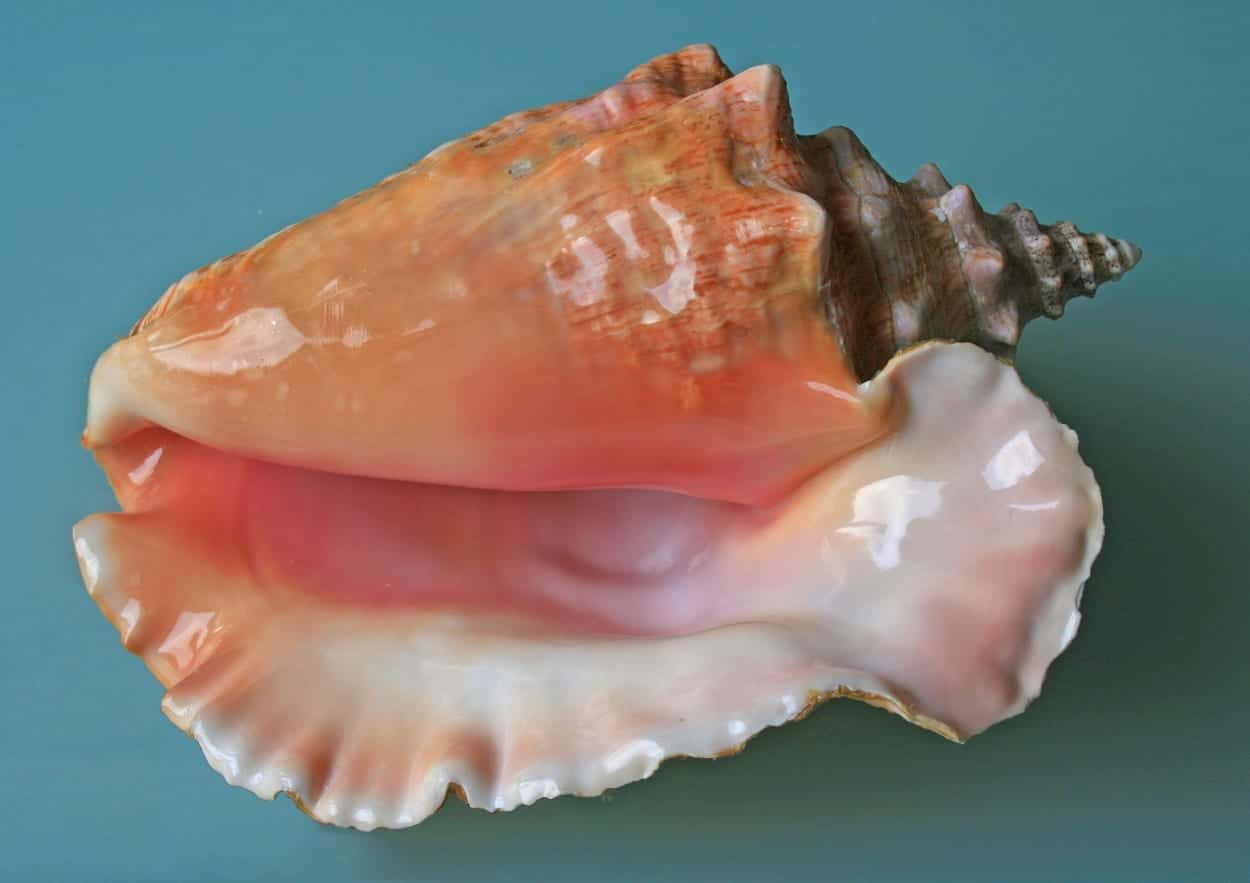
At the same time, Sullivan and Perry were fascinated by a study by a staff scientist at STRI, Aaron O’Dea, and colleagues, who showed that marine snails called fighting conch, commonly eaten as ceviche or fritters by Caribbean coastal residents, have steadily become smaller in areas where they were harvested for food. Modern shells contained 66% less meat than shells from ancient “pristine” reefs. The logistics of working at the Smithsonian’s Bocas del Toro Research Station were straightforward, but no one had ever extracted DNA from tropical shells before–modern or ancient.
“Most of the ancient DNA that had been sequenced was from animals or plants in permafrost which helps preserve the DNA,” Sullivan said. “We had no idea whether DNA would survive in a tropical environment for thousands of years.”
The first step she took was to create a reference sequence from fresh conch tissue. She then moved to the shell itself. Since conch shells have much more calcium carbonate than bone, Sullivan had to modify a standard approach typically used to extract DNA from human skeletal material. This crucial step was recommended by Stephanie Marciniak, a specialist in ancient DNA and post-doctoral fellow in Perry’s lab.
After refining the approach, Sullivan then moved to thousand-year-old shells from a trash midden at the Sitio Drago archeological site in Bocas del Toro. This site had been studied by STRI Research Associate and UCLA Professor Tom Wake.
“Those shells had probably been cooked by their pre-Columbian harvesters making Alexis’ successful extraction and sequencing of DNA even more incredible,” Wake said.
Finally, Sullivan turned to the same species of conch preserved in a mid-Holocene coral reef, again in Bocas del Toro. As they expected, the DNA was poorly preserved, but Sullivan demonstrated that even shells more than 7,000 years old faithfully preserved DNA.
“I was amazed,” O’Dea said. “After 7,000 years in temperatures over 20 degrees Celsius, these conch shells still preserved minute fragments of the original animals’ DNA. This work opens the door to exploring the genetic changes in the conch associated with size changes over millennia, and it’s all down to Alexis’ skill and perseverance.”
As the team learns more about the biology and genetics of the conch, they will be in a much better position to understand if human harvesting or something else explains why fighting conchs are smaller in areas where they are frequently harvested.
“We are especially grateful to the Cayo Agua community in Bocas del Toro who offered conch shells for our tests,” Sullivan said. She hopes to return to Panama soon to share her results with them.
Header Image Credit : Cheesy42 – CC BY 2.0




