
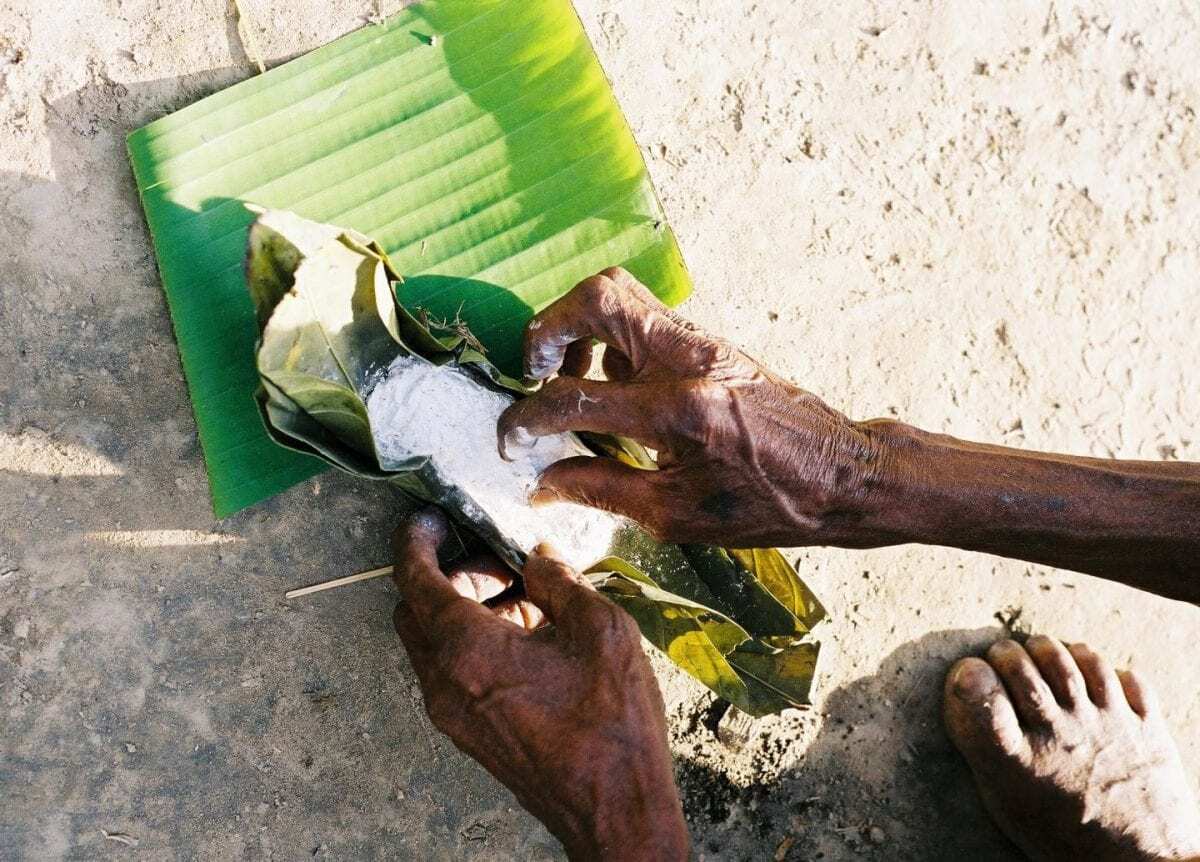
Hunter-gatherer ancestors, from around 300,000 years ago, facilitated a cultural revolution by developing ideas in small social networks, and regularly drawing on knowledge from neighbouring camps.
The study, published in Science Advances, mapped close-range social interactions of Agta hunter-gatherers in the Philippines using radio sensor technology to record close range interactions between individuals every hour for one month. The researchers observed inter-camp migrations and visits almost on a daily basis.
The anthropologists found that the social structure of Agta hunter gatherers, built around small family units linked by strong friendships and high in-between camp mobility, was key to the development of new cultural ideas. This is because the social structure allowed for the co-existence of multiple traditions or solutions to a similar problem in different parts of the network. The researchers highlight that this is distinct from the closely bound society of our closest cousins, chimpanzees.
Professor Andrea Migliano (UCL Anthropology & University of Zurich), the first author of the paper, said: “It is fair to say that ‘visits between camps’ is the social media of current hunter-gatherers, and probably of our extinct hunter-gatherer ancestors.
“When we need a new solution for a problem, we go online and use multiple sources to obtain information from a variety of people. Hunter-gatherers use their social network exactly in the same way. The constant visits between camps are essential for information to be recombined and continuously generate cultural innovations.”
The anthropologists tested the effect of the Agta social structure of sparsely populated close knit groups, on the evolution of cultural complexity using an agent-based model that simulated the creation of a new medicinal drug, having started with an original set of six medicinal plants.
This process was first simulated across the real social network of Agta hunter-gatherers. In this case, pairs of individuals were selected, based on the strength of their social ties, to combine different medicinal plants and share the discovery of any new super medicine with their close family ties. Second, the process was simulated over an artificial and fully connected network of a similar size, where all individuals were connected to each other and immediately transmitted any discoveries to all network members.
Contrary to some predictions, rates of cultural evolution were much higher across the real hunter-gatherer social networks. While fully connected networks spread innovations more quickly, the real hunter-gatherer networks promote the independent evolution of multiple medicines in different clusters of the network (different camps, households, family clusters), that can later be recombined producing a more complex culture.
Dr Lucio Vinicius (UCL Anthropology & University of Zurich), the last author of the paper, said: “Previous studies have shown that fluid social structures already characterised expanding Upper Palaeolithic human populations and that long-range cultural exchange in the Homo sapiens lineage dates back to at least 320,000 years ago.
“However, the link we found between cultural evolution and the fluid sociality of hunter-gatherers indicates that as hunter-gatherers expanded within and then out of Africa, this social structure of small and interconnected bands may have facilitated the sequence of cultural and technological revolutions that characterises our species.”
Dr Mark Dyble (UCL Anthropology), co-author of the paper, said: “Humans have a unique capacity to create and accumulate culture. From a simple pencil to the International Space Station, human culture is a product of multiple minds over many generations, and cannot be recreated from scratch by one single individual.
“This capacity for cumulative culture is central to humanity’s success, and evolved in our past hunter-gatherer ancestors. Our work shows that the kind of social organisation that is typical of contemporary hunter-gatherers serves to promote cultural evolution. If this kind of social structure was typical of hunter-gatherers in the past, it could go a long way to explaining why the human capacity for culture evolved”.
Header Image – Hunter-gatherer ancestors, from around 300,000 years ago, facilitated a cultural revolution by developing ideas in small social networks, and regularly drawing on knowledge from neighbouring camps, suggests a new study by UCL and University of Zurich. Credit : UCL and University of Zurich




