
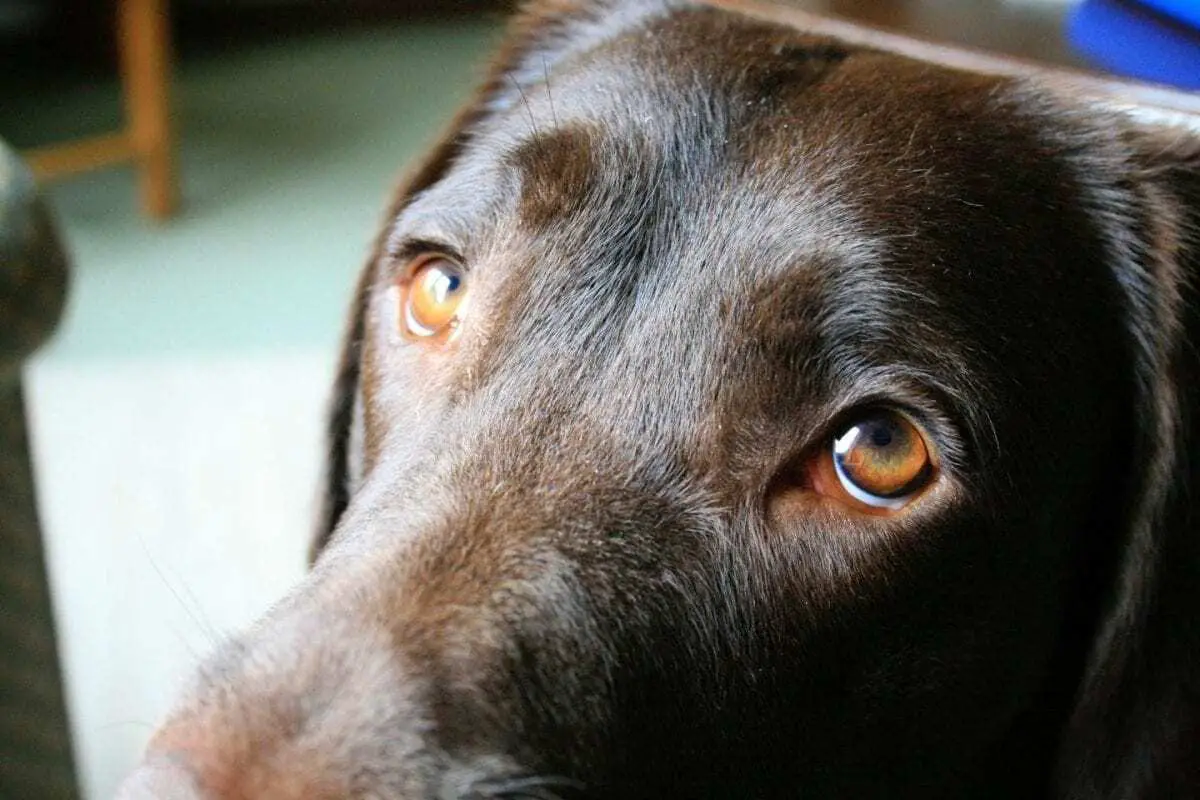
Dogs have evolved new muscles around the eyes to better communicate with humans.
New research comparing the anatomy and behavior of dogs and wolves suggests dogs’ facial anatomy has changed over thousands of years specifically to allow them to better communicate with humans.
In the first detailed analysis comparing the anatomy and behavior of dogs and wolves, researchers found that the facial musculature of both species was similar, except above the eyes. Dogs have a small muscle, which allows them to intensely raise their inner eyebrow, which wolves do not.
The authors suggest that the inner eyebrow raising movement triggers a nurturing response in humans because it makes the dogs’ eyes appear larger, more infant like and also resembles a movement humans produce when they are sad.
The research team, led by comparative psychologist Dr Juliane Kaminski, at the University of Portsmouth, included a team of behavioural and anatomical experts in the UK and USA.
It is published in the journal Proceedings of the National Academy of Sciences of the United States of America (PNAS).
Dr Kaminski said: “The evidence is compelling that dogs developed a muscle to raise the inner eyebrow after they were domesticated from wolves.
“We also studied dogs’ and wolves’ behavior, and when exposed to a human for two minutes, dogs raised their inner eyebrows more and at higher intensities than wolves.
“The findings suggest that expressive eyebrows in dogs may be a result of humans unconscious preferences that influenced selection during domestication. When dogs make the movement, it seems to elicit a strong desire in humans to look after them. This would give dogs, that move their eyebrows more, a selection advantage over others and reinforce the ‘puppy dog eyes’ trait for future generations.”
Dr Kaminski’s previous research showed dogs moved their eyebrows significantly more when humans were looking at them compared to when they were not looking at them.
She said: “The AU101 movement is significant in the human-dog bond because it might elicit a caring response from humans but also might create the illusion of human-like communication.”
Lead anatomist Professor Anne Burrows, at Duquesne University, Pittsburgh, USA, co-author of the paper, said: “To determine whether this eyebrow movement is a result of evolution, we compared the facial anatomy and behaviour of these two species and found the muscle that allows for the eyebrow raise in dogs was, in wolves, a scant, irregular cluster of fibres.
“The raised inner eyebrow movement in dogs is driven by a muscle which doesn’t consistently exist in their closest living relative, the wolf.
“This is a striking difference for species separated only 33,000 years ago and we think that the remarkably fast facial muscular changes can be directly linked to dogs’ enhanced social interaction with humans.”
Dr Kaminski and co-author, evolutionary psychologist Professor Bridget Waller, also at the University of Portsmouth, previously mapped the facial muscular structure of dogs, naming the movement responsible for a raised inner eyebrow the Action Unit (AU) 101.
Professor Waller said: “This movement makes a dogs’ eyes appear larger, giving them a childlike appearance. It could also mimic the facial movement humans make when they’re sad.
“Our findings show how important faces can be in capturing our attention, and how powerful facial expression can be in social interaction.”
Co-author and anatomist Adam Hartstone-Rose, at North Carolina State University, USA, said: “These muscles are so thin that you can literally see through them – and yet the movement that they allow seems to have such a powerful effect that it appears to have been under substantial evolutionary pressure. It is really remarkable that these simple differences in facial expression may have helped define the relationship between early dogs and humans.”
Co-author Rui Diogo, an anatomist at Howard University, Washington DC, USA, said: “I must admit that I was surprised to see the results myself because the gross anatomy of muscles is normally very slow to change in evolution, and this happened very fast indeed, in just some dozens of thousands of years.”
Soft tissue, including muscle, doesn’t tend to survive in the fossil record, making the study of this type of evolution harder.
The only dog species in the study that did not have the muscle was the Siberian husky, which is among more ancient dog breeds.
An alternative reason for the human-dog bond could be that humans have a preference for other individuals which have whites in the eye and that intense AU 101 movements exposes the white part of the dogs eyes.
It is not known why or precisely when humans first brought wolves in from the cold and the evolution from wolf to dog began, but this research helps us understand some of the likely mechanisms underlying dog domestication.
Header Image – The authors suggest that the inner eyebrow raising movement triggers a nurturing response in humans because it makes the dogs’ eyes appear larger, more infant like and also resembles a movement humans produce when they are sad. Credit : The University of Portsmouth




