
Date:

Young Archaeologists of the Year 2017 Announced – Cassie Bradshaw

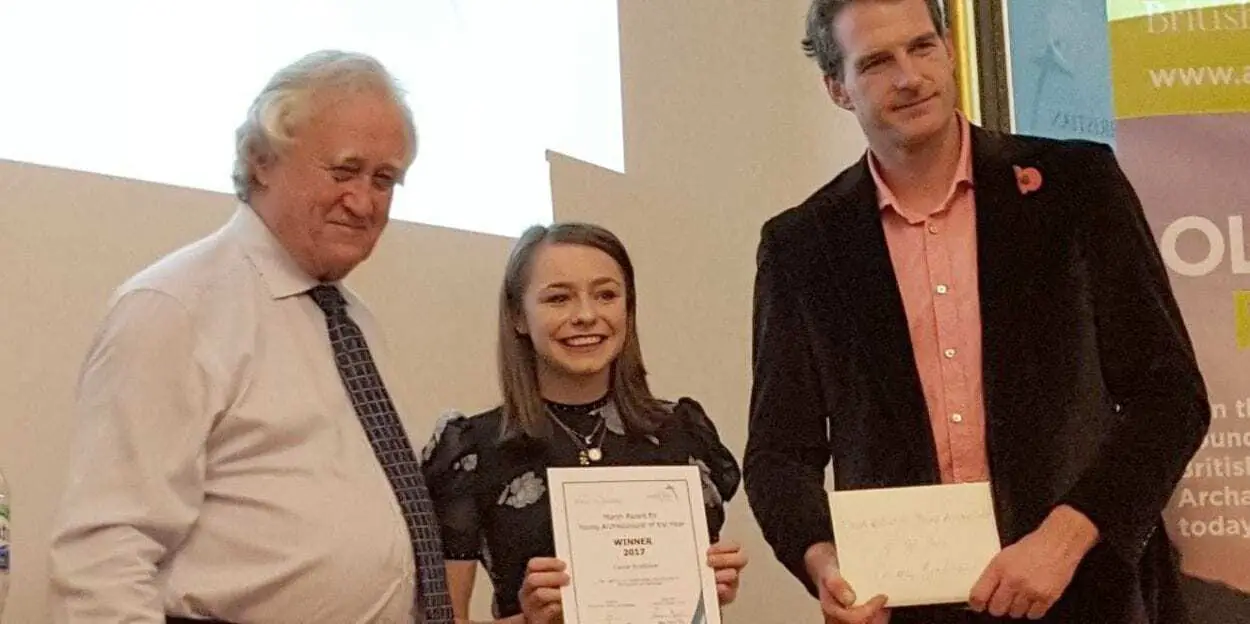
The YAC – Young Archaeologists Club has announced that Cassie Bradshaw from Formby has won the prestigious Young Archaeologist of the Year 2017 award at the Council for British Archaeology’s Day of Archaeology.

The Young Archaeologist of the Year Award is presented each year to a young person (or group of young people) aged 17 or under who has developed exceptional archaeological knowledge and skills, and who has shared their love of archaeology and the past with others.

- Advertisement -

Cassie has been taking part in the Ribchester Revisited Project, a long-term excavation of a Roman Fort in Lancashire.

Dr Jim Morris of the University of Central Lancashire who nominated Cassie describes her as “the best and most enthusiastic young archaeologist I have met in 20 years of archaeological study and work.”

The award was presented by CBA President Dan Snow and Brian Marsh of the Marsh Christian Trust.

When interviewed Cassie said “I have been interested in archaeology since I was 5! I got hooked on the subject back on holiday in 2005, where I first discovered archaeology by getting involved in different activities.

- Advertisement -

I’m applying to the University of Central Lancashire to do an integrated Masters degree in archaeology. And I also plan to go on and do a load more digs!”

Also nominated for the award was: Anna Priest, Roisin (Rosie) O’Toole, Emma Hardie, Joshua Eden, Megan Hardie.

About the YAC

The Young Archaeologists’ Club (YAC) is a youth organisation with a network of archaeology related clubs across the UK for 8–16 year olds. Each club is run by a team of adult volunteers. Find out more

- Advertisement -

Stay Updated: Follow us on iOS, Android, Google News, Facebook, Instagram, Twitter, Threads, TikTok, LinkedIn, and our newsletter

spot_img
Mark Milligan
Mark Milligan
Mark Milligan is a multi-award-winning journalist and the Managing Editor at HeritageDaily. His background is in archaeology and computer science, having written over 8,000 articles across several online publications. Mark is a member of the Association of British Science Writers (ABSW), the World Federation of Science Journalists, and in 2023 was the recipient of the British Citizen Award for Education, the BCA Medal of Honour, and the UK Prime Minister's Points of Light Award.
spot_img
spot_img

Mobile Application

spot_img

Related Articles

Bronze hand cannon offers rare evidence of early Korean firearms

Archaeologists in South Korea have authenticated a bronze hand cannon dating to the late Goryeo or early Joseon period, providing rare evidence for the early development of firearms on the Korean Peninsula.

Evidence of 15th-century fortified windmill unearthed in Poland

More than 300 archaeological features discovered on Windmill Hill in Puck could include rare fortifications linked to the Thirteen Years’ War

10,500-year-old wooden structures discovered beneath German lake

Rare Mesolithic timbers found 20 metres underwater could reveal previously unknown construction by Stone Age hunter-gatherers

Ancient auroch skull found impaled on wooden stake

Unique discovery of an aurochs skull impaled on a wooden stake may be linked to one of northern Germany’s oldest known burials

Rare medieval heating system uncovered beneath former Swiss monastery

Archaeologists in Basel have uncovered an exceptionally rare medieval heating system hidden beneath the remains of a former monastery for centuries.

Archaeologists to investigate possible Inca ceremonial geoglyph in the Andes

Archaeologists are preparing to investigate a possible Inca ceremonial geoglyph discovered at an altitude of approximately 3,000 metres in the Andes of Argentina.

2,100-year-old luxury tableware discovered in ancient shipwreck off Türkiye

Underwater archaeologists have discovered thousands of luxury ceramic vessels in a 2,100-year-old shipwreck off the Mediterranean coast of Türkiye.

Archaeologists uncover extensive Bronze Age settlement on Hungary’s Somló Hill

Archaeologists from the Hungarian National Museum have uncovered evidence of an extensive Bronze Age settlement on Somló Hill, revealing a sophisticated community that flourished more than 3,000 years ago.


