
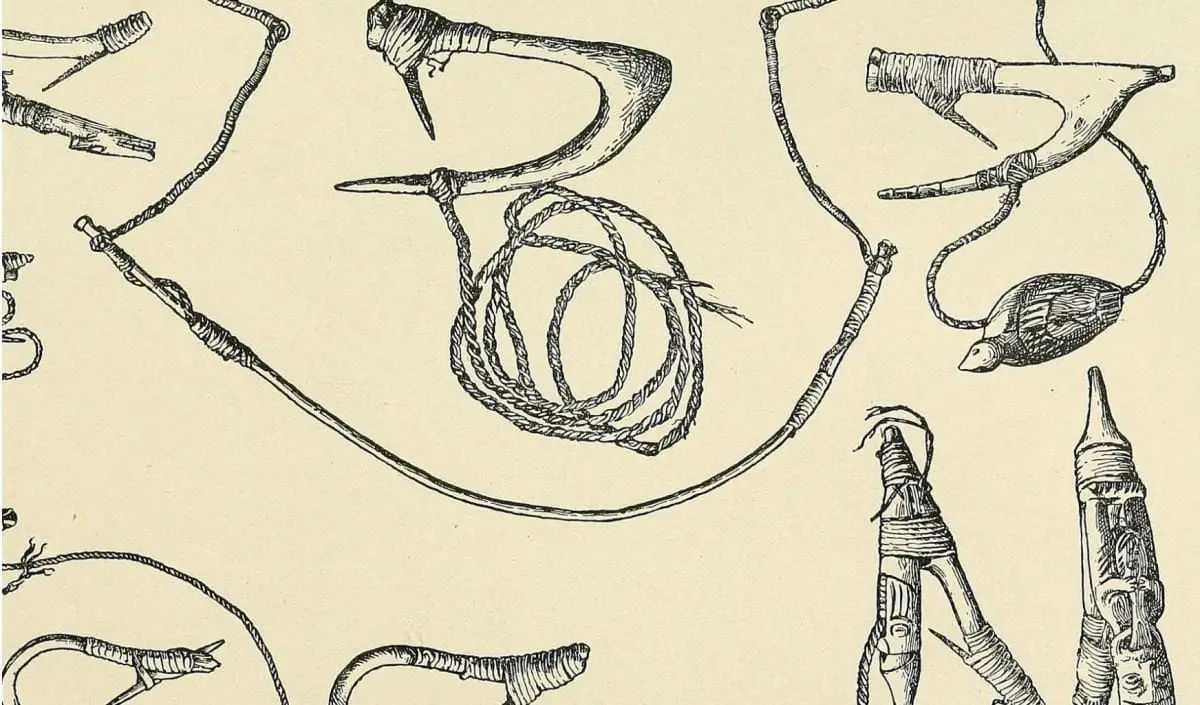
The Tlingit and Haida, indigenous peoples of the Northwest Coast (NWC), have used carved wooden hooks to catch halibut for centuries. As modern fishing technology crept into use, however, the old hooks practically disappeared from the sea. But they thrived on land — as decorative art.
The hook’s evolution from utilitarian tool to expression of cultural heritage is the subject of a paper by Jonathan Malindine, a doctoral student in UC Santa Barbara’s Department of Anthropology. In “Northwest Coast Halibut Hooks: an Evolving Tradition of Form, Function, and Fishing,” published in the journal Human Ecology, he traces the arc of the hook’s design and how its dimensions have changed over time.
“I used to be a commercial fisherman in Alaska, and also lived in a Tlingit and Haida community,” Malindine said. “So, the intersection of fisheries and Alaska Native art has always fascinated me. These NWC hooks are really effective at catching halibut, and also are intricately carved with rich, figural designs. Between the technology and the mythological imagery, there’s a lot going on.”
Halibut hooks, often called wood hooks, are part of a sophisticated apparatus for catching the flat, bottom-dwelling fish that can weigh more than 500 pounds. Constructed in two pieces of different woods, they look something like an open fish mouth from the side, with a barb, facing backwards, lashed to the top piece. When the fish tries to spit out the hook, the barb sets in its jaw. Hooks were carefully carved to maximize their potential for catching fish, and their shape and size varied depending on the size of halibut they were used for.
But as modern fishing technology displaced traditional gear, wood hooks began to change, varying greatly in design and dimension from early versions. These “art hooks” were created as decorative objects, often depicting animals important to NWC traditions and using materials such as abalone inlay.
It was that transition in the hooks, from utility to art, that Malindine studied. To do so, he examined, photographed and took detailed measurements of every intact NWC hook — 109 total — in the collections of the National Museum of Natural History and the National Museum of the American Indian. He found that “in the case of NWC halibut hooks, shifting function drives the shift in materials, dimension, and meaning,” he writes in the paper. “The NWC halibut hook has largely ceased to function to catch fish, and its dimensions are changing to favor decorative and symbolic content over utilitarian/functional requirements. Nowadays it is primarily designed to link Alaska Natives to their ancestral heritage, and the art buyer to a tangible representation of NWC mythological and artistic tradition.”
In addition to its contributions to academia, the research will benefit NWC carvers of wood hooks. Malindine has shared his work with them, allowing them to see what the hooks looked like as many as 150 years ago. “The Alaska Native carvers and Tribal members with whom I’ve shared these images and dimensional measurements are just happy to see them,” he said. “These hooks are part of their cultural heritage, and have basically been locked away in storage facilities — sometimes for a hundred years.
“I’ve specifically given the images and measurements I produced to several Alaska Native artists and carving instructors, so they can use them in their classes when teaching students to carve halibut hooks,” he continued. “Hopefully these images and measurements will be really useful in that type of classroom setting, especially for creating accurate reproductions.”
Malindine’s study of the hooks came through his participation in the Summer Institute in Museum Anthropology (SIMA) program, which is funded by the Smithsonian Institution and the National Science Foundation. He was one of 12 graduate students chosen from around the country to learn to use museum collections as field sites for research.
“There are vast numbers of important objects hidden away in museum collections facilities that are rarely studied,” he said. “The SIMA program taught us how to approach studying museum objects — from theory of material culture, collections management, conservation and object handling, to photography, research design, data collection, analysis and eventual publication of results.”
As Malindine noted, wood hooks are still more than curiosities or museum pieces. “I was fortunate enough to interview two of the very few people who still fish with traditional wood hooks,” he said. “One of them, Jon Rowan, claims he has as much, if not more, success using wood hooks to catch halibut than he does using modern fishing gear. These have stuck around for a reason: They’re very good at catching halibut. Of course most people don’t want to risk losing a valuable and beautiful carved NWC halibut hook, so almost everyone these days uses commercially produced circle hooks that cost a few dollars each.”
Casey Walsh, an associate professor of anthropology and Malindine’s graduate advisor, called the examination of wood hooks solid science that places it in a human context. “Jonathan’s paper is a great example of the explanatory strength of a holistic approach to understanding humans,” Walsh said. “He skillfully combined environmental, social and cultural elements to tell us why halibut hooks matter, not only for basic sustenance, but also for people’s relationships with each other and their creative, artistic lives.”
UNIVERSITY OF CALIFORNIA – SANTA BARBARA




