
The earliest Mesolithic encampment at Stonehenge has been discovered and it will reveal how Britain’s oldest ancestors lived – but it could be damaged if Government plans for a tunnel at Stonehenge go ahead.
A 1.8 mile tunnel is part of a £2bn plan to make the nearby A303 a dual carriageway.
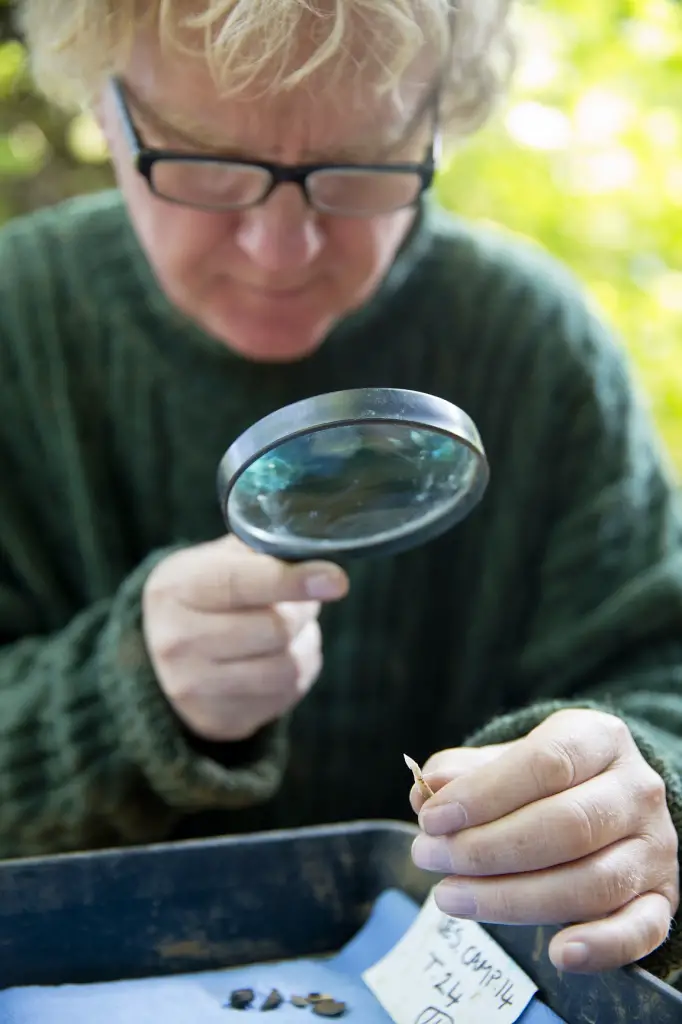
Charcoal dug up from the encampment, a mile and a half from Stonehenge, has been scientifically tested and reveals that it dates from around 4,000BC. The dig has also unearthed evidence of possible structures, but further investigation is needed to see in more detail what these features in the only untouched Mesolithic landscape in the Stonehenge World Heritage Site contain.
There is also evidence of feasting – burnt flints and remains of giant bulls – aurochs – eaten by early hunter gatherers, as well as tools.
A previous dig at the site, led by the University of Buckingham, revealed Amesbury is the longest continually-occupied place in the country and that burnt frogs’ legs from 7,000 years ago were a delicacy here long before the French took a liking to them. The highest density of Mesolithic burnt flints and tools anywhere in the UK was found in one small area at the site in a previous dig.
A natural spring at Blick Mead would have been the attraction for both people and animals. The combination of a water of a constant temperature and a rare algae also produced the only colour-changing stones, which change from brown to pink, found at any archaeological site in the country.
Archaeologist David Jacques, who made the discovery on a dig which launched the University of Buckingham’s MA in Archaeology in October, said: “The PM is interested in re-election in 140 days – we are interested in discovering how our ancestors lived six thousand years ago. British pre-History may have to be rewritten. This is the latest dated Mesolithic encampment ever found in the UK. Blick Mead site connects the early hunter gatherer groups returning to Britain after the Ice Age to the Stonehenge area all the way through to the Neolithic in the late 5th Millennium BC. Britain is beginning across this time period. Blick Mead connects a time when the country was still joined to the mainland to it becoming the British Isles for the first time.
“Was Stonehenge built in part as a monument to the ancestors from the deepest part of Britain’s past? Blick Mead could explain what archaeologists have been searching for for centuries – an answer to the story of Stonehenge’s past. But our only chance to find out about the earliest chapter of Britain’s history could be wrecked if the tunnel goes ahead.”
Professor Tim Darvill, of Bournemouth University has described this as “This is the most important discovery at Stonehenge in over 60 years.”
Andy Rhind-Tutt, of Amesbury and chairman of the Amesbury Museum and Heritage Trust, added: “Traffic congestion to one of the country’s most visited attractions will not be solved by a tunnel with one exit lane – the current tailback can extend five miles and can take two hours to get through. Any tunnel would need to be motorway standard, and even with four lanes there would still be tailbacks.
“Concerns have been raised about the water table. Due to the chalkland landscape the tunnel would effectively become a dam, which would change the water course, causing problems. Kilometers of chalk would have to be extracted. Air conditioning, water pumps, lighting and maintenance costs would be colossal. A much more practical solution would be to reroute the A303 supporting South Wiltshire as well as the West Country.”
What we already know about how and when Stonehenge came to be built is examined in a new Stonehenge MOOC, launched today(Friday) and run by the University of Buckingham.
For more details: https://iversity.org/en/courses/stonehenge