
Scientists are searching through an extremely large collection of 20-million-year-old amber unearthed in the Dominican Republic over 50 years ago; the effort is displaying new insights into ancient tropical insects and the world they lived in.
When the collection is fully curated, a task that is estimated to take many years, it will be the largest unbiased Dominican amber collection in the world, researchers report.
Perhaps the most remarkable discovery so far is that of the pygmy locust, a tiny grasshopper the size of a rose thorn that lived 18 to 20 million years ago and fed on moss, algae and fungi. The specimen is so extraordinary because it represents an intermediate stage of evolution in the life of its subfamily of locusts (known as the Cladonotinae). The most ancient representatives of this group had wings and the modern counterparts do not. This newly discovered locust contains what appear to be vestigial wings – remnant structures that had already lost their primary function.
The discovery is reported in the journal ZooKeys.
“Grasshoppers are very rare in amber and this specimen is extraordinarily well-preserved,” said Sam Heads, palaeontologist at the Illinois Natural History Survey, a division of the Prairie Research Institute at the University of Illinois.
Heads, a laboratory technician Jared Thomas and study co-author Yinan Wang discovered the new specimen a few months after the beginning of their project to screen more than 160 pounds of Dominican amber collected in the late 1950s by former INHS entomologist Milton Sanderson. Sanderson described several specimens from the vast collection in a paper back in 1960, a report that proceeded to inspire a generation of scientists to study amber and all its glory.
The bulk of the Sanderson amber collection remained in storage, until Heads uncovered it in 2010.
Heads has named the new pygmy locust Electrotettic attenboroughi, the genus name is a combination of electrum (Latin from Greek meaning “amber”) and tettix (Greek, meaning “grasshopper”). The species is named after Sir David Attenborough, the famous British naturalist and filmmaker (not to be confused with his brother, Richard Attenborough, the well-known actor who starred in “Jurassic Park”).
“Sir David has a personal interest in amber, and also he was one of my childhood heroes and still is one of my heroes and so I decided to name the species in his honor — with his permission of course,” Heads said. (Attenborough actually narrates and appears in a new video about the Sanderson collection and the specimen that bears his name).
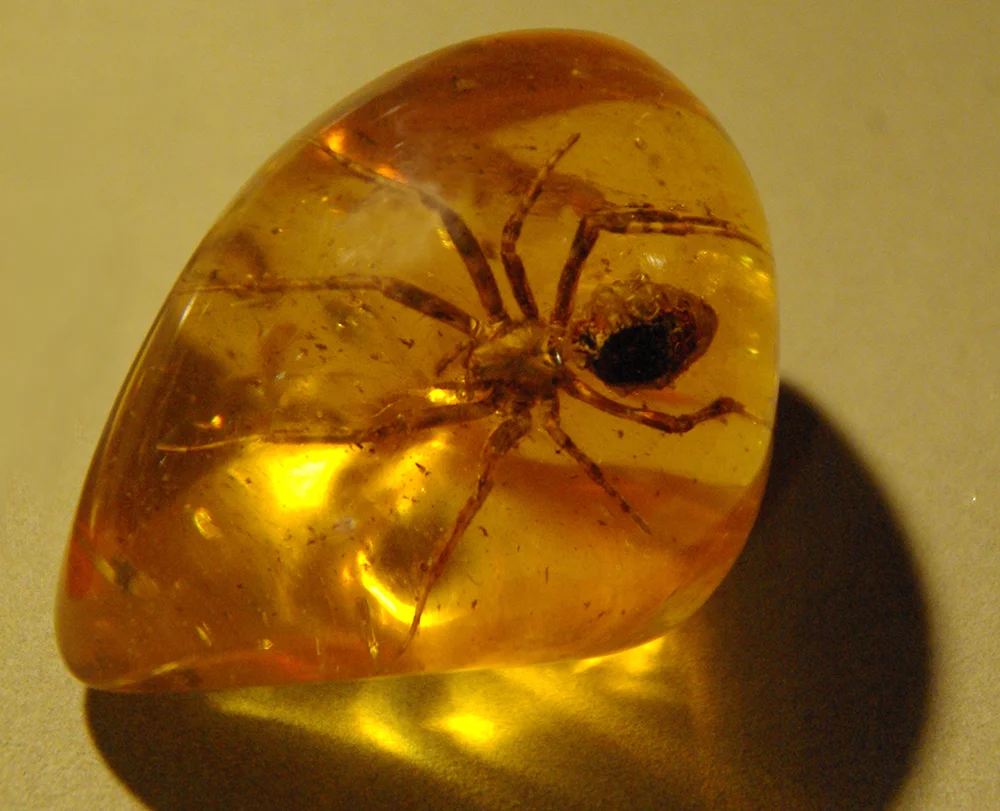
The long process of screening the amber is very slow and painstaking. A large amount of the amber is clouded with oxidation, and the researchers have to carefully cut and polish “windows” to get a good look at the inside of the amber. As well as the pygmy locust, Heads and his colleagues discovered mating flies, stingless bees, gall midges, Azteca ants, wasps, bark beetles, mites, spiders, plants parts and even mammal hair.
The pygmy locust was discovered in a fragment that also contained wasps, ants, midges, plant remnants and fungi. These associations provide a wealth of information, Heads said, offering clues about the creatures’ physiological needs and the nature of their habitat.
“Fossil insects can provide lots of insight into the evolution of specific traits and behaviors, and they also tell us about the history of the time period,” Heads said. “They’re a tremendous resource for understanding the ancient world, ancient ecosystems and the ancient climate – better even, perhaps, than dinosaur bones.”
Contributing Source: University of Illinois at Urbana-Champaign
Header Image Source: WikiPedia