
Date:

PM announces new project to continue search for Sir John Franklin’s lost ships

HMS Erebus and Terror in the Antarctic : Wiki Commons

- Advertisement -

Canadian Prime Minister Stephen Harper today announced a new project to continue the search for the ill-fated 1845-46 Franklin Expedition vessels: the HMS Erebus and HMS Terror.

The Prime Minister announced the 2012 Franklin Expedition after visiting with crew aboard the research vessel Martin Bergmann, the newest member of the multi-partner project. The announcement was made during the Prime Minister’s seventh annual Northern Tour, taking place from August 20-24, 2012.

“It is truly exciting to be launching this new initiative to continue searching for the lost vessels of the Franklin Expedition.  It is also a privilege to meet with members representing the extraordinary array of Canadian partners and researchers who hope to solve the mystery of the ill-fated HMS Erebus and HMS Terror and unlock the rich history of Canada’s Northwest Passage – a history that unites us all as Canadians,” said the Prime Minister. “The use of cutting-edge technology by the team to map the Arctic waters and locate the Franklin vessels is also a tribute to Canadian expertise.”
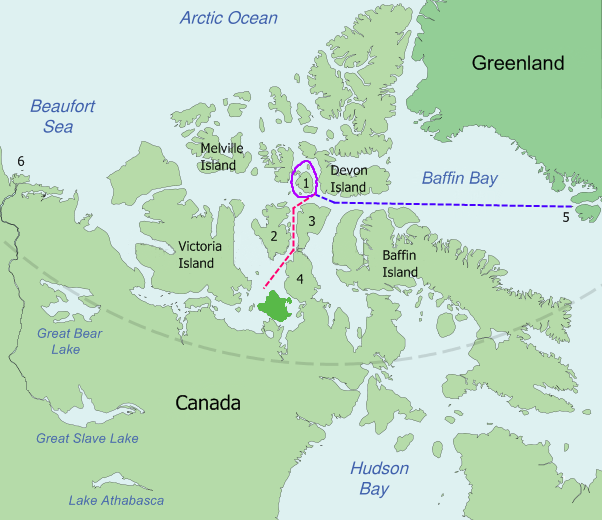
Map of the probable routes taken by Erebus and Terror during Franklin’s lost expedition. Wiki Commons

Led by Parks Canada, the 2012 Franklin Expedition will, with the help of a number of public and private sector partners, including Universities, continue to search for the two historic vessels in two primary areas of interest: the Victoria Strait/Alexandra Strait region, where one of the vessels is thought to have foundered, and the southern region near O’Reilly Island, west of the Adelaide peninsula and where Inuit oral tradition situates one of the wrecks.

The Expedition’s search efforts, which will take between 4-6 weeks, will also contribute to collecting scientific data to increase knowledge of the Arctic in a number of areas, including the collection of data for the production of navigational charts and topographical maps in the Arctic and supporting marine archaeology and ecosystem management.

During the visit, the Prime Minister also announced the signing of a Memorandum of Understanding with the Government of Nunavut that establishes a framework for the ongoing cooperation and coordination of the research, search and preservation activities regarding the HMS Erebus and HMS Terror. The Government of Nunavut is the permitting authority for all archaeology research conducted in Nunavut and will lead the land-based archaeological search.

- Advertisement -

This document is also available in Inuktitut at http://pm.gc.ca/grfx/docs/20120823_NR.pdf

Contributing Source: PMOC

HeritageDaily : Archaeology News : Archaeology Press Releases

- Advertisement -

Stay Updated: Follow us on iOS, Android, Google News, Facebook, Instagram, Twitter, Threads, TikTok, LinkedIn, and our newsletter

spot_img
Mark Milligan
Mark Milligan
Mark Milligan is a multi-award-winning journalist and the Managing Editor at HeritageDaily. His background is in archaeology and computer science, having written over 8,000 articles across several online publications. Mark is a member of the Association of British Science Writers (ABSW), the World Federation of Science Journalists, and in 2023 was the recipient of the British Citizen Award for Education, the BCA Medal of Honour, and the UK Prime Minister's Points of Light Award.
spot_img
spot_img

Mobile Application

spot_img

Related Articles

Bronze hand cannon offers rare evidence of early Korean firearms

Archaeologists in South Korea have authenticated a bronze hand cannon dating to the late Goryeo or early Joseon period, providing rare evidence for the early development of firearms on the Korean Peninsula.

Evidence of 15th-century fortified windmill unearthed in Poland

More than 300 archaeological features discovered on Windmill Hill in Puck could include rare fortifications linked to the Thirteen Years’ War

10,500-year-old wooden structures discovered beneath German lake

Rare Mesolithic timbers found 20 metres underwater could reveal previously unknown construction by Stone Age hunter-gatherers

Ancient auroch skull found impaled on wooden stake

Unique discovery of an aurochs skull impaled on a wooden stake may be linked to one of northern Germany’s oldest known burials

Rare medieval heating system uncovered beneath former Swiss monastery

Archaeologists in Basel have uncovered an exceptionally rare medieval heating system hidden beneath the remains of a former monastery for centuries.

Archaeologists to investigate possible Inca ceremonial geoglyph in the Andes

Archaeologists are preparing to investigate a possible Inca ceremonial geoglyph discovered at an altitude of approximately 3,000 metres in the Andes of Argentina.

2,100-year-old luxury tableware discovered in ancient shipwreck off Türkiye

Underwater archaeologists have discovered thousands of luxury ceramic vessels in a 2,100-year-old shipwreck off the Mediterranean coast of Türkiye.

Archaeologists uncover extensive Bronze Age settlement on Hungary’s Somló Hill

Archaeologists from the Hungarian National Museum have uncovered evidence of an extensive Bronze Age settlement on Somló Hill, revealing a sophisticated community that flourished more than 3,000 years ago.


