Date:

Thousands of human and animal bones hoarded by hyenas in lava tube system

Archaeologists conducting research in Arabia’s longest lava tube system, has found thousands of bones deposited by hyenas.

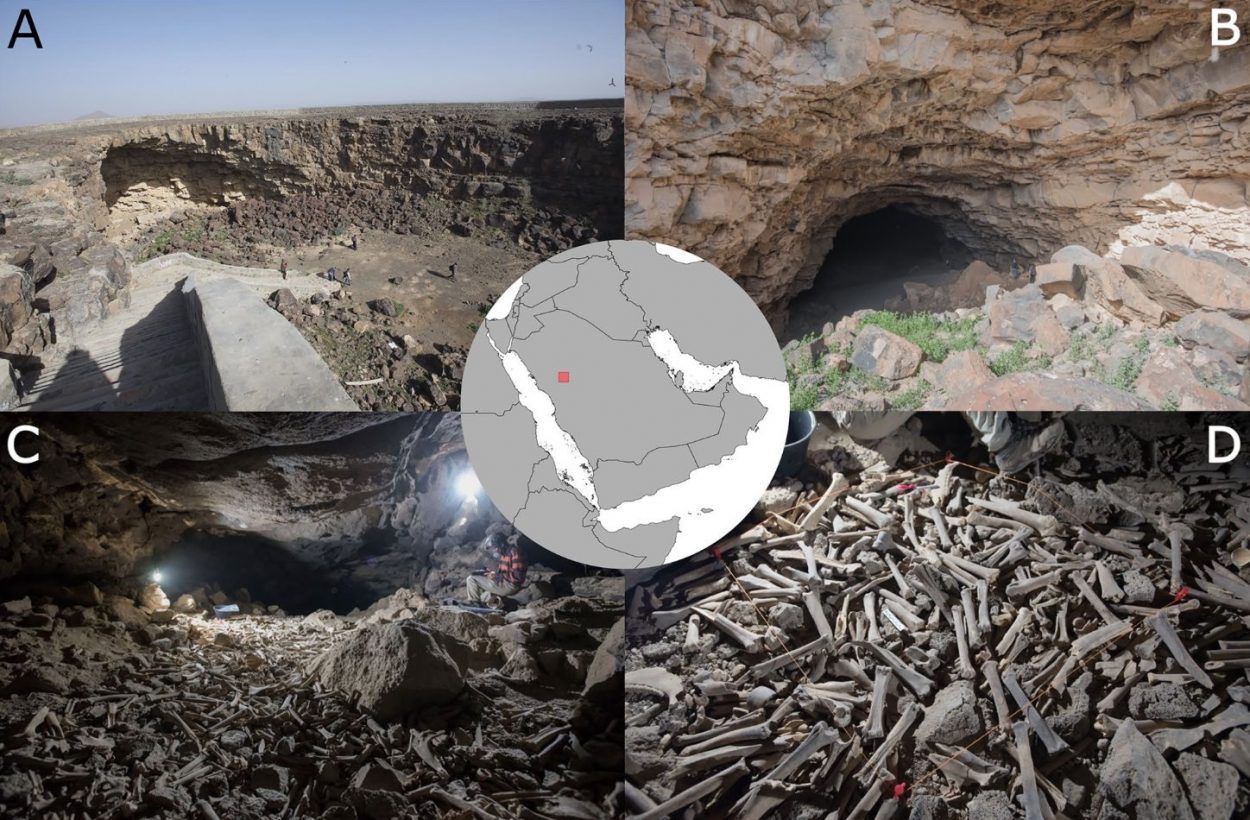
The Umm Jirsan lava tube system is located in the Harrat Khaybar Lava Field, 130 km north of Medina in the Kingdom of Saudi Arabia.

- Advertisement -

Taphonomic studies of fossil bone accumulations as part of the ‘Palaeodeserts Project’ to track human and animal migration across the Arabian Peninsula, has identified hundreds of thousands of bone accumulations consisting of over 40 different species, including horses, asses, cattle, camels, rodents, caprids, and even humans.

Although the lava-tube was discovered in the mid-2000s, only recently did researchers venture deeper into the tube system, where the bone accumulations were found.
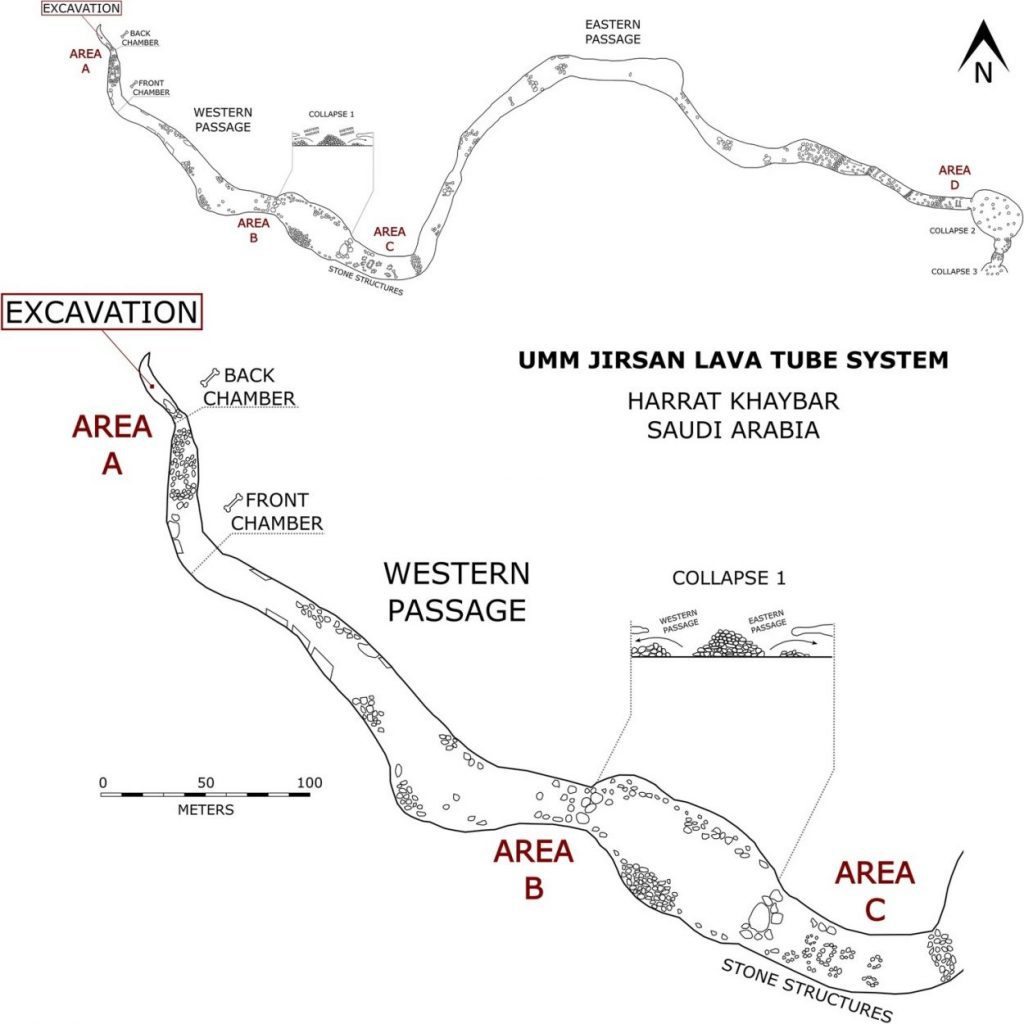
Image Credit : MA Al-Shanti and JJ Pint

Experts believe that the bone accumulation was deposited by hyenas using the lava system as a den, where carcasses and carcass parts were transported to and fed on over a period spanning 7,000 years.

The presence of hyena skeletal remains and coprolites, suggest that the assemblage was primarily accumulated by striped hyena (Hyaena hyaena).

- Advertisement -

The researchers said: The material dates back as far as ~ 7000 years, highlighting the exceptional preservation within the lava tube, and the potential for future research at Umm Jirsan and other nearby lava tubes.

These findings highlight the need for continued neo-taphonomic studies for capturing the full variation of carnivore bone-accumulating and modifying behaviour. Such sites have the potential to inform on the paleoecology and prehistory of this understudied region.”

Header Image Credit : Stewart et al. / Archaeological and Anthropological Sciences, 2021

- Advertisement -

Stay Updated: Follow us on iOS, Android, Google News, Facebook, Instagram, Twitter, Threads, TikTok, LinkedIn, and our newsletter

spot_img
Mark Milligan
Mark Milligan
Mark Milligan is a multi-award-winning journalist and the Managing Editor at HeritageDaily. His background is in archaeology and computer science, having written over 8,000 articles across several online publications. Mark is a member of the Association of British Science Writers (ABSW), the World Federation of Science Journalists, and in 2023 was the recipient of the British Citizen Award for Education, the BCA Medal of Honour, and the UK Prime Minister's Points of Light Award.
spot_img
spot_img

Mobile Application

spot_img

Related Articles

Archaeologists discover Roman Bath was larger than previously known

Archaeologists have uncovered evidence that Roman Bath extended further west than previously believed, following the discovery of ancient ditches, pottery, coins and a fragment of a military helmet beneath the city’s historic Assembly Rooms.

Motorway project uncovers vast prehistoric landscape

Archaeologists working ahead of construction of the D55 motorway in the Czech Republic have uncovered an extensive prehistoric landscape, including nearly 1,900 archaeological features, dozens of graves and the remains of enormous houses built by some of Europe’s earliest farming communities.

Roman hoard found far beyond the Empire’s frontiers

Archaeologists excavating a centuries-old farmstead on the Swedish island of Gotland have uncovered a remarkable hoard of 45 Roman silver coins and a gold ring, with evidence suggesting the collection was buried around AD 450.

Evidence points to lost Roman temple near Kourion

Archaeologists studying a collection of limestone architectural fragments discovered near ancient Kourion say the remains may have belonged to a previously unknown Roman-period temple, potentially adding a new chapter to the history of religious architecture in Cyprus.

Ancient gold bracelet could be part of “Fisherman’s Jewels”

A pre-Hispanic gold bracelet repatriated to Mexico from the United States may be a long-lost piece from the collection known as the “Fisherman’s Jewels”, according to Mexico’s National Institute of Anthropology and History (INAH).

Fragment of Kadesh Peace Treaty discovered at Hattusa

Archaeologists excavating Hattusa, the ancient capital of the Hittite Empire in modern-day Turkey, have discovered a cuneiform tablet fragment belonging to a copy of the Kadesh Peace Treaty.

Roman-era workshop complex discovered in Dortmund

Archaeologists in Dortmund have uncovered an exceptionally well-preserved workshop complex dating from the Roman Imperial period, including evidence of pottery production and the recycling of Roman metal by Germanic communities.

Tomb discovery could be resting place of fabled Chinese Empress

A vast ancient tomb discovered beside one of China’s major airports may be the burial place of Empress Dowager Huayang, the influential adoptive grandmother of Qin Shi Huang, the ruler who unified China more than 2,200 years ago.