
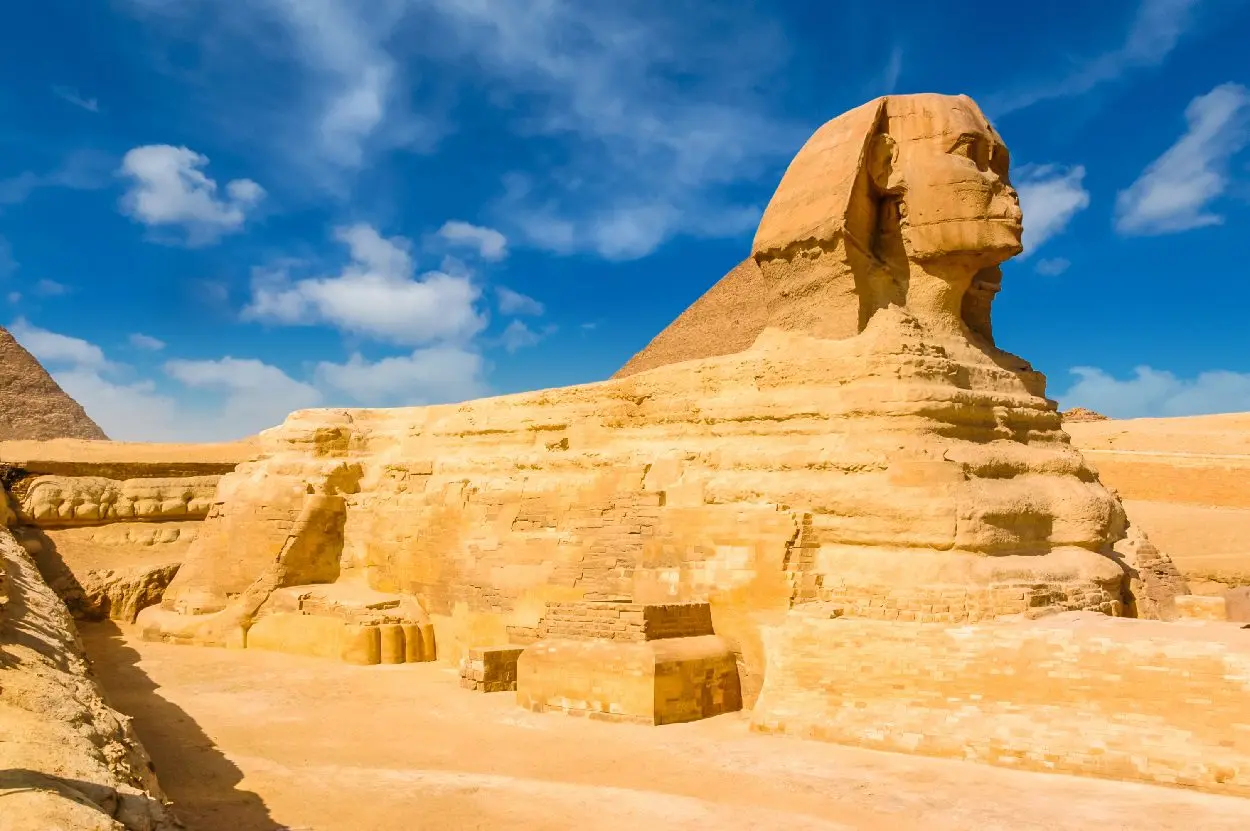
The Great Sphinx of Giza is a limestone statue of a reclining sphinx, a mythical creature characterised by the combination of a human head and a lion’s body.
Situated on the Giza Plateau along the west bank of the Nile in Giza, the Great Sphinx stands as the oldest recognised monumental sculpture in Egypt.
The archaeological findings suggest that the Great Sphinx was built around 2500 BC, a period corresponding to the rule of Pharaoh Khafre, who was responsible for overseeing the construction of the Second Pyramid at Giza.
Many mysteries enshroud the Great Sphinx, including its original appearance and the symbolism it was intended to convey. Remarkably, there has been little focus placed on examining the landscape’s pre-existing state and the potential influence of the natural environment on its design.
In a recent study conducted by New York University (NYU) researchers, scientists recreated environmental conditions from 4,500 years ago. Their aim was to illustrate how wind patterns interacted with rock formations, potentially contributing to the shaping of the monument.
“Our findings offer a possible ‘origin story’ for how Sphinx-like formations can come about from erosion,” explains Leif Ristroph, an associate professor at New York University’s Courant Institute of Mathematical Sciences and the senior author of the study, which has been accepted for publication in the journal Physical Review Fluids.
“Our laboratory experiments showed that surprisingly Sphinx-like shapes can, in fact, come from materials being eroded by fast flows,” added Leif Ristroph.
The study centred on duplicating yardangs, distinctive rock formations found in deserts formed by the accumulation of wind-blown dust and sand. The researchers propose the likelihood that the Great Sphinx might have originated as a natural yardang, subsequently developed and sculpted by humans into the iconic monument recognized today.

To support this theory, the study authors from NYU’s Applied Mathematics Laboratory worked with soft clay mounds containing embedded less erodible material, simulating the landscape of northeastern Egypt where the Great Sphinx is located.
They then subjected these formations to a rapid-flowing water stream, mimicking the erosive action of wind, which gradually carved and reshaped them, eventually leading to the emergence of a structure resembling the Great Sphinx.
The harder or more resistant material within these mounds took on the role of forming the “head” of the lion, while various other features, including a sculpted “neck,” “paws” resting on the ground in front, and an arched “back,” began to take shape.
“Our results provide a simple origin theory for how Sphinx-like formations can come about from erosion,” observes Ristroph. “There are, in fact, yardangs in existence today that look like seated or lying animals, lending support to our conclusions.”
Header Image Credit : Shutterstock