

Date:

Metallurgical fingerprint points to lost Roman legion

A new scientific study has provided Roman legions with a so-called metallurgical fingerprint, which has allowed researchers to identify the lost 19th Legion that was completely destroyed in the Battle of the Teutoburg Forest.

The 19th Legion was founded by Augustus in 41 or 40 BC, first operating in Sicily against a revolt led by Sextus Pompey, the son of Pompey the Great.

- Advertisement -

Active throughout the Germanic campaigns of Drusus (13–9 BC) and Tiberius (8–5 BC), the 19th legion would eventually be destroyed at the Battle of the Teutoburg Forest in AD 9, resulting in the legion’s eagle being captured and the 19th name stricken from the Roman army listings.

The Battle of the Teutoburg Forest was fought between an alliance of Germanic peoples, against the Legions XVII, XVIII & XIX, 6 auxiliary cohorts, and 3 cavalry squadrons. The defeat, described as the Varian Disaster, is commonly seen as one of the most important defeats in Roman history, bringing expansion into Germanic lands by Augustus to an abrupt end.

The new study is a joint research project by scientists from the German Mining Museum Bochum, Leibniz Research Museum for Geo-Resources, and the Varus Battle Museum.
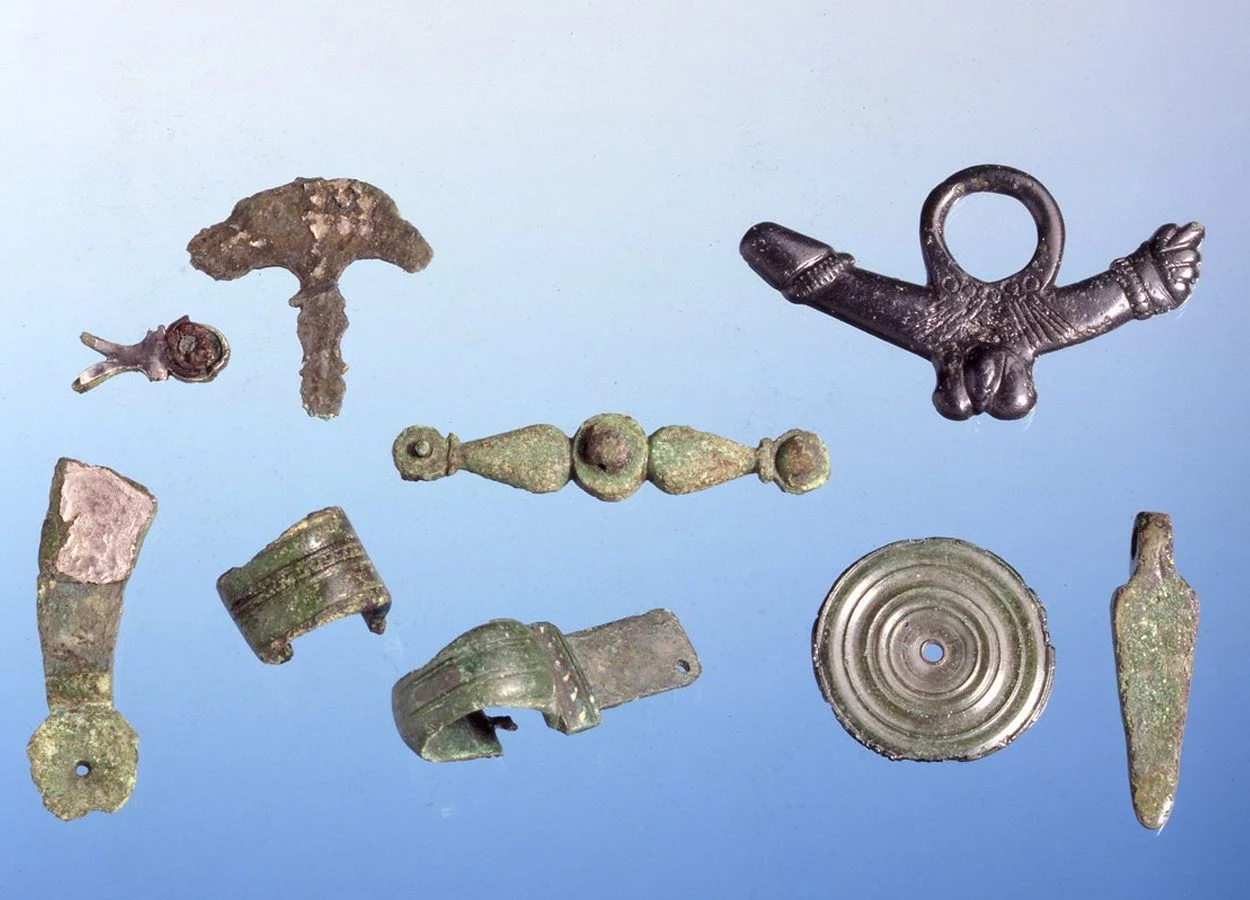
metal4
Image Credit : Christian Grovermann

The team analysed the composition of chemical trace elements in Roman artefacts found at modern-day Kalkriese (site of the Battle of the Teutoburg Forest), which are mainly made from non-ferrous metals such as bronze and brass.

- Advertisement -

By applying a mass spectrometer to detect small traces, the researchers are able to determine the difference in the non-ferrous metal composition that differ with each legion. Each legion had their own blacksmiths for repairing and replacing weapons or equipment. This gave their metalworking a distinct chemical signature, as techniques differed in each legion’s camp.

German Mining Museum Bochum researcher, Annika Diekmann, said: “In this way, we can allocate a legion-specific metallurgical fingerprint, for which we know the camp locations at which they were stationed.”

According to historical text, the 19th was stationed in Dangstetten in southern Germany, years before the events of the Battle of the Teutoburg Forest. “We find that the finds from Dangstetten and Kalkriese show significant similarities. The finds that come from legion sites whose legions did not perish in the battle, differ significantly from the finds from Kalkriese”, added Diekmann.

Bergau-Museum

Header Image Credit : iSTOCK (Under Copyright)

 

- Advertisement -

Stay Updated: Follow us on iOS, Android, Google News, Facebook, Instagram, Twitter, Threads, TikTok, LinkedIn, and our newsletter

spot_img
Mark Milligan
Mark Milligan
Mark Milligan is a multi-award-winning journalist and the Managing Editor at HeritageDaily. His background is in archaeology and computer science, having written over 8,000 articles across several online publications. Mark is a member of the Association of British Science Writers (ABSW), the World Federation of Science Journalists, and in 2023 was the recipient of the British Citizen Award for Education, the BCA Medal of Honour, and the UK Prime Minister's Points of Light Award.
spot_img
spot_img

Mobile Application

spot_img

Related Articles

Archaic-Era tomb contains elaborate bronze diadem

Excavations by the Ephorate of Antiquities of Phthiotis and Evrytania have made the remarkable discovery of an Archaic-Era tomb containing the remains of a woman buried with an elaborate bronze diadem.

Archaeologists open 5,000-year-old Begazi–Dandibay tomb

Archaeologists in Kazakhstan have announced the discovery of an exceptionally well-preserved tomb attributed to the Begazi–Dandibay, a late Bronze Age culture known for constructing megalithic mausolea.

Receding waters reveals submerged ancient ruins

Receding waters at Lake Sapanca in Turkey have revealed an ancient structure with mosaic flooring.

Archaeologists stunned by treasure-laden Roman pyre burial

Archaeologists in southwestern France have uncovered a Roman pyre burial containing an assemblage of high-status grave goods, offering rare insights on the region’s Imperial-era elite.

Chasing History Expeditions – Collect moments, not just miles

Built on the belief that adventure should be empowering rather than intimidating, Chasing History Expeditions provides travellers with expertly crafted itineraries that prioritise meaningful discovery, cultural immersion, and seamless logistics.

Structure for observing celestial movements predates the Chankillo observatory

The Peruvian Ministry of Culture has announced the discovery of an early Andean structure that predates the Chankillo solar observatory – long regarded as the earliest known observatory in the Americas.

2,300-year-old fortified city discovered in Kashkadarya

Archaeologists from the Samarkand Institute in Kashkadarya, southern Uzbekistan, have announced a major discovery: the remains of a fortified city dating back 2,300 years.

Jewel “worthy of a duke” unearthed at Castle Kolno

Researchers from the Institute of Archaeology at the University of Wroclaw have unearthed a jewel “worthy of a duke” at Castle Kolno, located between the Stobrawa and Budkowiczanka rivers in Stare Kolnie, Poland.