
Date:

Archaeologists excavate giant stone spheres in Costa Rica

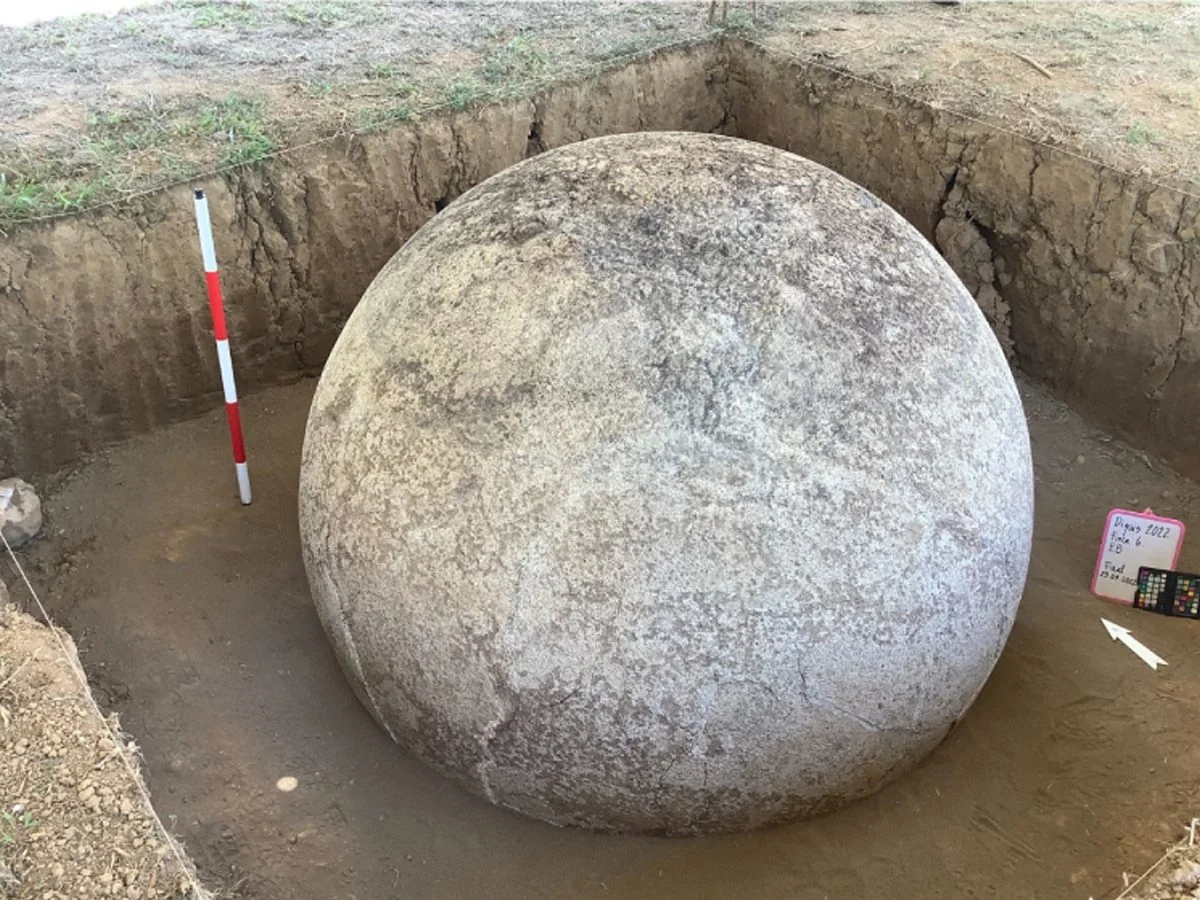
Archaeologists have excavated giant stone spheres in the Diquís Delta of Costa Rica.

Stone spheres are found on the small island of Isla del Caño and the Diquís Delta, where over 300 stone Petrospheres have been previously identified from the Diquís culture.

- Advertisement -

The Diquís culture emerged in the Valley of the Rio Grande de Térraba, where they established complex social, economic, and political systems to govern their society.

During the Chiriquí Period between AD 800 – 1500, many settlements grew into large communities around the alluvial lands of the Térraba River and its main tributaries, constructing large structures using round-edged boulders, paved areas, burial sites, and circular or rectangular mounds with stone walls.

The Diquís reached an apex of cultural development during this period, with Diquís artisans creating elaborate ceramic, bone, and gold objects, and sculpturing stone spheres in important zones within the settlements. Stone spheres were also placed in alignments in public plazas, or along the approach to the dwellings of the ruling elite or chieftains.

Archaeologists from the Instituto Nacional de Antropología e Historia (INAH) and the National Museum of Costa Rica (MNCR) have excavated 6 stone spheres as part of a wider project to preserve the monuments.

- Advertisement -

The team focused on the Finca 6 archaeological site located in the canton of Osa in the Puntarenas Province, in which stone spheres have deteriorated due to alterations derived from the constitution of the rock, damage caused by humidity, and floods resulting from hurricanes and tropical storms.

Isabel Medina-González from ENCRyM-INAH said: “The intervention included surface cleaning and stabilisation through the application of edging and patches of enriched lime-sand mortar to slightly increase the hardness, as well as the placement of protective layers with mortar “.

The spheres were then reburied with layers of geotextile, gravel and sand. “We have verified that this allows a homogenisation of temperature and humidity that avoids contact with the acidity of the clay soil and prevents the growth of vegetation in the vicinity.” said Javier Fallas from MNCR.

INAH

Header Image Credit : INAH

- Advertisement -

Stay Updated: Follow us on iOS, Android, Google News, Facebook, Instagram, Twitter, Threads, TikTok, LinkedIn, and our newsletter

spot_img
Mark Milligan
Mark Milligan
Mark Milligan is a multi-award-winning journalist and the Managing Editor at HeritageDaily. His background is in archaeology and computer science, having written over 8,000 articles across several online publications. Mark is a member of the Association of British Science Writers (ABSW), the World Federation of Science Journalists, and in 2023 was the recipient of the British Citizen Award for Education, the BCA Medal of Honour, and the UK Prime Minister's Points of Light Award.
spot_img
spot_img

Mobile Application

spot_img

Related Articles

Ancient stone labyrinth discovered in India’s Solapur district

Archaeologists have identified what is believed to be India’s largest circular stone labyrinth in the Boramani grasslands of Solapur district, shedding new light on the region’s ancient cultural and trade connections.

Stone Age rock paintings discovered in Tingvoll

Archaeologists have discovered previously unknown Stone Age rock paintings near Tingvoll municipality, located in Møre og Romsdal county, Norway.

Archaeologists find a rare sitella in Cartagena

Archaeologists excavating at the Molinete Archaeological Park in Cartagena have uncovered a heavily charred metal vessel buried beneath the collapsed remains of a building destroyed by fire at the end of the 3rd century AD.

Study searches for hidden chambers in the El Castillo pyramid

An international team of archaeologists are preparing to use advanced muography technology to search for hidden chambers in the El Castillo pyramid at Chichén Itzá, Mexico.

Stone Age dog burial unearthed in Swedish Bog

Archaeologists have unearthed an exceptionally rare Stone Age dog burial in a bog just outside Järna, southern Sweden.

Submerged structural remains discovered off Crimean coastline

Archaeologists have discovered an underwater stone structure, believed to be part of the ancient city of Chersonesus in present-day Sevastopol, occupied Ukraine.

Fragments of Nazi vengeance weapon discovered in southeastern Poland

A team of detectorists have discovered V-2 rocket fragments during a survey near the Blizna Historical Park in Ropczyce-Sędziszów County, Poland.

16th-century gallows discovered in Grenoble

Archaeologists have discovered the remains of rare 16th-century gallows during excavations in advance of the redevelopment of the Boulevard de l’Esplanade in Grenoble, France.