
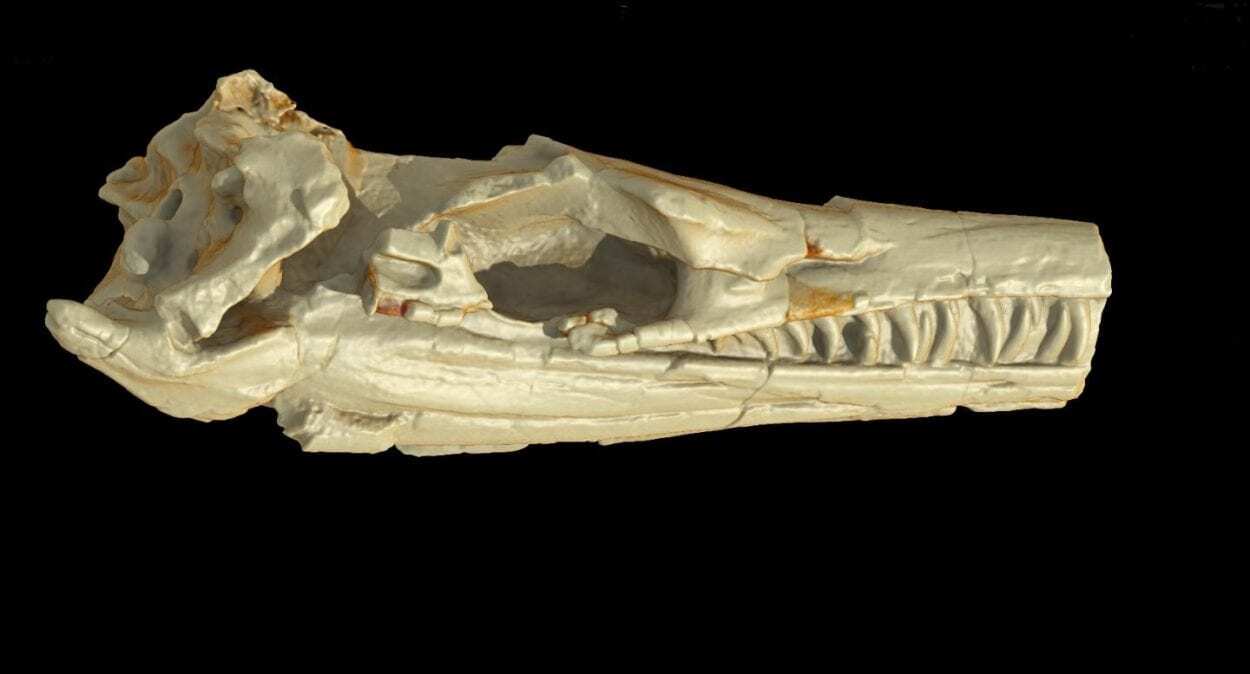
The tree of life is rich in examples of species that changed from living in water to a land-based existence.
Occasionally, some species took the opposite direction. New insights into the anatomy of the inner ear of prehistoric reptiles, the thalattosuchians, revealed details about one of these evolutionary turning points. During the Mesozoic era, these now extinct crocodile relatives ventured into the ocean after a long semiaquatic phase.
During this process, the skeleton of the thalattosuchians gradually adapted to the new pelagic habitat. In particular, the changes to the inner ear vestibular system of these reptiles enhanced their ability to swim. Compared to whales, which adapted quickly to life in water without a prolonged semiaquatic stage, this is a strikingly different evolutionary path for the same transition.
These new findings of an international research team were made possible by the use of a Canon high-tech computed tomography (CT) scanner from the Leibniz Institute for Zoo and Wildlife Research (Leibniz-IZW). The results have been published in the „Proceedings of the National Acadamy of Sciences of the USA”.
Thalattosuchians lived during the Mesozoic about 182 to 125 million years ago and evolved from their land-living relatives to become fast-swimming marine predators. An international research team led by scientists from the School of Geosciences at the University of Edinburgh studied the evolutionary changes which these crocodylomorphs went through during their transition from land to the ocean. The team focused on one of the most important vertebrate sensory systems – the inner ear. Using high-resolution computed tomography (CT), the skulls of 18 thalattosuchians from the late Triassic to the Early Cretaceous were scanned to span much of the evolutionary history of crocodylomorphs. The CT scans were compared with the scans of modern crocodiles. Some of the scans were performed at the Leibniz-IZW in Berlin. The x-ray scans reveal detailed changes in the vestibular system of the inner ear, particularly in the bony labyrinth, which plays a crucial role in sensing balance and spatial orientation. “As they transitioned from land to water, thalattosuchians developed a strikingly compact, reduced and thickened bony labyrinth reminiscent of the reduced labyrinths of other marine reptiles and whales,” explains Guido Fritsch, scientist and CT expert at the Leibniz-IZW. “Extinct land crocodiles, on the other hand, had a taller and narrower bony labyrinth. The labyrinths of semiaquatic crocodiles, which also include modern crocodiles, are longer and more compact than those of their land-living relatives”. These results illustrate that the inner ear morphology of an animal is strongly linked to its habitat.
Interestingly, thalattosuchians developed the reduction of their inner ear labyrinth only after a long semiaquatic phase that lasted tens of millions of years. First, their skeleton changed during this phase – limbs became flippers, the body became streamlined, which allowed them to move efficiently in the water and improved their ability to swim. Only then did the changes in the inner ear develop, possibly as a response to changing sensory requirements, when the thalattosuchians moved into deeper, more open waters. This adaptation process distinguishes them from whales, whose inner ear labyrinth was miniaturised soon after their transition from land to water, without a prolonged semiaquatic phase. Thus, thalattosuchians and whales took different evolutionary routes for the same type of transition.
Future studies will examine the advantages of a reduced inner ear labyrinth for water-living animals, investigate how quickly thalattosuchians developed the adaptations in their inner ear as they entered the water, and how other sensory organs changed during this transition.
FORSCHUNGSVERBUND BERLIN
Header Image Credit : G. Fritsch/Leibniz-IZW.




