
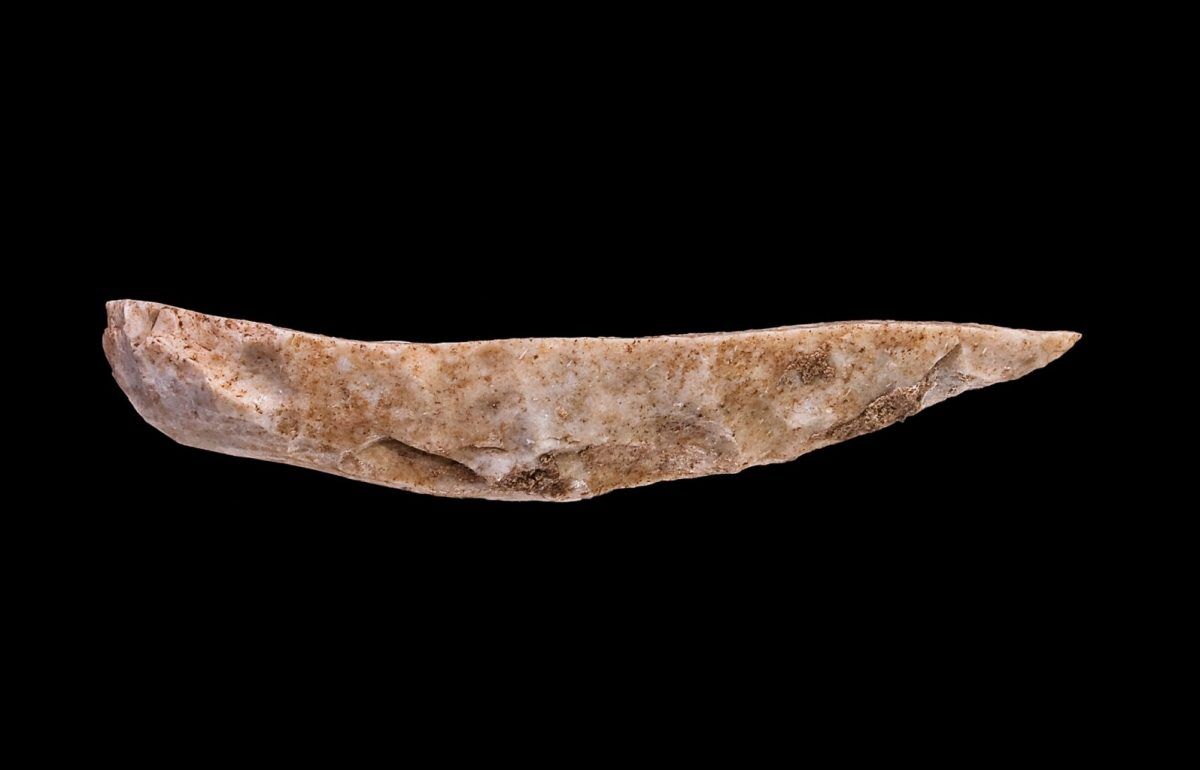
Archaeologists from the Tel Aviv University have revealed that “modern” blade production was also an element of Amudian industry during the late Lower Paleolithic period, 200,000-400,000 years ago as part of the Acheulo-Yabrudian cultural complex, a geographically limited group of hominins who lived in modern-day Israel, Lebanon, Syria and Jordan.
Archaeology has long associated advanced blade production with the Upper Palaeolithic period, about 30,000-40,000 years ago, linked with the emergence of Homo Sapiens and cultural features such as cave art.
Prof. Avi Gopher, Dr. Ran Barkai and Dr. Ron Shimelmitz of TAU’s Department of Archaeology and Ancient Near Eastern Civilizations say that large numbers of long, slender cutting tools were discovered at Qesem Cave, located outside of Tel Aviv, Israel. This discovery challenges the notion that blade productitools, on is exclusively linked with recent modern humans.
The blades, which were described recently in the Journal of Human Evolution, are the product of a well planned “production line,” says Dr. Barkai. Every element of the blades, from the choice of raw material to the production method itself, points to a sophisticated tool production system to rival the blade technology used hundreds of thousands of years later.
An innovative product
Though blades have been found in earlier archaeological sites in Africa, Dr. Barkai and Prof. Gopher say that the blades found in Qesem Cave distinguish themselves through the sophistication of the technology used for manufacturing and mass production.
Evidence suggests that the process began with the careful selection of raw materials. The hominins collected raw material from the surface or quarried it from underground, seeking specific pieces of flint that would best fit their blade making technology, explains Dr. Barkai.
With the right blocks of material, they were able to use a systematic and efficient method to produce the desired blades, which involved powerful and controlled blows that took into account the mechanics of stone fracture. Most of the blades of were made to have one sharp cutting edge and one naturally dull edge so it could be easily gripped in a human hand.
This is perhaps the first time that such technology was standardized, notes Prof. Gopher, who points out that the blades were produced with relatively small amounts of waste materials. This systematic industry enabled the inhabitants of the cave to produce tools, normally considered costly in raw material and time, with relative ease.
Thousands of these blades have been discovered at the site. “Because they could be produced so efficiently, they were almost used as expendable items,” he says.
Prof. Cristina Lemorini from Sapienza University of Rome conducted a closer analysis of markings on the blades under a microscope and conducted a series of experiments determining that the tools were primarily used for butchering.
Modern tools a part of modern behaviors
According to the researchers, this innovative industry and technology is one of a score of new behaviors exhibited by the inhabitants of Qesem Cave. “There is clear evidence of daily and habitual use of fire, which is news to archaeologists,” says Dr. Barkai. Previously, it was unknown if the Amudian culture made use of fire, and to what extent. There is also evidence of a division of space within the cave, he notes.
The cave inhabitants used each space in a regular manner, conducting specific tasks in predetermined places. Hunted prey, for instance, was taken to an appointed area to be butchered, barbequed and later shared within the group, while the animal hide was processed elsewhere.
Tel Aviv University




