
Date:

Archaeologists find Nordic Bronze Age meeting hall from time of legendary King Hinz

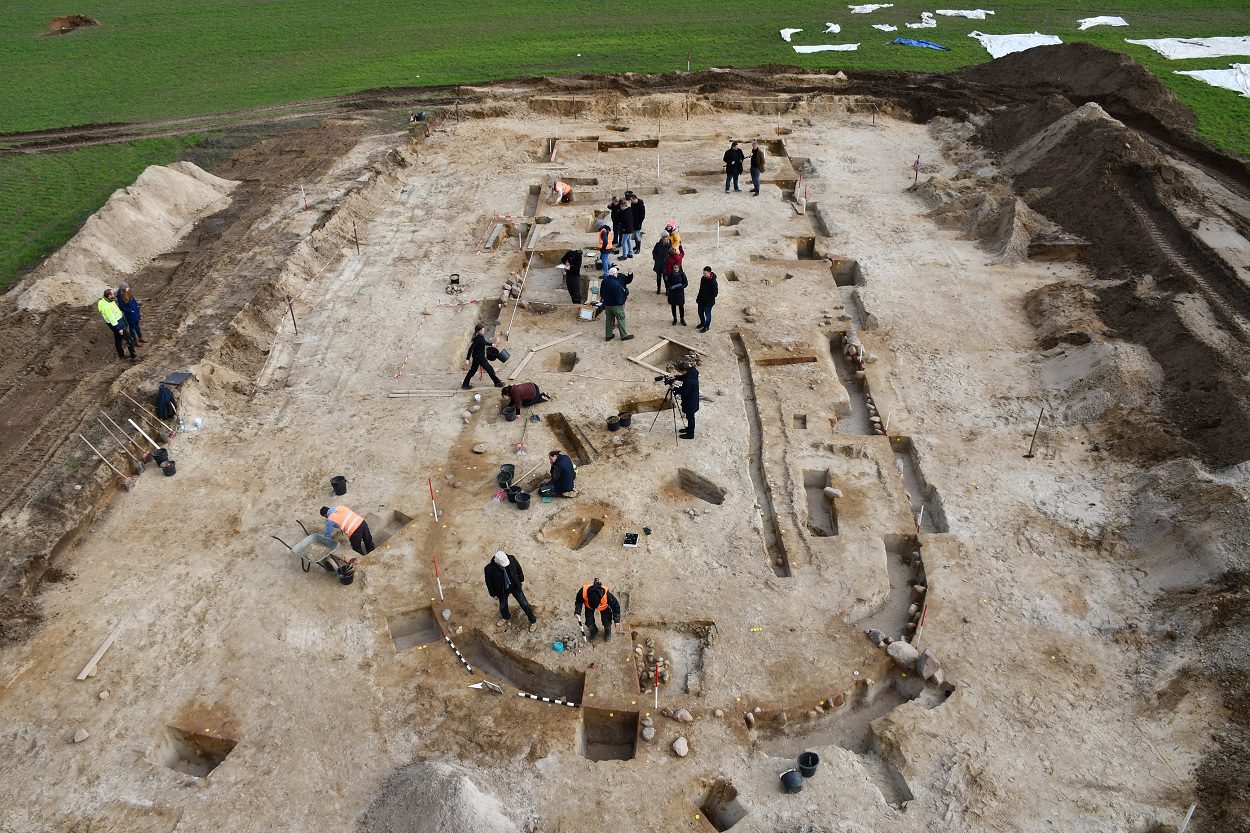
Archaeologists have uncovered a large meeting hall near the Bronze Age burial mound of King Hinz, also known as the “King’s Grave”, located in Seddiner in northwestern Brandenburg, Germany.

The “King’s Grave” is regarded as the most significant burial site from the 9th century BC in northern Central Europe. It was discovered in 1899 during stone extraction work,

- Advertisement -

Since spring 2023, archaeologists have conducted extensive excavations around the royal burial mound, with the Brandenburg State Office for Monument Preservation collaborating with archaeologists from the University of Göttingen.

The hall measures 31 by 10 metres and dates from the 9th to 10th century BC. According to the researchers, the discovery is “unique for the Bronze Age – a find of Germany-wide, if not Europe-wide, significance.”

Dr. Immo Heske from the University of Göttingen, said: “ This is the largest building of its kind. We only know of four buildings from this era over a period of 1000 years that are this wide.”

Archaeologists suggest that the structure was used as a meeting hall by King Hinz, a legendary figure who ruled in Prignitz, however, very little is known about this monarch except that he was reputed to have been buried in a coffin made from gold.

- Advertisement -

The hall was originally up to 7-metres tall and was built using wooden planks covered in a wattle of clay plaster. Due to the building’s considerable height, the researchers suggest that the structure likely accommodated multiple levels. Excavations also revealed a centrally positioned fireplace and a miniature vessel that may have been used for ceremonial purposes.

Tobias Dünow from the Brandenburg State Secretary for Science, said: “Here we have the opportunity – like hardly anywhere else in Europe – to gain an insight into the way of life, the culture, the building of houses and to get the burial culture in the Bronze Age.”

Prignitz District

Header Image Credit : Prignitz District

- Advertisement -

Stay Updated: Follow us on iOS, Android, Google News, Facebook, Instagram, Twitter, Threads, TikTok, LinkedIn, and our newsletter

spot_img
Mark Milligan
Mark Milligan
Mark Milligan is a multi-award-winning journalist and the Managing Editor at HeritageDaily. His background is in archaeology and computer science, having written over 8,000 articles across several online publications. Mark is a member of the Association of British Science Writers (ABSW), the World Federation of Science Journalists, and in 2023 was the recipient of the British Citizen Award for Education, the BCA Medal of Honour, and the UK Prime Minister's Points of Light Award.
spot_img
spot_img

Mobile Application

spot_img

Related Articles

Gold-enamelled artefacts uncovered at Ho Dynasty Citadel

Archaeologists have uncovered dozens of rare gold-enamelled terracotta artefacts at the Ho Dynasty Citadel World Heritage site, marking one of the most significant discoveries at the historic complex in recent years.

Lost medieval town discovered in West Pomerania

Archaeologists have confirmed the discovery of a long-forgotten medieval town hidden beneath woodland near the settlement of Zagrody, close to Sławoborze in Poland.

Archaeologists excavate lost royal palace

Between 2021 and 2023, the long-lost royal palace of Helfta near Lutherstadt Eisleben (Mansfeld-Südharz district) was systematically investigated by the State Office for Heritage Management and Archaeology (LDA) of Saxony-Anhalt.

LiDAR study reveals previously unknown fortress

A previously unknown fortification has been identified in Chełm County, eastern Poland, following a study using airborne laser scanning and other remote sensing techniques.

Study reveals how early humans developed new technologies 400,000 years ago

A sweeping international study of European Stone Age sites is reshaping understanding of how early humans developed new technologies roughly 400,000 years ago.

Guano fuelled the rise of Pre-Inca powerhouse in Peru

A multidisciplinary study reveals that nutrient-rich seabird guano was a key driver of agricultural productivity and sociopolitical expansion in ancient coastal Peru - long before the rise of the Inca Empire.

Medieval panels shed light on Toledo’s storied past

A remarkable medieval discovery hidden beneath a private home in Toledo has shed new light on the city’s storied past.

Bass Rock: Scotland’s Alcatraz

From the beaches of North Berwick, Scotland, Bass Rock is a sheer-sided mass of stone rising abruptly from the steel-grey waters of the Firth of Forth.