
Date:

New discovery places mass obsidian hand axe production to 1.2 million years ago

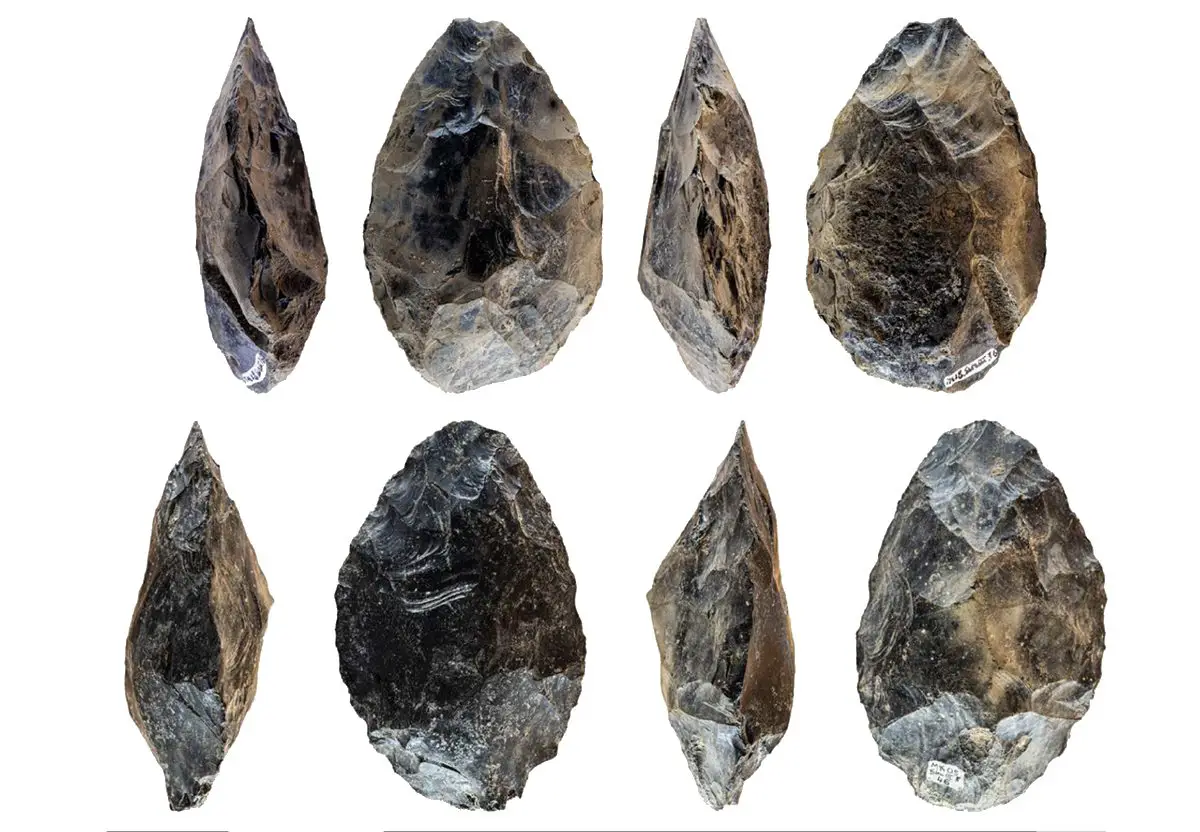
A trove of obsidian hand-axes discovered in Melka Kunture, Ethiopia, has placed mass obsidian hand axe production to 1.2 million years ago.

Melka Kunture is located in the Ethiopian highlands, on the western side of the Main Ethiopian Rift, which has been affected by proximal to distal volcanic activity, dispersing raw materials such as obsidian which is suitable for knapping.

- Advertisement -

Obsidian is a naturally occurring volcanic glass, formed when lava extruded from a volcano cools rapidly with minimal crystal growth. Due to the hard, brittle, and amorphous nature of the glass, it fractures with sharp edges, making it a reliable material for manufacturing cutting and piercing tools.

Archaeologists excavating at the Simbiro III archaeological site have found a trove obsidian hand-axes from 1.2 million years ago, indicating that hand axe production on a mass scale occurred 500,000 years earlier than previously thought.

Simple obsidian tool production has been documented from sites as early as 3.3 million years ago, but the complexity for mass tool production of hand axes by an unknown group of hominins at Simbiro III, predates the earliest known example found at Kariandusi in Kenya which dates to 700,000-years-ago.

The results of the study at Simbiro III have been published in the journal Nature Ecology & Evolution, where the researchers document almost 600 obsidian hand-axes being discovered.

- Advertisement -

The hand axes provide ample evidence of the repetitive use of fully mastered skills. The hominins that created them solved through convergent thinking, technological problems, such as effectively detaching and shaping large flakes of the unusually brittle and cutting volcanic glass.

The study states: “Following the deposition of an accumulation of obsidian cobbles by a meandering river, hominins began to exploit these in new ways, producing large tools with sharp cutting edges. We show through statistical analysis that this was a focused activity, that very standardised hand axes were produced and that this was a stone-tool workshop.”


Nature

https://doi.org/10.1038/s41559-022-01970-1

Header Image Credit : Margherita Mussi, Eduardo Mendez-Quintas

 

- Advertisement -

Stay Updated: Follow us on iOS, Android, Google News, Facebook, Instagram, Twitter, Threads, TikTok, LinkedIn, and our newsletter

spot_img
Mark Milligan
Mark Milligan
Mark Milligan is a multi-award-winning journalist and the Managing Editor at HeritageDaily. His background is in archaeology and computer science, having written over 8,000 articles across several online publications. Mark is a member of the Association of British Science Writers (ABSW), the World Federation of Science Journalists, and in 2023 was the recipient of the British Citizen Award for Education, the BCA Medal of Honour, and the UK Prime Minister's Points of Light Award.
spot_img
spot_img

Mobile Application

spot_img

Related Articles

LiDAR study reveals previously unknown fortress

A previously unknown fortification has been identified in Chełm County, eastern Poland, following a study using airborne laser scanning and other remote sensing techniques.

Study reveals how early humans developed new technologies 400,000 years ago

A sweeping international study of European Stone Age sites is reshaping understanding of how early humans developed new technologies roughly 400,000 years ago.

Guano fuelled the rise of Pre-Inca powerhouse in Peru

A multidisciplinary study reveals that nutrient-rich seabird guano was a key driver of agricultural productivity and sociopolitical expansion in ancient coastal Peru - long before the rise of the Inca Empire.

Medieval panels shed light on Toledo’s storied past

A remarkable medieval discovery hidden beneath a private home in Toledo has shed new light on the city’s storied past.

Bass Rock: Scotland’s Alcatraz

From the beaches of North Berwick, Scotland, Bass Rock is a sheer-sided mass of stone rising abruptly from the steel-grey waters of the Firth of Forth.

Petroglyphs found in Monagas are 8,000 years old

A newly discovered petroglyph in the municipality of Cedeño Municipality is being hailed as one of the oldest known rock art records in Venezuela, with experts estimating the engravings to be between 4,000 and 8,000 years old.

Ancient antler headdress proves contact between hunter-gatherers and the earliest farmers

A new examination of a 7,000-year-old roe deer antler headdress from Eilsleben provides compelling evidence of contact between Central Europe’s last hunter-gatherers and its earliest farming communities.

Drone survey reveals Roman forum and theatre at Fioccaglia

Aerial drone surveys have revealed a forum and a previously unknown theatre at the Roman site of Fioccaglia in Flumeri, along the legendary Appian Way.