
Date:

2,700-Year-Old Water System Discovered Near Rosh Ha-Ayin

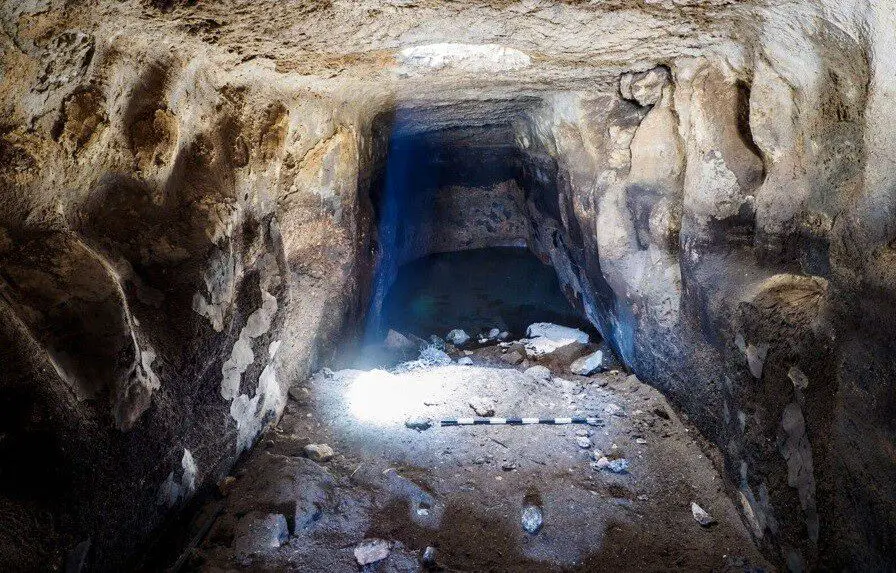
An impressively large 2,700-year-old water system has been discovered during excavations conducted by the Israel Antiquities Authority near Rosh Ha-Ayin.

According to Gilad Itach, director of excavations for the IAA, “It is difficult not to be impressed by the sight of the immense underground reservoir quarried out so many years ago. In antiquity, rainwater collection and storage was a fundamental necessity. With an annual rainfall of 500 mm, the region’s winter rains would easily have filled the huge reservoir. On its walls, near the entrance, we identified engravings of human figures, crosses, and a vegetal motif that were probably carved by passersby in a later period. Overall, we identified seven figures measuring 15–30 cm. Most have outstretched arms and a few appear to be holding some kind of object.”

- Advertisement -

The water system exposed is nearly 20 m long and reaches a depth of over 4 m. The excavations reveal that the reservoir was built beneath a large structure with walls that are all nearly 50 m long. Some of the potsherds found on the floors of the rooms probably belonged to vessels used to draw water from the reservoir.

It is highly likely that the structure and the reservoir were built at the end of the Iron Age (late eighth or early seventh century BCE), but whereas the building was abandoned during the Persian period the reservoir was still in use until modern times.

In recent years, a number of other farmsteads built at the end of the First Temple period have been discovered near Rosh Ha-Ayin. They were probably erected after the destruction of the Kingdom of Israel in 720 BCE, when the Assyrian empire dominated the region. The establishment of farmhouses in this area is interesting, given the fact that many regions within the decimated Kingdom of Israel remained desolate.

- Advertisement -

Some scholars believe that the establishment of the farmsteads was motivated by the empire’s wish to settle the area, which lay on an international route and near the western border of the Assyrian empire. According to Itach, “The structure exposed in this excavation is different from most of the previously discovered farmsteads. Its orderly plan, vast area, strong walls, and the impressive water reservoir hewn beneath it suggest that the site was administrative in nature and it may well have controlled the surrounding farmsteads.”

High-school students majoring in the Education Ministry’s Land of Israel and Archaeology track participated in the Rosh Ha-Ayin excavations as part of the Ministry and the IAA’s new educational program, which is designed to connect students with the past and train the archaeologists of tomorrow.

In cooperation with the Ministry of Construction and Housing and Rosh Ha-Ayin Municipality, the Israel Antiquities Authority has plans for the site to remain an open area accessible to the public.

IAA

- Advertisement -

Stay Updated: Follow us on iOS, Android, Google News, Facebook, Instagram, Twitter, Threads, TikTok, LinkedIn, and our newsletter

spot_img
Mark Milligan
Mark Milligan
Mark Milligan is a multi-award-winning journalist and the Managing Editor at HeritageDaily. His background is in archaeology and computer science, having written over 8,000 articles across several online publications. Mark is a member of the Association of British Science Writers (ABSW), the World Federation of Science Journalists, and in 2023 was the recipient of the British Citizen Award for Education, the BCA Medal of Honour, and the UK Prime Minister's Points of Light Award.
spot_img
spot_img

Mobile Application

spot_img

Related Articles

Archaeologists uncover extensive Bronze Age settlement on Hungary’s Somló Hill

Archaeologists from the Hungarian National Museum have uncovered evidence of an extensive Bronze Age settlement on Somló Hill, revealing a sophisticated community that flourished more than 3,000 years ago.

Excavations reveal Bishop’s Palace and Medieval monastery secrets at Posa Hill

Archaeologists working at Posa Hill near Zeitz, Germany, have uncovered new evidence of an early medieval castle, an imposing bishop’s palace and sophisticated infrastructure belonging to a Benedictine monastery.

Rare Venus statuette unearthed at Roman settlement in Hungary

Archaeologists excavating the Roman vicus of Pilisszentiván have uncovered a lead statuette of Venus alongside coins, tools and other objects offering new insights into everyday life at the ancient settlement.

Ancient Ethiopian palace could have stood 16 storeys high, study finds

Computer simulations of a 2,800-year-old monumental building in northern Ethiopia suggest its unusual timber-reinforced walls were strong enough to support far more floors than archaeologists had previously assumed.

Rare Samanid-Era ganch panels with Kufic inscriptions discovered in Bukhara

Archaeologists excavating the Shahristan archaeological site in Bukhara, Uzbekistan, have discovered fragments of an ornate ganch panel bearing Kufic inscriptions dating to the Samanid era.

Stone Age sites identified in Uzbekistan’s Jizzakh region

Archaeologists surveying Uzbekistan’s Jizzakh region have discovered previously unknown Palaeolithic and Neolithic sites alongside a remarkable collection of ancient petroglyphs depicting hunters, animals and a mysterious solar symbol.

Rare Polish army field telephones discovered in forest near Sochaczew

Two remarkably well-preserved Polish military field telephones, believed to date from the September Campaign of 1939, have been discovered during a search for wartime relics near Sochaczew.

Rare Roman sculptures discovered at vast ancient sanctuary in Chartres

Archaeologists excavating one of the largest religious complexes in Roman Gaul have uncovered an unusually rich collection of sculptures and reliefs, alongside new evidence of an elaborate water system that may have played a role in ancient rituals.