
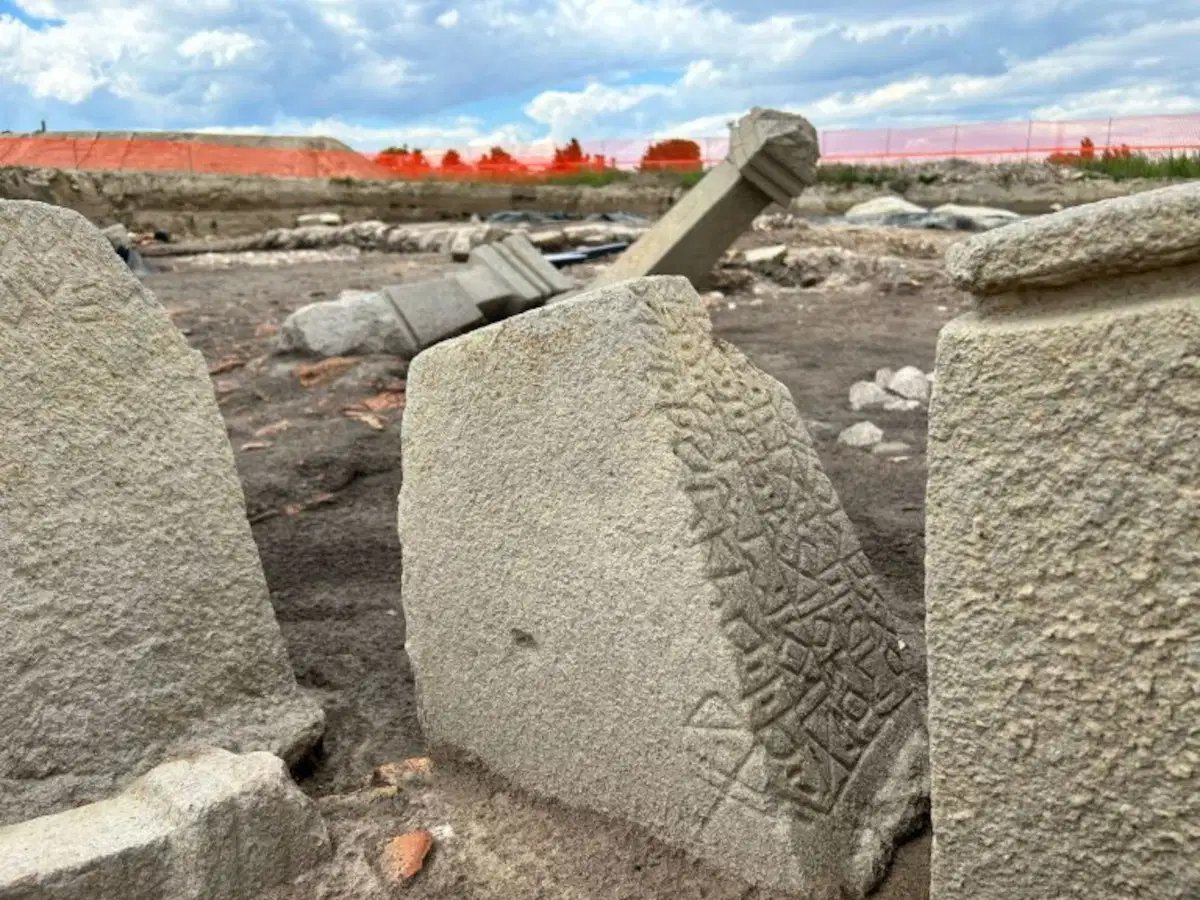
An ancient sanctuary containing inscriptions in the Venetic language was discovered in Ponso, in the Italian Province of Padua, during infrastructure works for the construction of the first section of the SR10 “Padana Inferiore” regional road between Borgo Veneto and Carceri.
The ABAP Superintendency overseeing the discovery, covering the provinces of Padua, Treviso and Belluno, is shedding new light on religious activity in the region from pre-Roman through to Roman times. Archaeologists identified a cult site believed to have been active from at least the 5th–4th centuries BC and continued to hold significance during the Roman era.
Some of the most important finds are several stone artefacts inscribed in both Latin and Venetic script, many containing what experts believe to be votive dedications. Some inscriptions are carved on three faces of the stones, emphasising their ceremonial significance.
Some of the inscribed stones were later reused in the construction of a paved surface whose exact purpose remains unclear. Preliminary work indicates the pavement may date to the 1st century AD, so the site still had a sacred purpose, although it changed significantly during the Roman era.

During land reclamation work, the first artefacts were uncovered, prompting a broader programme of stratigraphic excavation. Later studies revealed additional monumental rectangular structures interpreted as temples. One building showcases architectural characteristics associated with the peripteral style, with a colonnade around it.
The excavations suggest that the sanctuary eventually succumbed to a powerful flood of the Adige River, which in antiquity ran through the area. Although that may have happened, the site was not abandoned without warning, the researchers say.
It seems instead to have evolved incrementally, sustaining a key position over the centuries as cultural and religious practices evolved. Excavations and analysis are underway at a pace that archaeologists hope will clarify the layout of the complex, as well as the sequence of its various phases of use.
Sources : ABAP Superintendency for the provinces of Padua, Treviso and Belluno




