
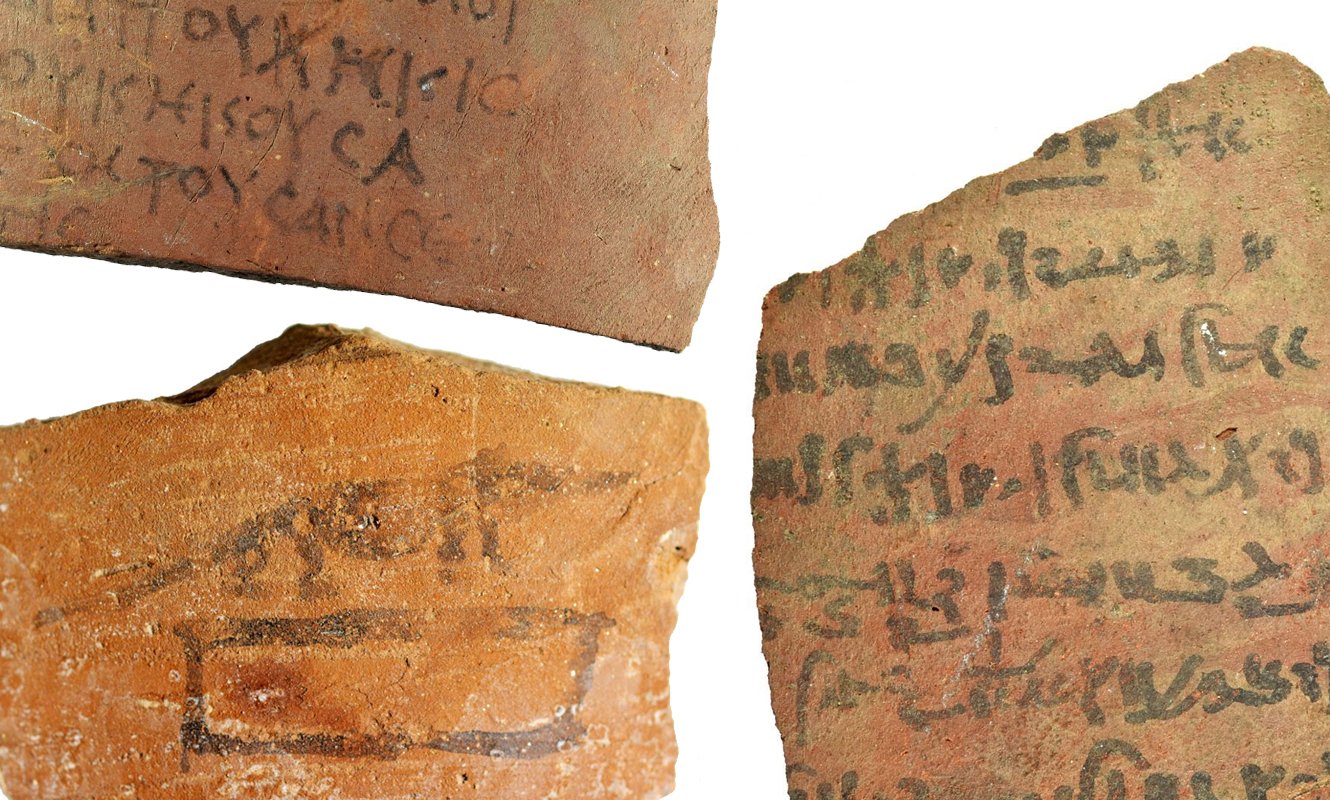
Archaeologists working in Upper Egypt have uncovered around 3,000 ostraca pottery fragments during the current excavation season at the Athribis (Atreps) archaeological site in Sohag province.
The discovery raises the total number of ostraca found at the site to approximately 43,000 since excavations began there in 2005, making it the largest known collection of inscribed pottery fragments from a single archaeological location in Egypt.
The finds were made by a joint Egyptian–German archaeological mission conducted by Egypt’s Supreme Council of Antiquities in partnership with Germany’s University of Tübingen.
The Athribis site lies near the modern city of Sohag, about 7 kilometres west of the Nile in the area of Naga Sheikh Hamad, a region rich in ancient settlements and religious structures.
“The discovery is a significant scientific addition to our understanding of Egypt’s social and economic history across multiple historical periods”, said Sherif Fathy, Egypt’s Minister of Tourism and Antiquities.
Hisham El-Leithy, the Secretary-General of the Supreme Council of Antiquities, said the collection of ostraca from Athribis has now surpassed the number of similar inscriptions found at any other site in Egypt. It even surpasses the famous ostraca archive from Deir el-Medina near Luxor, which has long been considered the most significant source of such materials in the country after more than two centuries of archaeological exploration.
Ostraca, which are pieces of broken pottery or limestone used as inexpensive writing surfaces, were very important in ancient Egypt for everyday use. The newly discovered fragments contain text spanning over a thousand years of history, written in several languages and scripts. Researchers have identified the oldest texts so far as tax receipts written in the Demotic script, dating back to approximately the third century BC. The most recent inscriptions are Arabic labels and some Arabic notes from the 9th and 11th centuries AD, indicating how long the site remained in use.
A statistical study of the inscriptions shows that 60-75% of the ostraca are covered with Demotic script, and between 15 to 30% have Greek inscriptions. Small portions are still written in Hieratic, Hieroglyphic, Coptic, and Arabic script.
The fragments also include geometric drawings instead of written text, which represent about four to five percent of cases, or are illustrative drawings with geometric outlines.
The inscriptions, with their pages of writing, provide rare insight into the daily administrative, commercial, and religious life of the ancient city. Examples include records of financial computations, receipts for taxes, delivery orders, and inventory lists. Others appear to be writing exercises for students learning scripts and languages. Additionally, some texts contain religious material related to temple work, such as hymns, prayers, devotional texts, and utterances concerning ritual offerings.
The ostraca are now under the focus of the international research project “Ostraca d’Athribis,” a group of researchers from several different fields focused on ancient languages, scripts and the analysis of ceramics.
Sources : Ministry of Tourism and Antiquities




