
Date:

Aerial photographs indicate an enormous Avar-Era cemetery

An analysis of aerial photographs has led to the discovery of a previously unknown Avar-era cemetery on the outskirts of Tatabánya, Hungary.

The site was first identified in April 2025 by researchers from the Hungarian National Museum, who spotted rectangular discolorations in a grain field.

- Advertisement -

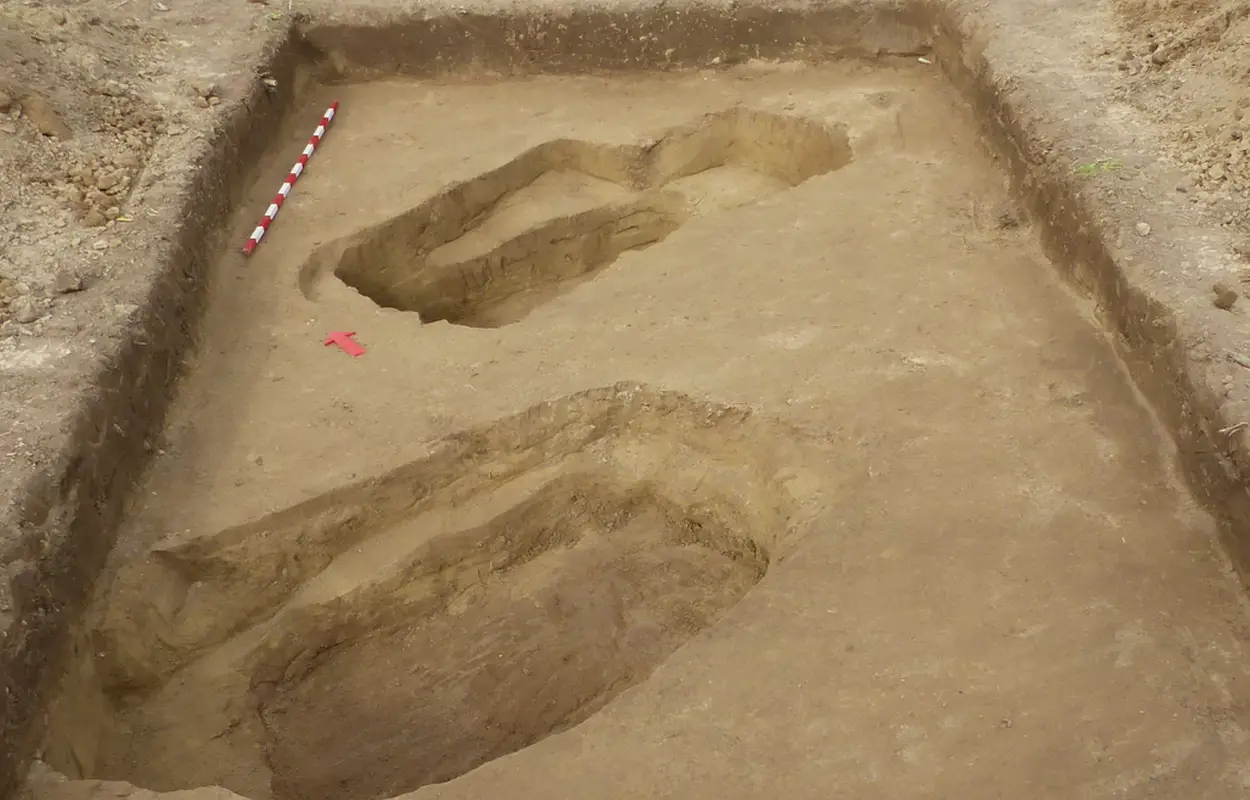
Working in collaboration with the Tatabánya Museum, archaeologists conducted an exploratory excavation on one of the features, which led to the discovery of two log coffin tombs.

The tombs are linked to Avar-era burial traditions dating from the 6th to 9th century. Due to prior looting, only bone fragments and remnants of coffin lids remain, offering faint but valuable insights into the burial practices from this period.

Researchers have identified up to 1000 other features, indicating that the site is an enormous Avar-Era cemetery.

Experts believe that continued excavation at the site could offer unprecedented insights into the Avar people, a nomadic group that once held power in the Carpathian Basin.

- Advertisement -

As research progresses, the Tatabánya cemetery promises to become a significant contributor to our understanding of early medieval life and death in Central Europe.

The study at Tatabánya forms part of a national research program “Cemeteries from Space”, which is applying new methods of archaeological research, including identification based on satellite and drone footage.

Header Image Credit : Tatabányai Múzeum

Sources : Tatabányai Múzeum

- Advertisement -

Stay Updated: Follow us on iOS, Android, Google News, Facebook, Instagram, Twitter, Threads, TikTok, LinkedIn, and our newsletter

spot_img
Mark Milligan
Mark Milligan
Mark Milligan is a multi-award-winning journalist and the Managing Editor at HeritageDaily. His background is in archaeology and computer science, having written over 8,000 articles across several online publications. Mark is a member of the Association of British Science Writers (ABSW), the World Federation of Science Journalists, and in 2023 was the recipient of the British Citizen Award for Education, the BCA Medal of Honour, and the UK Prime Minister's Points of Light Award.
spot_img
spot_img

Mobile Application

spot_img

Related Articles

Fragment of Kadesh Peace Treaty discovered at Hattusa

Archaeologists excavating Hattusa, the ancient capital of the Hittite Empire in modern-day Turkey, have discovered a cuneiform tablet fragment belonging to a copy of the Kadesh Peace Treaty.

Roman-era workshop complex discovered in Dortmund

Archaeologists in Dortmund have uncovered an exceptionally well-preserved workshop complex dating from the Roman Imperial period, including evidence of pottery production and the recycling of Roman metal by Germanic communities.

Tomb discovery could be resting place of fabled Chinese Empress

A vast ancient tomb discovered beside one of China’s major airports may be the burial place of Empress Dowager Huayang, the influential adoptive grandmother of Qin Shi Huang, the ruler who unified China more than 2,200 years ago.

Archaeologists uncover 2,000-year-old Han dynasty city

Archaeologists investigating an ancient city in south-west China have uncovered evidence of a major Han Dynasty urban centre, including fortified walls, streets, workshops and what researchers believe could be the only known Han-era “water gateway” yet discovered in the country.

Archaeologists discover lost Roman settlement with evidence of mysterious fire

Archaeologists in southern Switzerland have uncovered the remains of a Roman-era settlement dating to the second and third centuries AD, including a substantial masonry building and evidence of metalworking activity.

Ancient rock-cut tombs found beneath Roman camp in Egypt

Archaeologists working at the ancient site of Tell el-Yahudiya in Egypt’s Qalyubia Governorate have uncovered a series of rare rock-cut tombs and further remains of a Roman military camp, revealing new evidence of the site’s use across several periods of Egyptian history.

Archaeologists race to save centuries-old Yup’ik artefacts from Alaska coastline

Archaeologists in western Alaska are scrambling to recover centuries-old Yup’ik artefacts from an important coastal site after a storm supercharged erosion and scattered cultural objects along the shoreline.

New evidence points to possible hidden chambers beyond Tutankhamun’s tomb

Scientists working in Tutankhamun’s tomb in Egypt have found geophysical evidence that unknown corridors and chambers lie beyond its walls — reviving the search for Queen Nefertiti’s burial place.