
Date:

Roman amphitheatre discovered at ancient Ategua

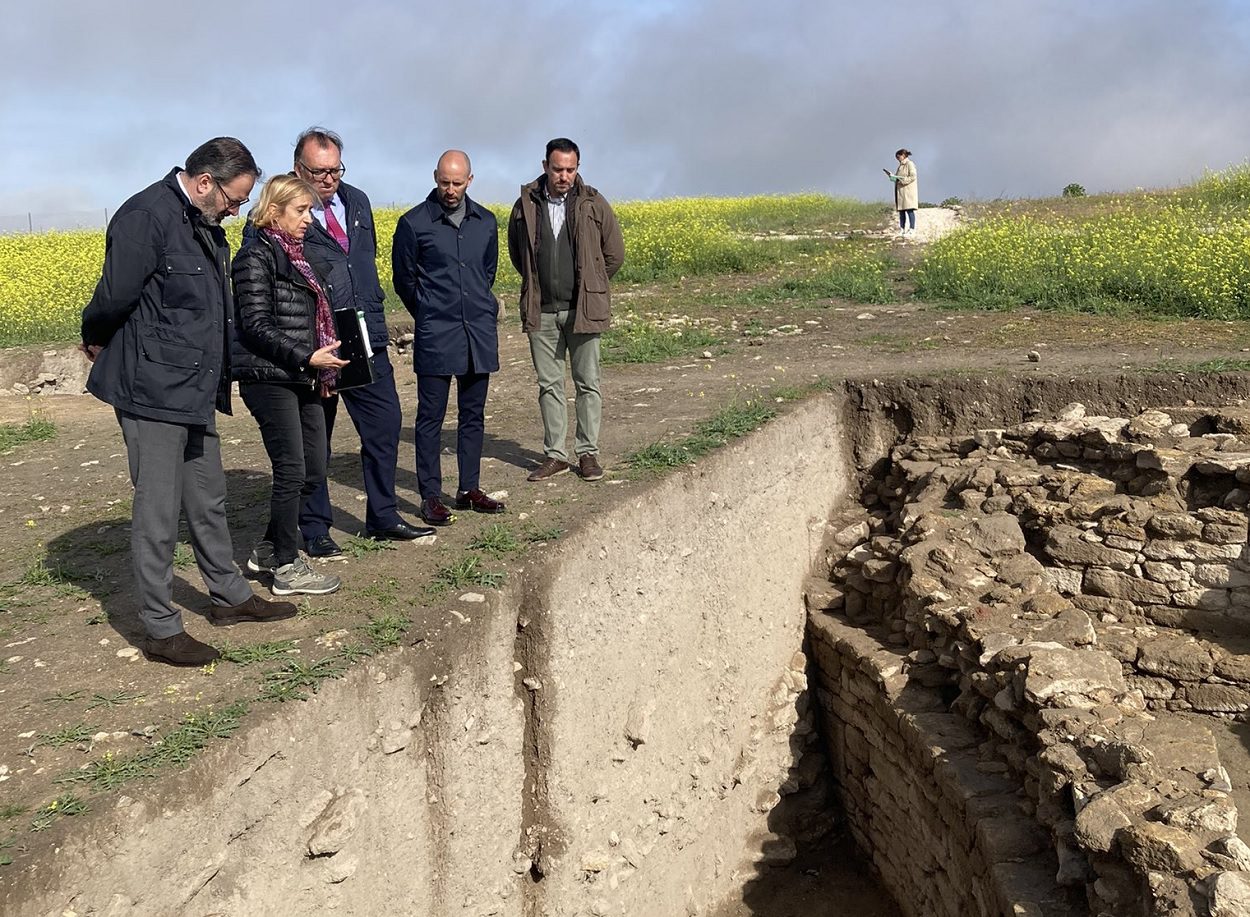
Archaeologists have discovered a Roman amphitheatre during excavations at the Roman city of Ategua, located in the municipality of Cordoba, Spain.

Early occupation of Ategua dates from the Chalcolithic period, with the emergence of a major settlement around the 8th and 7th centuries BC, consisting of orthogonal-plan dwellings defended by an outer wall.

- Advertisement -

According to the De Bello Hispaniensi, a Latin work continuing Julius Caesar’s commentaries, the city inhabitants sided with Pompey during Caesar’s civil war in the late Republic Era, resulting in the city being besieged by the Caesarian army in 45 BC.

Most of the current morphology of Ategua is from the Roman period, including several domus abandoned during the 2nd century AD, a civil building, bathhouses, and burials on the hillside.

In an announcement by Arturo Bernal, the Minister of Tourism, Culture and Sport, recent excavations at Ategua have uncovered the remains of a Roman amphitheatre, the second amphitheatre to be discovered within the city precinct.

The amphitheatre measures only 44 metres in diameter, with a central arena of around 27 metres, making it one of the smallest amphitheatres ever found from the Roman world.

- Advertisement -

Preliminary dating suggests that the amphitheatre was constructed during the 1st century AD, but only remained in use for around two centuries until it was abandoned.

The Ategua complex was declared a National Monument in 1982 and an Asset of Cultural Interest as an Archaeological Zone in 2004, and is part of the network of cultural enclaves of the Junta de Andalucía.

Header Image Credit : Culture Junta de Andalucía

- Advertisement -

Stay Updated: Follow us on iOS, Android, Google News, Facebook, Instagram, Twitter, Threads, TikTok, LinkedIn, and our newsletter

spot_img
Mark Milligan
Mark Milligan
Mark Milligan is a multi-award-winning journalist and the Managing Editor at HeritageDaily. His background is in archaeology and computer science, having written over 8,000 articles across several online publications. Mark is a member of the Association of British Science Writers (ABSW), the World Federation of Science Journalists, and in 2023 was the recipient of the British Citizen Award for Education, the BCA Medal of Honour, and the UK Prime Minister's Points of Light Award.
spot_img
spot_img

Mobile Application

spot_img

Related Articles

Mysterious heat-scarred shaft discovered at Hungarian castle

Archaeologists excavating the ruins of a medieval castle in western Hungary have uncovered an unusual stone-lined shaft showing evidence of intense heat, but its original purpose remains a mystery.

Bronze Age burial mound reveals weapons and ceremonial sceptre

Archaeologists in Azerbaijan have uncovered a roughly 3,600-year-old burial mound containing a bronze dagger, stone arrowheads and an unusual ceremonial staff head, providing new evidence of a high-ranking military elite in the South Caucasus during the Middle Bronze Age.

Rare Roman inscription marks lightning strike at Hadrian’s Villa

Archaeologists excavating Hadrian’s Villa at Tivoli have uncovered an unusual Roman inscription identifying a place believed to have been struck by lightning during the night.

Vast Iron Age mining complex discovered deep inside Hallstatt salt mine

Archaeologists exploring the prehistoric salt mine at Hallstatt in Austria have discovered an extensive network of previously unknown Iron Age mining chambers stretching for at least 300 metres beneath the mountain.

Uncovering 12,000 Years of human history at Saint-Laurent-Nouan

Archaeologists excavating a seven-hectare site in central France have uncovered evidence of human activity spanning some 12,000 years, including prehistoric hunting camps, Bronze Age settlements and a fortified community dating to the Carolingian period.

Gallic enclosure unearthed in France reveals new insights into ancient settlement and community life

Archaeologists excavating the site of a planned data centre complex in northern France have uncovered a rare palisaded settlement dating back around 2,800 years, revealing evidence of farming, food storage and domestic life during the Early Iron Age.

Rare 5,500-year-old trapezoidal burial monument discovered in Germany

Archaeologists in Germany have uncovered a rare 5,500-year-old trapezoidal burial monument containing human remains, adding to growing evidence of elaborate funerary traditions among Neolithic communities in Central Europe.

Rare 3,700-year-old Olmec offerings displayed in Mexico

Remarkably preserved rubber balls, wooden figures, jadeite axes and traces of cacao are among ancient Olmec offerings being brought together in Mexico for the first time in nearly four decades, revealing extraordinary details about religious practices dating back as far as 3,700 years.