
Date:

Archaeologists Discover Ornate Roman Domūs in Central Nîmes

Archaeologists conducting excavations in the French city of Nîmes have discovered the remains of two high status Roman domus (houses).

Nîmes became a Roman colony called Colonia Nemausus sometime before 28 BC, emerging as a major administrative centre to govern southern Gaul.

- Advertisement -

At its peak, the city had around 50,000–60,000 inhabitants and various civic and recreational buildings, such as a civil basilica, a curia, a gymnasium, amphitheatre, several temples, and perhaps a circus.

Excavations were conducted by the National Institute for Preventive Archaeological Research (Inrap) in the area of the Roman forum district.

Image Credit : Inrap

The team excavated two Roman domus, a typical high-status building occupied by the elite upper classes of Roman society. A domus normally has a vestibulum (entrance hall) that led into a large central hall: the atrium, with several cubicula (bedrooms), a dining room triclinium, a tablinum (living room or study), and a culina (Roman kitchen).

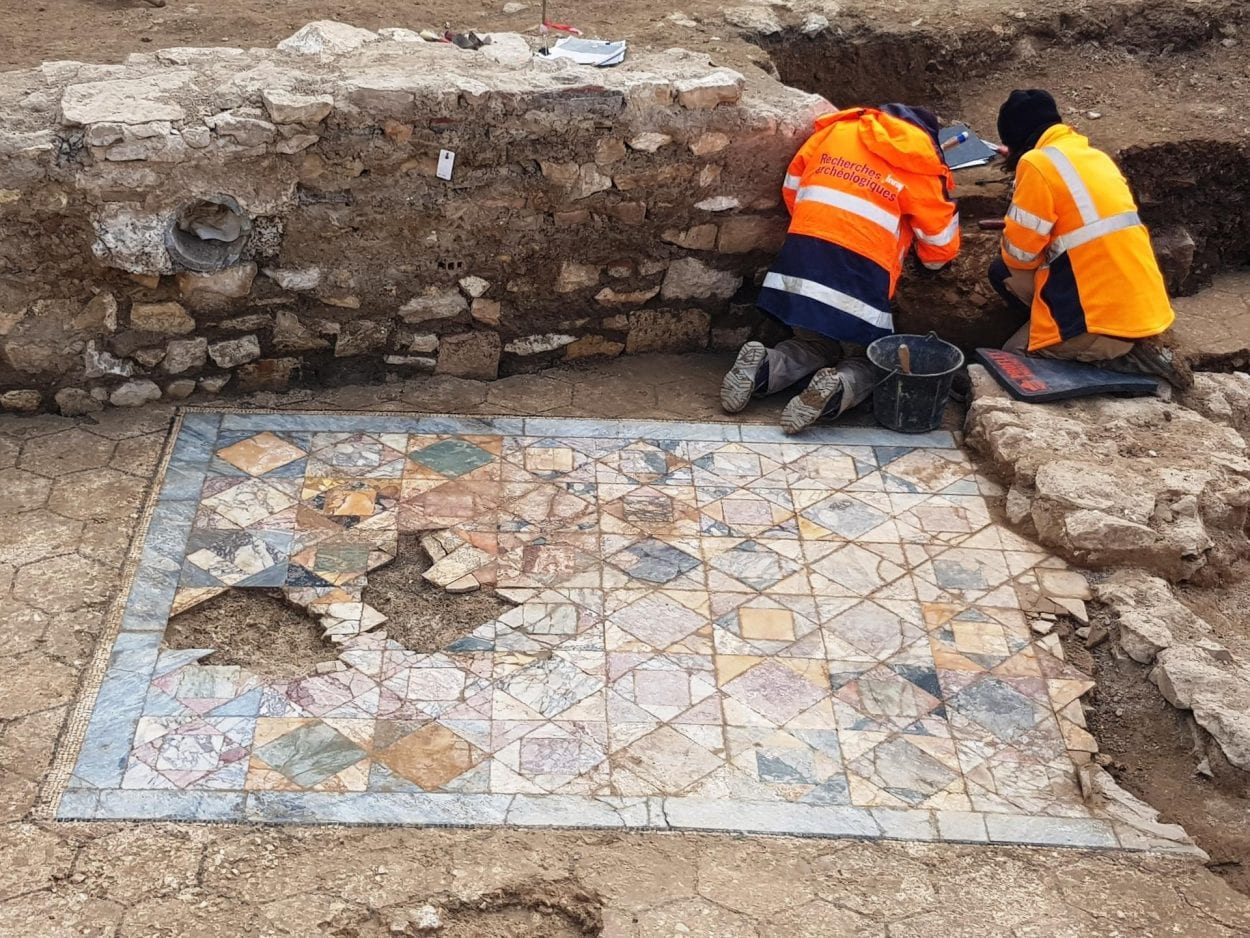
One of the domus excavated has a decorated checkerboard shaped marble floor called a sectile opus, an art technique where material is cut into pieces, polished, then trimmed further according to a chosen pattern. Unlike tessellated mosaics, where the placement of very small uniformly sized pieces forms a picture, opus sectile pieces are much larger and can be shaped to define large parts of the design.

- Advertisement -

Other discoveries include rooms heated by a hypocaust (a system of central heating where hot air circulates beneath a floor and through a series of pipes in the walls), courtyards containing horticultural pots, and a marble basin with a semi-circular apse.

Inrap

Header Image Credit : Inrap

- Advertisement -

Stay Updated: Follow us on iOS, Android, Google News, Facebook, Instagram, Twitter, Threads, TikTok, LinkedIn, and our newsletter

spot_img
Mark Milligan
Mark Milligan
Mark Milligan is a multi-award-winning journalist and the Managing Editor at HeritageDaily. His background is in archaeology and computer science, having written over 8,000 articles across several online publications. Mark is a member of the Association of British Science Writers (ABSW), the World Federation of Science Journalists, and in 2023 was the recipient of the British Citizen Award for Education, the BCA Medal of Honour, and the UK Prime Minister's Points of Light Award.
spot_img
spot_img

Mobile Application

spot_img

Related Articles

Structure for observing celestial movements predates the Chankillo observatory

The Peruvian Ministry of Culture has announced the discovery of an early Andean structure that predates the Chankillo solar observatory – long regarded as the earliest known observatory in the Americas.

2,300-year-old fortified city discovered in Kashkadarya

Archaeologists from the Samarkand Institute in Kashkadarya, southern Uzbekistan, have announced a major discovery: the remains of a fortified city dating back 2,300 years.

Jewel “worthy of a duke” unearthed at Castle Kolno

Researchers from the Institute of Archaeology at the University of Wroclaw have unearthed a jewel “worthy of a duke” at Castle Kolno, located between the Stobrawa and Budkowiczanka rivers in Stare Kolnie, Poland.

Preserved 3rd century mosaic excavated in Iznik

Excavations in the İznik district of northwestern Türkiye have uncovered a preserved mosaic floor dating from the 3rd century AD.

Time capsule of medieval artefacts unearthed in Łasztownia excavation

Archaeologists have unearthed a time capsule of medieval artefacts on the island of Łasztownia in Szczecin, Poland.

Mask reliefs unearthed during Castabala excavations

Archaeologists have unearthed a new series of mask reliefs during excavations in the ancient city of Castabala, Turkey.

Bronze Age proto-city discovered on the Kazakh Steppe

Archaeologists have discovered a late Bronze-Age proto-city on the Kazakh Steppe in north-eastern Kazakhstan.

Altamura Man resolves long-standing debate over Neanderthal evolution

A preserved Neanderthal fossil is providing new insights into how this ancient human species adapted to the cold climates of Ice Age Europe.