
Date:

New Study of Molar Size Regulation in Hominins

The molar size relationship is one of the peculiar characteristics of the different species of hominins and various theories have been proposed to account for this, as well as the differences in shape between the different kinds of teeth (incisors, canines, premolars and molars).

The latest theory, called the inhibitory cascade model, arose out of experiments with mice embryos, and in 2016 it was applied theoretically to fossil hominins, with satisfactory results.

- Advertisement -

It appeared that all hominins satisfy the inhibitory cascade model. In a paper by the Dental Anthropology Group at the Centro Nacional de Investigación sobre la evolución Humana (CENIEH), published recently in the Journal of Anatomy, this model was tested on the molar sample from the individuals identified at the Sima de los Huesos site, situated in the Sierra de Atapuerca (Burgos).

The results match the model generated in mice extraordinarily well, thus confirming the theory’s utility once more. “Nevertheless, our conclusions have brought out an anomaly in the model, when it is applied to the oldest species of the genus Homo”, explains José María Bermúdez de Castro, Paleobiology Program Coordinator at the CENIEH and lead author of this work.

Increasing and decreasing patterns
In the genera Ardipithecus, Australopithecus and Paranthropus, as well as in Homo habilis, the size pattern is increasing and fits the premises of the inhibitory cascade model perfectly. The same thing happens in Homo sapiens, except that the pattern is decreasing, with the first molar larger than the second, which in turn is bigger than the third one (wisdom tooth).

Application of the inhibitory cascade model had led to the assumption that the switch from increasing to decreasing pattern would have arisen a little under two million years ago, perhaps coinciding with the transition between the genera Australopithecus and Homo. “However, in our work we noticed that this change could have required at least a million years to take place”, states Bermúdez de Castro.

- Advertisement -

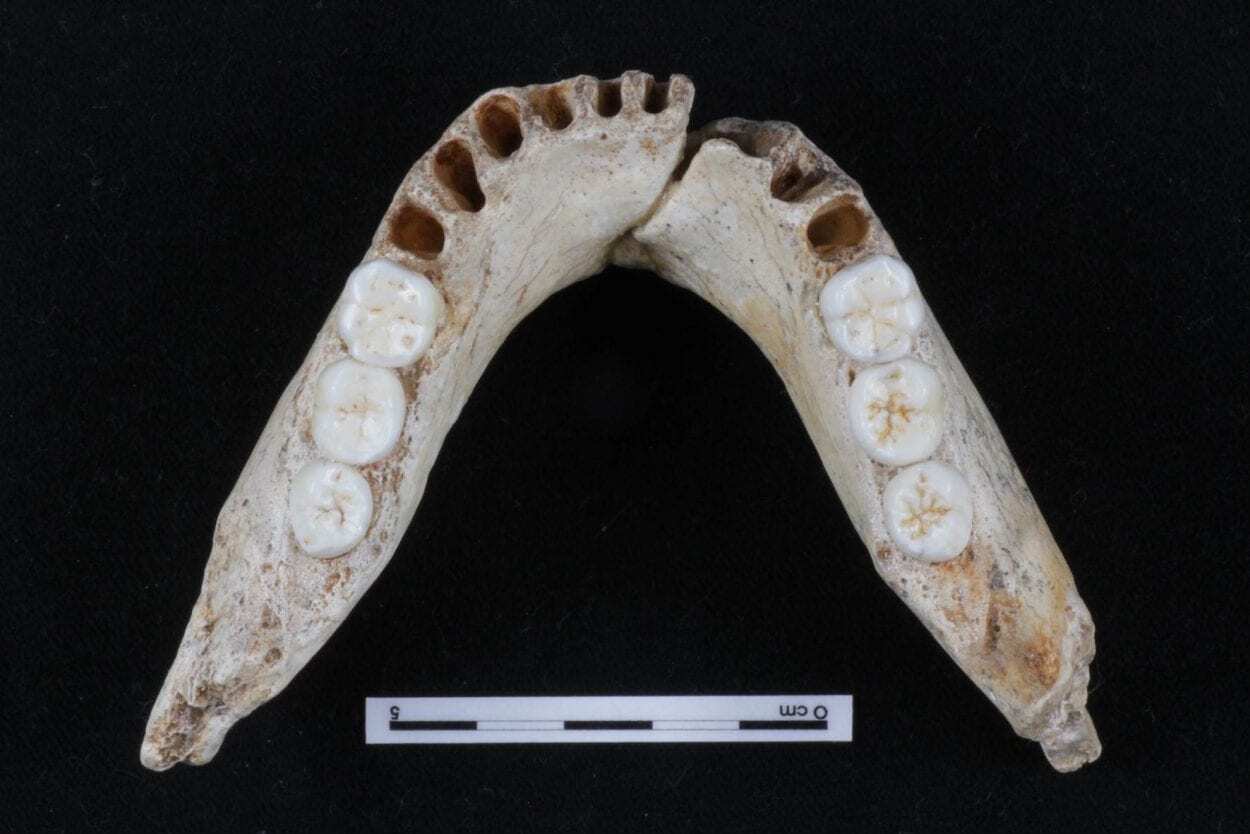
The hominins from the Sima de los Huesos, which are around 430,000 years old, are a good example of that transition, whereas most specimens of Homo ergaster, Homo erectus, Homo antecessor and Homo heidelbergensis, as well as other species, do not fit the inhibitory cascade model. “Our idea is to continue our research to determine which genetic mechanisms lie behind this anomaly in the model”, says Bermúdez de Castro.

CENIEH

Header Image – Mandible AT-1 from Sima de los Huesos – Image Credit : Mario Modesto

- Advertisement -

Stay Updated: Follow us on iOS, Android, Google News, Facebook, Instagram, Twitter, Threads, TikTok, LinkedIn, and our newsletter

spot_img
Mark Milligan
Mark Milligan
Mark Milligan is a multi-award-winning journalist and the Managing Editor at HeritageDaily. His background is in archaeology and computer science, having written over 8,000 articles across several online publications. Mark is a member of the Association of British Science Writers (ABSW), the World Federation of Science Journalists, and in 2023 was the recipient of the British Citizen Award for Education, the BCA Medal of Honour, and the UK Prime Minister's Points of Light Award.
spot_img
spot_img

Mobile Application

spot_img

Related Articles

Bronze hand cannon offers rare evidence of early Korean firearms

Archaeologists in South Korea have authenticated a bronze hand cannon dating to the late Goryeo or early Joseon period, providing rare evidence for the early development of firearms on the Korean Peninsula.

Evidence of 15th-century fortified windmill unearthed in Poland

More than 300 archaeological features discovered on Windmill Hill in Puck could include rare fortifications linked to the Thirteen Years’ War

10,500-year-old wooden structures discovered beneath German lake

Rare Mesolithic timbers found 20 metres underwater could reveal previously unknown construction by Stone Age hunter-gatherers

Ancient auroch skull found impaled on wooden stake

Unique discovery of an aurochs skull impaled on a wooden stake may be linked to one of northern Germany’s oldest known burials

Rare medieval heating system uncovered beneath former Swiss monastery

Archaeologists in Basel have uncovered an exceptionally rare medieval heating system hidden beneath the remains of a former monastery for centuries.

Archaeologists to investigate possible Inca ceremonial geoglyph in the Andes

Archaeologists are preparing to investigate a possible Inca ceremonial geoglyph discovered at an altitude of approximately 3,000 metres in the Andes of Argentina.

2,100-year-old luxury tableware discovered in ancient shipwreck off Türkiye

Underwater archaeologists have discovered thousands of luxury ceramic vessels in a 2,100-year-old shipwreck off the Mediterranean coast of Türkiye.

Archaeologists uncover extensive Bronze Age settlement on Hungary’s Somló Hill

Archaeologists from the Hungarian National Museum have uncovered evidence of an extensive Bronze Age settlement on Somló Hill, revealing a sophisticated community that flourished more than 3,000 years ago.


