
Date:

Amber specimens reveal origin of long mouthpart of scorpionflies

Mesopsychoid scorpionflies are peculiar Mesozoic insects with a distinctly elongate mouthpart and are considered to be a critical group of pollinators prior to the rise of angiosperms.

A new genus found from 99-million-year-old Burmese amber reveals the origin of scorpionflies’ long mouthpart. This discovery was reported in Science Advances on March 4. Aneuretopsychidae is a family of mecopteran insects with a long siphonate mouthpart. In particular, this family is the key to understanding both the early evolution of highly modified mouthparts in Mesopsychoidea and arguably the origin of fleas.

- Advertisement -

Previously, all known aneuretopsychids were from compression fossils, and the detailed structure of their mouthparts was still unclear.

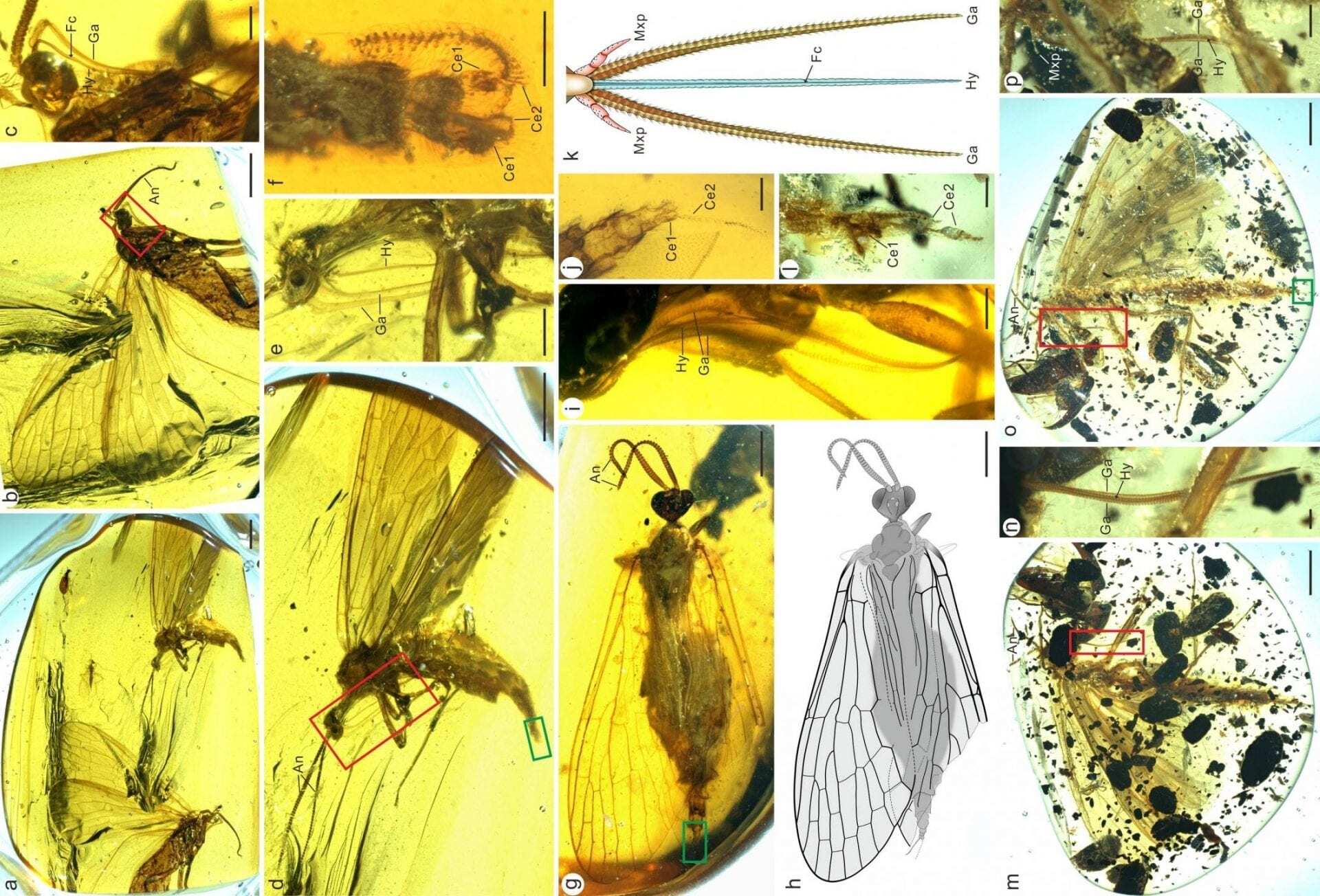
Now, however, an international research group led by Prof. WANG Bo from the Nanjing Institute of Geology and Palaeontology of the Chinese Academy of Sciences (NIGPAS) has found a new genus, including two new aneuretopsychid species from early Late Cretaceous (99 million years ago) Burmese amber, which reveals new anatomically significant details of the elongate mouthpart elements.

The aneuretopsychid mouthpart in the new amber fossils consists of one pair of galeae and one unpaired central hypopharynx. During feeding, the galeae would come together temporarily and enclose the hypopharynx thus forming a functional tube.

The structures of the new three-dimensionally preserved fossils thus reveal that the aneuretopsychid mouthpart is not labial but maxillary in origin.

- Advertisement -

The phylogenetic results based on 38 taxa and 54 discrete characters support the monophyly of Mesopsychoidea and demonstrate that an elongate mouthpart is one of its key synapomorphies, challenging the view that the long-proboscid condition independently originated two or three times in this clade.

In addition, the mouthpart of Mesopsychoidea differs structurally from the highly modified piercing mouthparts of Siphonaptera. So, neither Aneuretopsychidae nor Mesopsychoidea is a sister group to Siphonaptera.

In the Burmese amber forest, at least five families of long-proboscid insects have been discovered, further revealing the variety and complexity of mid-Cretaceous pollinating insects.

This study provides new insights into the separate origin of the long mouthpart of Mesopsychoidea and fleas, and the evolution of Cretaceous pollinating insects.

CHINESE ACADEMY OF SCIENCES HEADQUARTERS

Header Image – These are Aneuretopsychidae from Late Cretaceous Burmese amber. Credit : NIGPAS

- Advertisement -

Stay Updated: Follow us on iOS, Android, Google News, Facebook, Instagram, Twitter, Threads, TikTok, LinkedIn, and our newsletter

spot_img
Mark Milligan
Mark Milligan
Mark Milligan is a multi-award-winning journalist and the Managing Editor at HeritageDaily. His background is in archaeology and computer science, having written over 8,000 articles across several online publications. Mark is a member of the Association of British Science Writers (ABSW), the World Federation of Science Journalists, and in 2023 was the recipient of the British Citizen Award for Education, the BCA Medal of Honour, and the UK Prime Minister's Points of Light Award.
spot_img
spot_img

Mobile Application

spot_img

Related Articles

Underwater archaeologists discover seal ring depicting the Lighthouse of Alexandria

Underwater archaeologists excavating the Eastern Harbour of Alexandria have discovered a bronze seal ring depicting the Lighthouse of Alexandria.

Rare early medieval boat burial discovered in Poland

Archaeologists from the Institute of Archaeology and Ethnology of the Polish Academy of Sciences (IAE PAN) have discovered a rare early medieval boat burial during excavations at Chodlik in eastern Poland.

Melting ice reveals 6,000-year-old artefacts in Norwegian mountains

Melting ice in Norway’s highest mountains is revealing archaeological remains dating back as far as 6,000 years, providing new insights into prehistoric activity at high elevations.

Ice Age spearheads reveal how early Americans adapted to new landscapes

An analysis of around 500 stone spearheads has revealed how Ice Age hunter-gatherers adapted to unfamiliar landscapes in the Tennessee River Valley.

Pre-Hispanic frog pendants shed light on ancient Maya trade networks

Archaeologists in Mexico are studying a collection of pre-Hispanic shell pendants that could provide new insights into ancient Maya trade networks, ritual practices and technological knowledge.

Bronze hand cannon offers rare evidence of early Korean firearms

Archaeologists in South Korea have authenticated a bronze hand cannon dating to the late Goryeo or early Joseon period, providing rare evidence for the early development of firearms on the Korean Peninsula.

Evidence of 15th-century fortified windmill unearthed in Poland

More than 300 archaeological features discovered on Windmill Hill in Puck could include rare fortifications linked to the Thirteen Years’ War

10,500-year-old wooden structures discovered beneath German lake

Rare Mesolithic timbers found 20 metres underwater could reveal previously unknown construction by Stone Age hunter-gatherers


