
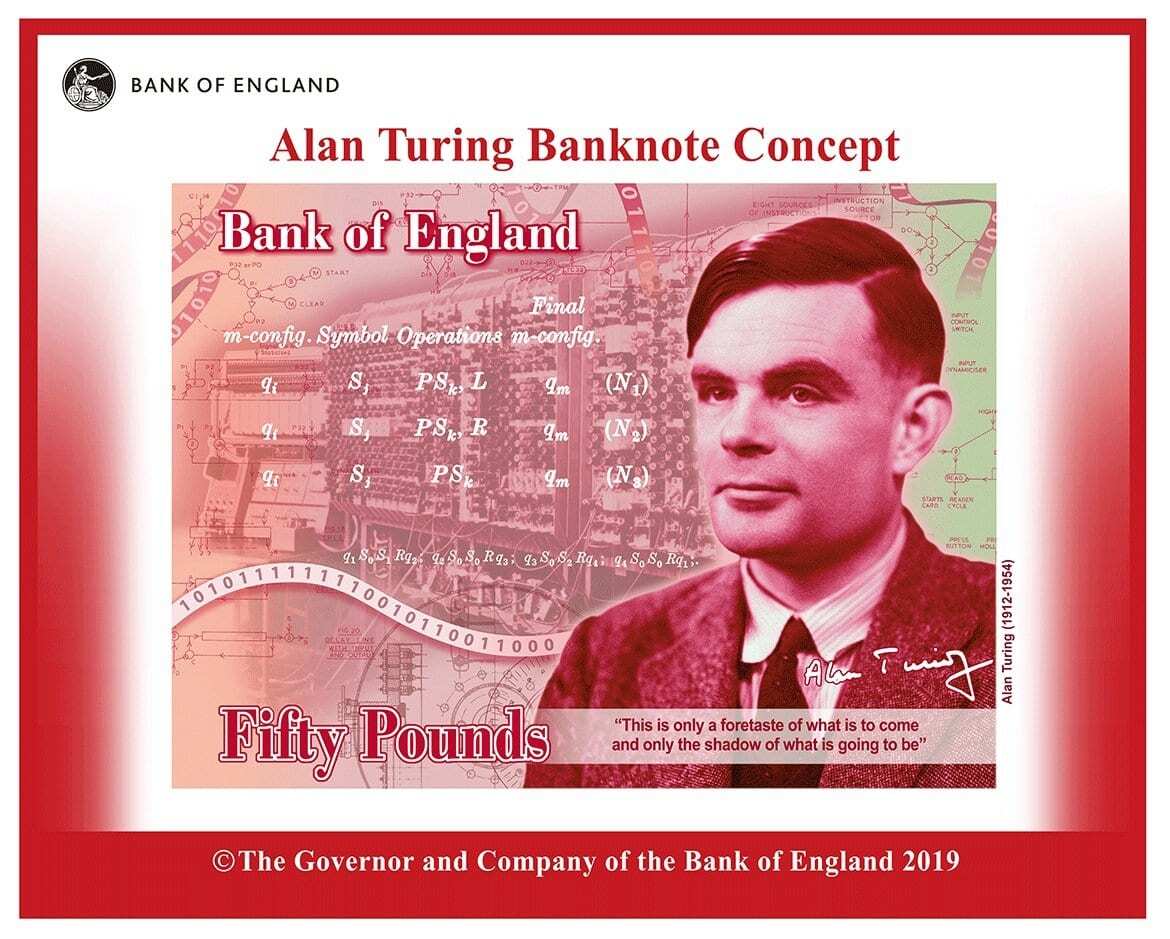
The Bank of England Governor, Mark Carney, announced that Alan Turing will appear on the new £50 polymer note that is expected to enter circulation by the end of 2021.
Making the announcement at the Science and Industry Museum in Manchester, the Governor also revealed the imagery depicting Alan Turing and his work that will be used for the reverse of the note.
Alan Turing was chosen following the Bank’s character selection process including advice from scientific experts…..The Bank received a total of 227,299 nominations, covering 989 eligible characters.
Mark Carney, Governor of the Bank of England, commented: “Alan Turing was an outstanding mathematician whose work has had an enormous impact on how we live today. As the father of computer science and artificial intelligence, as well as war hero, Alan Turing’s contributions were far ranging and path breaking. Turing is a giant on whose shoulders so many now stand.”
Alan Turing provided the theoretical underpinnings for the modern computer. While best known for his work devising code-breaking machines during WWII, Turing played a pivotal role in the development of early computers first at the National Physical Laboratory and later at the University of Manchester. He set the foundations for work on artificial intelligence by considering the question of whether machines could think.
Turing was convicted of gross indecency because he was homosexual and was given a choice between imprisonment or probation. His probation would be conditional on his agreement to undergo forced hormonal physical changes designed to reduce libido by a series of injections. Turing’s conviction led to the removal of his security clearance and barred him from continuing with his cryptographic consultancy for the Government Communications Headquarters (GCHQ). On 8 June 1954, Turing’s housekeeper found him dead at the age of 41 with Cyanide poisoning being established as the cause of death.
In 2009, British programmer John Graham-Cumming started a petition urging the British government to apologise for Turing’s prosecution as a homosexual.
In 2009, Gordon Brown made an official posthumous apology for Turing’s treatment and Turing received a royal pardon for the conviction in December 2013. In 2017, the ‘Alan Turing Law’, was passed that posthumously pardoned men cautioned or convicted under historical legislation that outlawed homosexual acts.
The shortlisted figures for the £50 note included: Mary Anning, Paul Dirac, Rosalind Franklin, William Herschel and Caroline Herschel, Dorothy Hodgkin, Ada Lovelace and Charles Babbage, Stephen Hawking, James Clerk Maxwell, Srinivasa Ramanujan, Ernest Rutherford, Frederick Sanger and Alan Turing.
Header Image Credit : Bank of England




