
Dinosaurs were unaffected by long-term climate changes and flourished before their sudden demise by asteroid strike.
Scientists largely agree that an asteroid impact, possibly coupled with intense volcanic activity, wiped out the dinosaurs at the end of the Cretaceous period 66 million years ago.
However, there is debate about whether dinosaurs were flourishing before this, or whether they had been in decline due to long-term changes in climate over millions of years.
Previously, researchers used the fossil record and some mathematical predictions to suggest dinosaurs may have already been in decline, with the number and diversity of species falling before the asteroid impact.
Now, in a new analysis that models the changing environment and dinosaur species distribution in North America, researchers from Imperial College London, University College London and University of Bristol have shown that dinosaurs were likely not in decline before the meteorite.
Lead researcher Alessandro Chiarenza, a PhD student in the Department of Earth Science and Engineering at Imperial, said: “Dinosaurs were likely not doomed to extinction until the end of the Cretaceous, when the asteroid hit, declaring the end of their reign and leaving the planet to animals like mammals, lizards and a minor group of surviving dinosaurs: birds.
“The results of our study suggest that dinosaurs as a whole were adaptable animals, capable of coping with the environmental changes and climatic fluctuations that happened during the last few million years of the Late Cretaceous. Climate change over prolonged time scales did not cause a long-term decline of dinosaurs through the last stages of this period.”
The study, published today in Nature Communications, shows how the changing conditions for fossilisation means previous analyses have underestimated the number of species at the end of the Cretaceous.
The team focused their study on North America, where many Late Cretaceous dinosaurs are preserved, such as Tyrannosaurus rex and Triceratops. During this period, the continent was split in two by a large inland sea.
In the western half there was a steady supply of sediment from the newly forming Rocky Mountains, which created perfect conditions for fossilising dinosaurs once they died. The eastern half of the continent was instead characterised by conditions far less suitable for fossilisation.
This means that far more dinosaur fossils are found in the western half, and it is this fossil record that is often used to suggest dinosaurs were in decline for the few million years before the asteroid strike.
Co-author Dr Philip Mannion, from University College London, commented: “Most of what we know about Late Cretaceous North American dinosaurs comes from an area smaller than one-third of the present-day continent, and yet we know that dinosaurs roamed all across North America, from Alaska to New Jersey and down to Mexico.”
Instead of using this known record exclusively, the team employed ‘ecological niche modelling’. This approach models which environmental conditions, such as temperature and rainfall, each species needs to survive.
The team then mapped where these conditions would occur both across the continent and over time. This allowed them to create a picture of where groups of dinosaur species could survive as conditions changed, rather than just where their fossils had been found.
The team found habitats that could support a range of dinosaur groups were actually more widespread at the end of the Cretaceous, but that these were in areas less likely to preserve fossils.
Furthermore, these potentially dinosaur-rich areas were smaller wherever they occurred, again reducing the likelihood of finding a fossil from each of these areas.
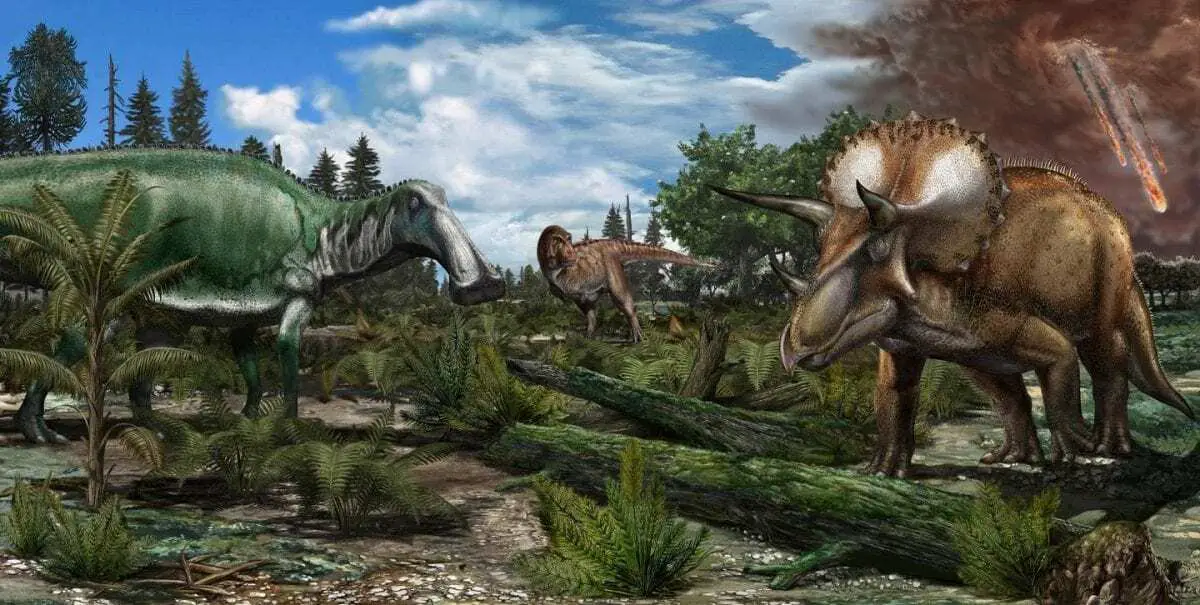
Header Image – Reconstruction of a late Maastrichtian (~66 million years ago) palaeoenvironment in North America, where a floodplain is roamed by dinosaurs like Tyrannosaurus rex, Edmontosaurus and Triceratops. Credit : Davide Bonadonna




