
Date:

Grand armoury of Roman Legion unveiled by AMU Archaeologists

Dr. Elena Klenina and Dr Andrzej B. Biernacki worked on the site of a former legionary camp belonging to the soldiers of the First Italian Legion.

Last year, they determined that it a large structure was an arsenal – armoury, which this year’s excavations have made it possible to learn more about the subsequent history of the area.

- Advertisement -

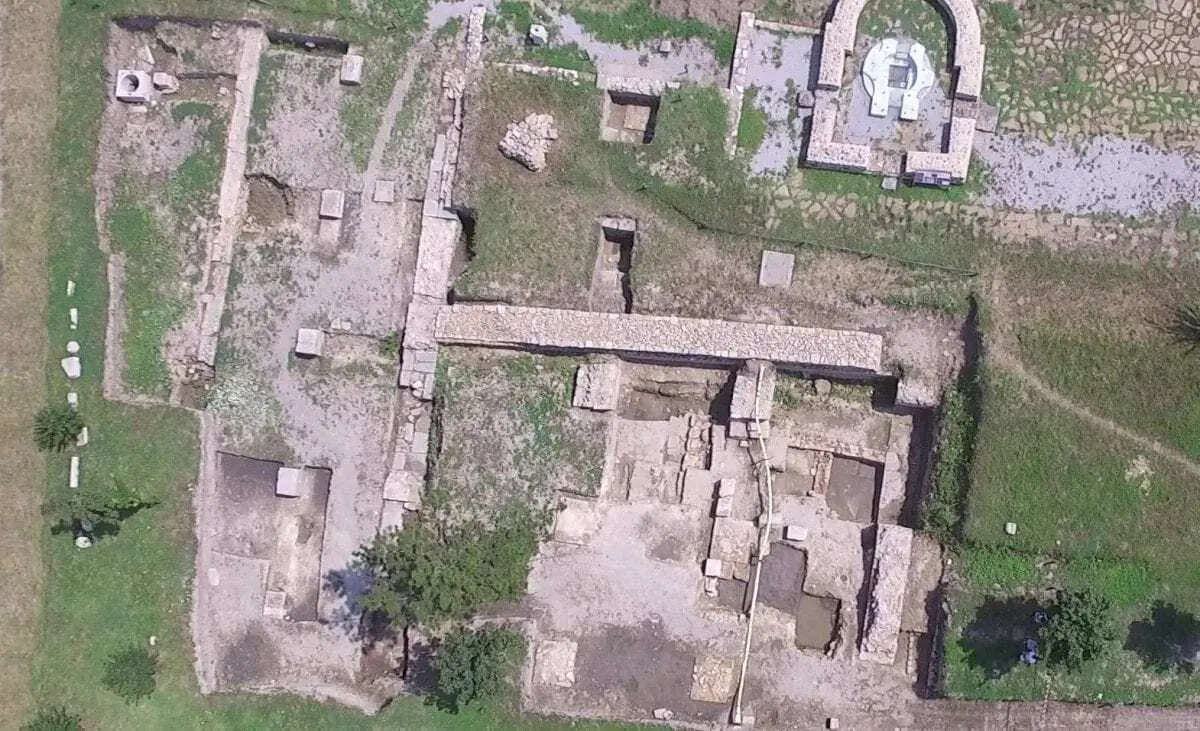
The structure built by the Roman soldiers was huge, it occupied about 1800 square meters and was erected in the first half of the second century. Consisting of six monumental rectangular pillars arranged in two rows they were made of precisely matched, hexagonal blocks of limestone.

In the opinion of the researchers, it is one of the most monumental buildings ever discovered in a legion camp along the Danube River.

Credit : Andrzej Biernacki

“At the end of the 4th century construction was rebuilt and then it also changed its function: instead of military installations, it started to store grain and other food necessary to keep the legion stationed here”– said Dr Klenina, head of the International Interdisciplinary Archeological Expedition “Novae” of Adam Mickiewicz University in Poznań.

Excavations have found numerous artefacts and over one hundred bronze coins that were minted in the first quarter of the fourth century AD and a dozen or so coins dating from the reign of Emperor Licinius I (308-324 AD).

- Advertisement -

Also uncovered by archaeologists is the limestone head sculpture depicting a syncretic deity – Dionysus-Sabazios. According to Dr. Biernacki,  the artefact may indicate the arrival of settlers from very distant regions. From the artistic side, the sculpture exhibits distinctly middle-eastern influences with elements of the Greek art of the archaic period of the 1st or 2nd century AD.

Adam Mickiewicz University, Poznan, Poland

Header Image Credit : Andrzej Biernacki

- Advertisement -

Stay Updated: Follow us on iOS, Android, Google News, Facebook, Instagram, Twitter, Threads, TikTok, LinkedIn, and our newsletter

spot_img
Mark Milligan
Mark Milligan
Mark Milligan is a multi-award-winning journalist and the Managing Editor at HeritageDaily. His background is in archaeology and computer science, having written over 8,000 articles across several online publications. Mark is a member of the Association of British Science Writers (ABSW), the World Federation of Science Journalists, and in 2023 was the recipient of the British Citizen Award for Education, the BCA Medal of Honour, and the UK Prime Minister's Points of Light Award.
spot_img
spot_img

Mobile Application

spot_img

Related Articles

Study reveals declining inequality in Bronze Age city of Mohenjo-daro

A new study suggests that economic inequality declined as the Bronze Age city of Mohenjo-daro developed, challenging the assumption that urbanisation inevitably led to greater social inequality.

Ancient cave paintings reveal thousands of years of religious activity in China

A new study of ancient cave paintings in the Altai Mountains of north-western China has revealed evidence of artistic and religious activity spanning thousands of years.

Church appeals for help deciphering mysterious labyrinth

The Churches Conservation Trust is appealing to the public to help unravel the mystery of a labyrinth at St Mary’s Church in Itchen Stoke, Hampshire, where unusual patterns of sunlight have raised questions about its original purpose.

Geophysical survey reveals possible hidden chambers in Italy’s “Cave of Venuses”

A geophysical survey of the Grotta delle Veneri (Cave of Venuses) in southern Italy has identified possible hidden cavities that may connect to the existing prehistoric cave system.

184 cuneiform tablets discovered in Hittite royal archive

Archaeologists excavating the ancient city of Kayalıpınar in Türkiye have discovered a Hittite royal archive containing 184 cuneiform tablets and fragments.

3,000-year-old bronze sword discovered in submerged settlement in Italy

Underwater archaeologists have discovered a 3,000-year-old bronze sword during excavations of a submerged Bronze Age settlement in Lake Mezzano, Italy.

Underwater archaeologists discover seal ring depicting the Lighthouse of Alexandria

Underwater archaeologists excavating the Eastern Harbour of Alexandria have discovered a bronze seal ring depicting the Lighthouse of Alexandria.

Rare early medieval boat burial discovered in Poland

Archaeologists from the Institute of Archaeology and Ethnology of the Polish Academy of Sciences (IAE PAN) have discovered a rare early medieval boat burial during excavations at Chodlik in eastern Poland.


