
New research at Lund University in Sweden can now show what Stone Age people actually ate in southern Scandinavia 10 000 years ago. The importance of fish in the diet has proven to be greater than expected. So, if you want to follow a Paleo diet – you should quite simply eat a lot of fish.
Osteologists Adam Boethius and Torbjörn Ahlström have studied the importance of various protein sources in the human diet across three millennia, from around 10 500 to 7 500 years ago. This was done by combining chemical analyses of human bones from over 80 individuals, whose skeletons are the oldest discovered in Scandinavia, with osteological analyses of animal bone material.
The study is part of a doctoral thesis that has used various methods to examine the significance of fishing for the people who settled in southern Scandinavia during the millenniums after the ice from the last ice age had melted away.
“At the Norje Sunnansund settlement, outside Sölvesborg in Sweden, you can see that just over half of the protein intake has come from fish, ten per cent from seals, and around 37 per cent from land mammals, such as wild boar and red deer, and scarcely three per cent from plants such as mushrooms, berries and nuts”, says Adam Boethius. “On the island of Gotland, which did not have any land mammals apart from hares, the percentage of fish in total protein consumption was even higher at just under 60 per cent. Here, seals have replaced the land mammals and account for almost 40 per cent of the protein intake, whereas hares and vegetables account for a negligible proportion”, he continues.
The study shows that fish was also a highly significant protein source on the Swedish west coast, but it seems that seals and dolphins were more important for the first pioneer settlers, and that after an initial focus on hunting aquatic mammals, fishing increased as a protein source.
Previously, the researchers believed that humans at that time had been far more involved in mobile groups of big-game hunters whose main protein intake thus should have come from herbivores such as red deer, aurochs and elk, and consequently the role of fishing was not recognised.
“The dominance of fishing is a discovery that has an enormous significance for our understanding of how people lived. Fishing is relatively stationary compared to the hunting of land mammals, which provides clear indications that settlements appeared in Scandinavia much earlier than researchers previously believed”, says Adam Boethius.
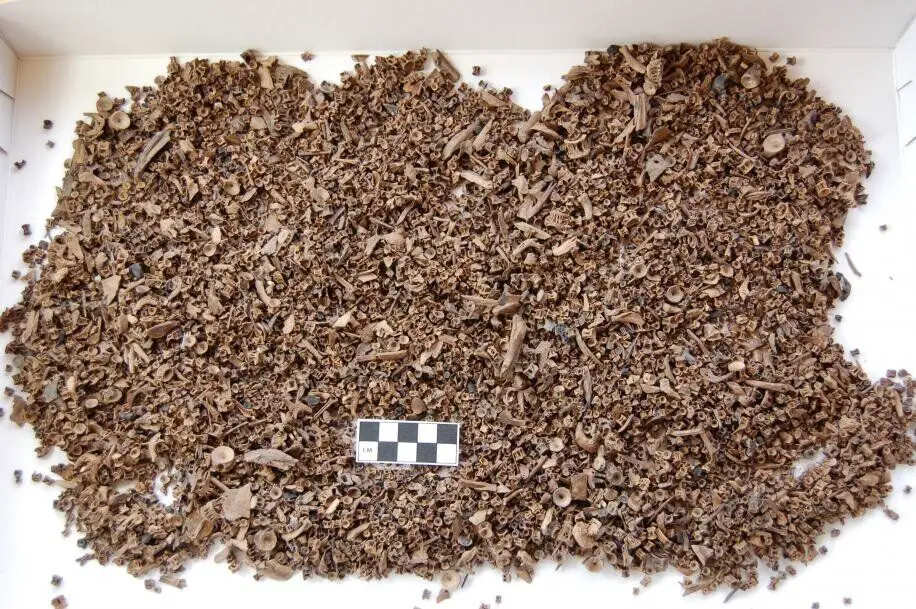
The fact that researchers have often missed the significance of fishing is probably because they have not actively looked for the traces that exist. Fish bones are much smaller and more brittle than the bones of mammals, and are not as well preserved. In an excavation, fish bones are almost impossible to detect while in the ground and fine-mesh sieves must be used to find them.
The researchers found that fishing was surprisingly dominant at all the sites investigated. In the study, the individuals were divided up into those who lived in marine environments and those who lived in freshwater environments. In freshwater environments the protein intake is dominated by different types of carp fish species, perch, pike and burbot. Cod dominates in marine environments, but herring, saithe, haddock, spiny dogfish and plaice are also important species. On the other hand, migratory fish, such as eel and salmon, did not account for a large proportion of food intake.
“What’s interesting is that the values from the people in the various groups do not overlap. This indicates that the groups had limited mobility and mostly lived on a local diet”, says Adam Boethius.
The results also show that people become more dependent on fishing over time and that certain areas were probably more densely populated than previously thought.
“Even though fish can be caught in most lakes, there are certain places that are especially favourable. It is at these sites that the people begin to settle, creating their own territory. This probably entailed violent clashes between different groups of people, which is often reflected in the various violence-related injuries to the skeletons we find in archaeological excavations.”
“The increasing importance of fish means that the land was divided up. For groups that continued to be mobile this meant the creation of no-go zones, that these groups were forced to skirt around in order to find food. In the long term this leads to increasing “costs” for foraging strategies and an increasing tendency to settle is to be expected, as it becomes the best alternative”, concludes Adam Boethius.
More on the scientific model behind the findings:
Stable isotopes of the elements carbon and nitrogen are present in all parts of the human body, including the skeleton, and reflect a person’s diet. By analysing these isotope signals for possible food sources and relating them to the values shown in human bone material, it is possible to deduce the diet the person in question has lived on.
In this study, the bones of the 82 oldest humans in Sweden and Denmark were used. The bones were sampled and the collagen extracted and analysed in a mass spectrometer in order to obtain the stable isotope values from carbon and nitrogen. Using Bayesian statistical modelling, these values were related to corresponding values for animals and plants, thereby providing information on the general human diet in the first millenniums after the ice receded from southern Scandinavia.
To gain an insight into how diets vary between different places, the study also included an analysis of animal bone material from four different early Mesolithic settlements, which was put in a framework consisting of information from ethnographic hunter-gatherer-fisher populations at corresponding latitudes around the world. The results show that the water’s resources dominated protein intake in both marine and fresh water environments. The results also show there are considerable local variations in the preferred species, but that fishing has been highly significant for human subsistence, and the significance of fishing appears to constantly increase.
Header Image: Fish bones (Photo: Blekinge Museum)




