
Date:

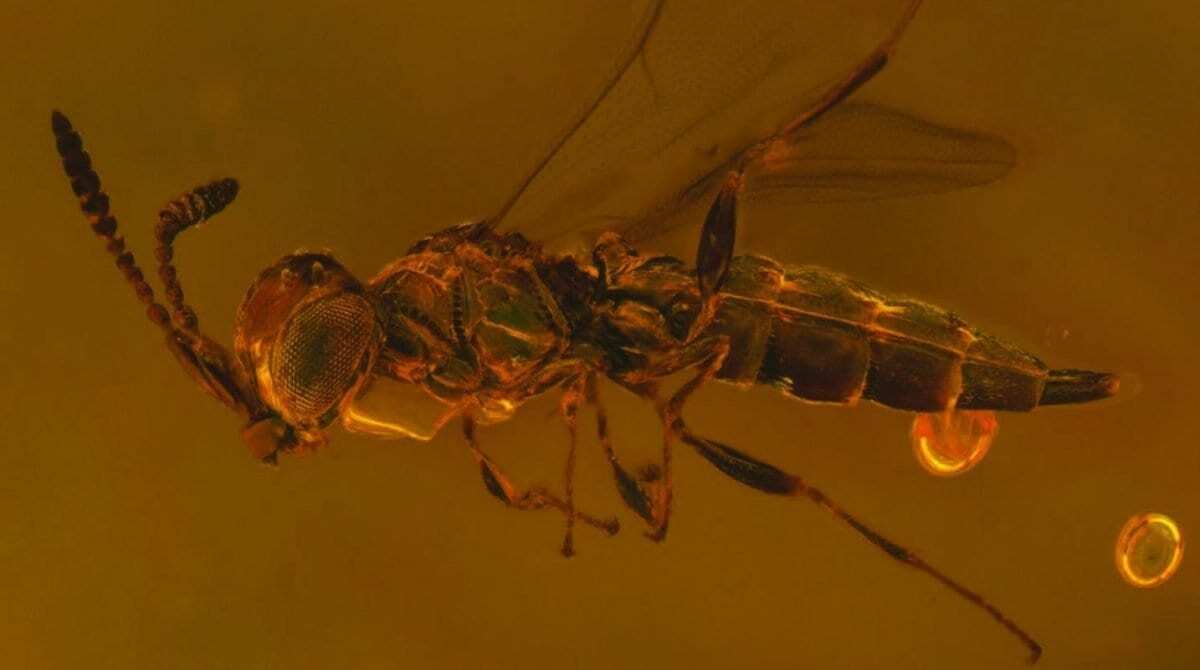
The ‘Star dust’ wasp is a new extinct species named after David Bowie’s alter ego

During her study on fossil insects of the order Hymenoptera at China’s Capitol Normal University, student Longfeng Li visited the Smithsonian National Museum of Natural History, Washington, carrying two unidentified wasp specimens that were exceptionally well-preserved in Burmese amber.

This type of fossilized tree resin is known for the quality of the fossil specimens which can be preserved inside it. Being 100 million years old, they provide an incredible view into the past.

- Advertisement -

The subsequent analysis of the specimens revealed that both represent species new to science. Furthermore, one of the wasps showed such amazing similarities to a modern group of wasps that it was placed in a currently existing genus, Archaeoteleia which has long been considered as an ancient lineage. The species are described in a study published in the open access Journal of Hymenoptera Research.

However, Archaeoteleia has changed since the times when the ancient wasp got stuck on fresh tree resin. The authors note that “a novice might not recognize the characters that unite the fossil with extant species”. For instance, the modern wasp species of the genus show visibly longer antennal segments and a different number of teeth on the mandible when compared to the fossil. In turn, the description of the new extinct species enhances the knowledge about living species by highlighting anatomical structures shared by all species within the genus.

This fossil wasp with living relatives received quite a curious name, Archaeoteleia astropulvis. The species name, astropulvis, translates from Latin to ‘star dust’. The discoverers chose the name to refer to both “the ancient source of the atoms that form our planet and its inhabitants”, as well as to commemorate the late David Bowie’s alter ego – Ziggy Stardust.

Unlike the Star dust wasp, the second new species belongs to a genus (Proteroscelio) known exclusively from Cretaceous fossils. Likewise, it is a tiny insect, measuring less than 2mm in length. It also plays an important role in taxonomy by expanding the anatomical diversity known from this extinct genus.

- Advertisement -

The authors conclude that their discovery, especially the Star dust wasp and its placement in an extant genus, where it is the only fossil species, “exemplifies the importance of understanding the extant fauna of a taxon to interpret fossils”.

“Such union of fossil and extant morphologies is especially illuminating and requires examination of both kinds of specimens,” they add.

PENSOFT PUBLISHERS

- Advertisement -

Stay Updated: Follow us on iOS, Android, Google News, Facebook, Instagram, Twitter, Threads, TikTok, LinkedIn, and our newsletter

spot_img
Mark Milligan
Mark Milligan
Mark Milligan is a multi-award-winning journalist and the Managing Editor at HeritageDaily. His background is in archaeology and computer science, having written over 8,000 articles across several online publications. Mark is a member of the Association of British Science Writers (ABSW), the World Federation of Science Journalists, and in 2023 was the recipient of the British Citizen Award for Education, the BCA Medal of Honour, and the UK Prime Minister's Points of Light Award.
spot_img
spot_img

Mobile Application

spot_img

Related Articles

Geophysical survey reveals possible hidden chambers in Italy’s “Cave of Venuses”

A geophysical survey of the Grotta delle Veneri (Cave of Venuses) in southern Italy has identified possible hidden cavities that may connect to the existing prehistoric cave system.

184 cuneiform tablets discovered in Hittite royal archive

Archaeologists excavating the ancient city of Kayalıpınar in Türkiye have discovered a Hittite royal archive containing 184 cuneiform tablets and fragments.

3,000-year-old bronze sword discovered in submerged settlement in Italy

Underwater archaeologists have discovered a 3,000-year-old bronze sword during excavations of a submerged Bronze Age settlement in Lake Mezzano, Italy.

Underwater archaeologists discover seal ring depicting the Lighthouse of Alexandria

Underwater archaeologists excavating the Eastern Harbour of Alexandria have discovered a bronze seal ring depicting the Lighthouse of Alexandria.

Rare early medieval boat burial discovered in Poland

Archaeologists from the Institute of Archaeology and Ethnology of the Polish Academy of Sciences (IAE PAN) have discovered a rare early medieval boat burial during excavations at Chodlik in eastern Poland.

Melting ice reveals 6,000-year-old artefacts in Norwegian mountains

Melting ice in Norway’s highest mountains is revealing archaeological remains dating back as far as 6,000 years, providing new insights into prehistoric activity at high elevations.

Ice Age spearheads reveal how early Americans adapted to new landscapes

An analysis of around 500 stone spearheads has revealed how Ice Age hunter-gatherers adapted to unfamiliar landscapes in the Tennessee River Valley.

Pre-Hispanic frog pendants shed light on ancient Maya trade networks

Archaeologists in Mexico are studying a collection of pre-Hispanic shell pendants that could provide new insights into ancient Maya trade networks, ritual practices and technological knowledge.


