
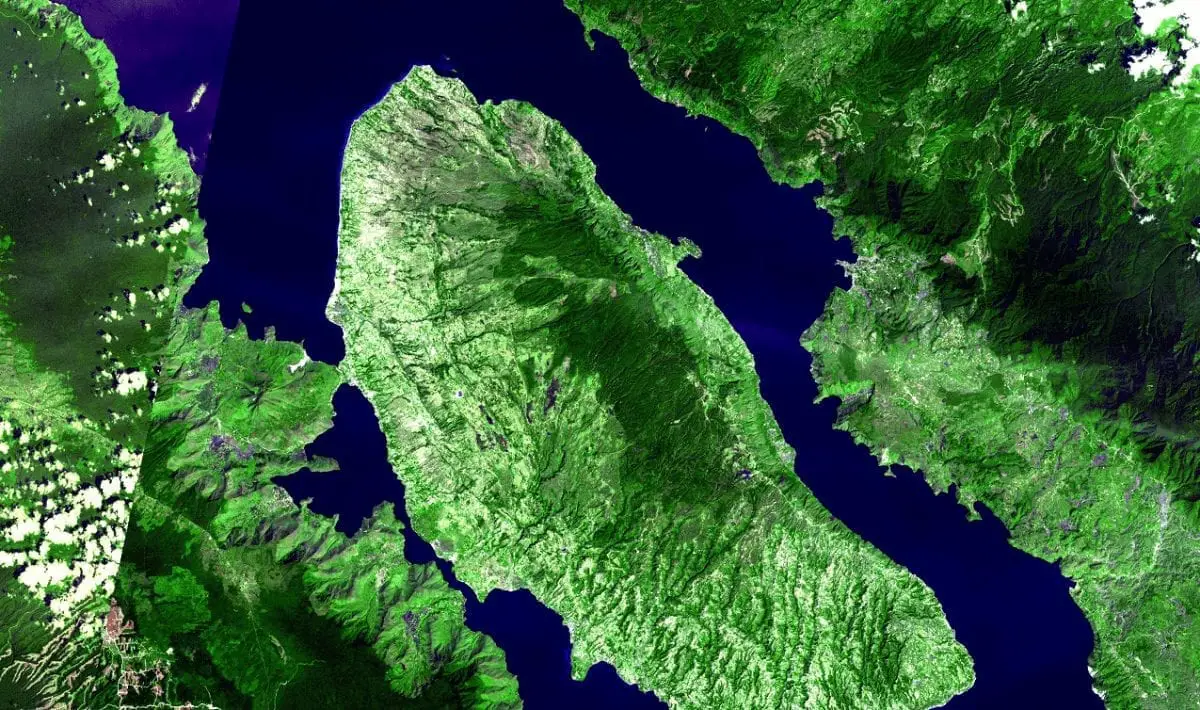
The rare but spectacular eruptions of supervolcanoes can cause massive destruction and affect climate patterns on a global scale for decades – and a new study has found that these sites also may experience ongoing, albeit smaller eruptions for tens of thousands of years after.
In fact, Oregon State University researchers were able to link recent eruptions at Mt. Sinabung in northern Sumatra to the last eruption on Earth of a supervolcano 74,000 years ago at the Toba Caldera some 25 miles away.
The findings are being reported this week in the journal Nature Communications.
“The recovery from a supervolcanic eruption is a long process, as the volcano and the magmatic system try to re-establish equilibrium – like a body of water that has been disrupted by a rock being dropped into it,” said Adonara Mucek, an Oregon State doctoral candidate and lead author on the study.
“At Toba, it appears that the eruptions continued for at least 15,000 to 20,000 years after the supereruption and the structural adjustment continued at least until a few centuries ago – and probably is continuing today. It is the magmatic equivalent to aftershocks following an earthquake.”
This is the first time that scientists have been able to pinpoint what happens following the eruption of a supervolcano. To qualify as a supervolcano, the eruption must reach at least magnitude 8 on the Volcano Explosivity Index, which means the measured deposits for that eruption are greater than 1,000 cubic kilometers, or 240 cubic miles.
When Toba erupted, it emitted a volume of magma 28,000 times greater than that of the 1980 eruption of Mount St. Helens in Washington state. It was so massive, it is thought to have created a volcanic winter on Earth lasting years, and possibly triggering a bottleneck in human evolution.
Other well-known supervolcano sites include Yellowstone Park in the United States, Taupo Caldera in New Zealand, and Campi Flegrei in Italy.
“Supervolcanoes have lifetimes of millions of years during which there can be several supereruptions,” said Shanaka “Shan” de Silva, an Oregon State University volcanologist and co-author on the study. “Between those eruptions, they don’t die. Scientists have long suspected that eruptions continue after the initial eruption, but this is the first time we’ve been able to put accurate ages with those eruptions.”
Previous argon dating studies had provided rough ages of eruptions at Toba, but those eruption dates had too much range of error, the researchers say. In their study, the OSU researchers and their colleagues from Australia, Germany, the United States and Indonesia were able to decipher the most recent volcanic history of Toba by measuring the amount of helium remaining in zircon crystals in erupted pumice and lava.
The helium remaining in the crystals is a remnant of the decaying process of uranium, which has a well-understood radioactive decay path and half-life.
“Toba is at least 1.3 million years old, its supereruption took place about 74,000 years ago, and it had at least six definitive eruptions after that – and probably several more,” Mucek said. “The last eruption we have detected occurred about 56,000 years ago, but there are other eruptions that remain to be studied.”
The researchers also managed to estimate the history of structural adjustment at Toba using carbon-14 dating of lake sediment that has been uplifted up to 600 meters above the lake in which they formed. These data show that structural adjustment continued from at least 30,000 years ago until 2,000 years ago – and may be continuing today.
The study also found that the magma in Toba’s system has an identical chemical fingerprint and zircon crystallization history to Mt. Sinabung, which is currently erupting and is distinct from other volcanoes in Sumatra. This suggests that the Toba system may be larger and more widespread than previously thought, de Silva noted.
“Our data suggest that the recent and ongoing eruptions of Mt. Sinabung are part of the Toba system’s recovery process from the supereruption,” he said.
The discovery of the connection does not suggest that the Toba Caldera is in danger of erupting on a catastrophic scale any time soon, the researchers emphasized. “This is probably ‘business as usual’ for a recovering supervolcano,” de Silva said. It does emphasize the importance of having more sophisticated and frequent monitoring of the site to measure the uplift of the ground and image the magma system, the researchers note.
“The hazards from a supervolcano don’t stop after the initial eruption,” de Silva said. “They change to more local and regional hazards from eruptions, earthquakes, landslides and tsunamis that may continue regularly for several tens of thousands of years.
“Toba remains alive and active today.”
As large as the Toba eruption was, the reservoir of magma below the caldera is much, much greater, the researchers say. Studies at other calderas around Earth, such as Yellowstone, have estimated that there is between 10 and 50 times as much magma than is erupted during a supereruption.




