
Eusocial insects, such as ants, social wasps and bees, and termites, include some of the most ecologically ubiquitous of terrestrial animals. The nests of these insects are well protected and provide a safe, communal space for the storing of resources and production of brood, so the nests are often cohabited by various highly specialized symbionts that take advantage of the abundant resources and protection inside the nests.
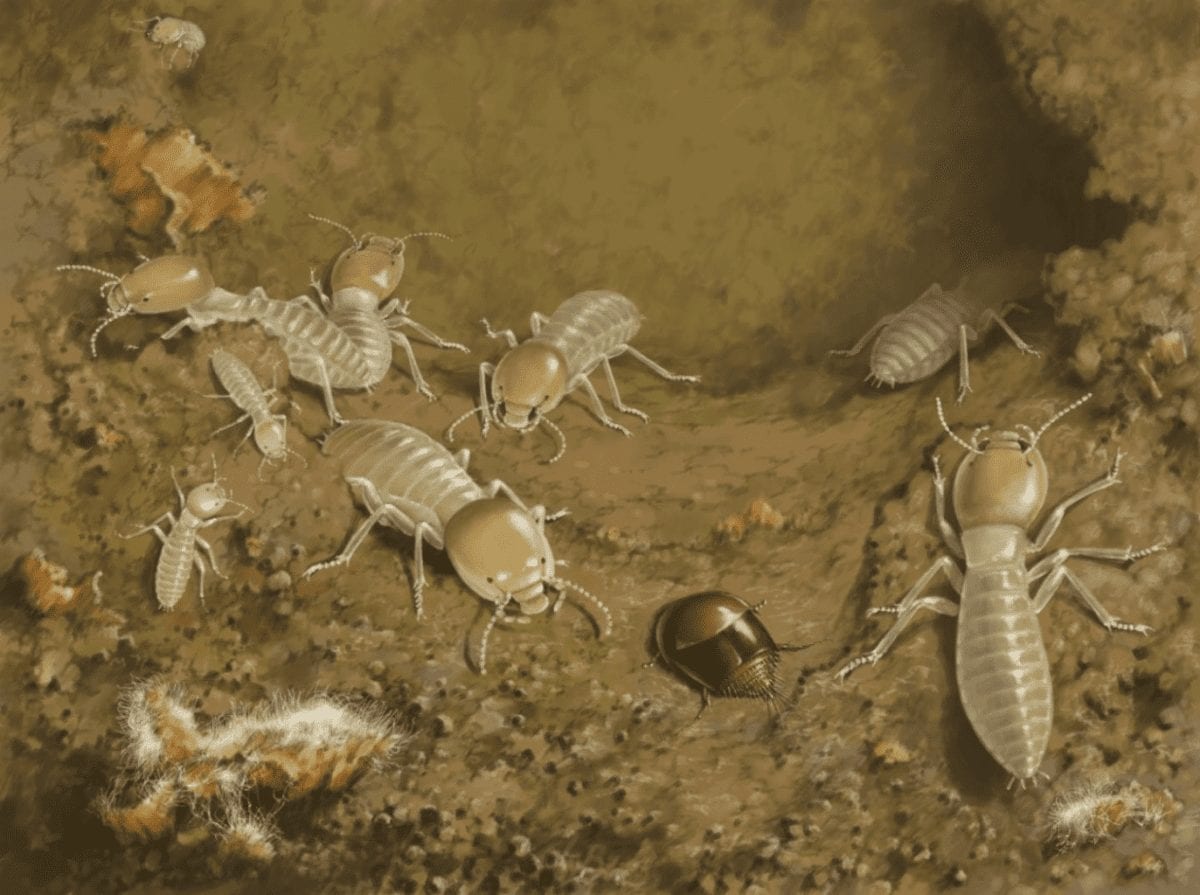
Recently, a research team led by Dr. CAI Chenyang and Prof. HUANG Diying from Nanjing Institute of Geology and Palaeontology (NIGPAS) of the Chinese Academy of Sciences reported the oldest, horseshoe-crab-shaped, and obligate termite-loving rove beetles from mid-Cretaceous Burmese amber. These fossils represent the oldest known termitophiles, which are able to hack into termite nest and to exploit their controlled physical conditions and “steal” plentiful resources (e.g., fungi) inside it. The discovery reveals that ancient termite societies were quickly invaded by beetles about 99 million year ago.
Termitophiles, symbionts that live in termite nests, include a wide range of morphologically and behaviorally specialized organisms. Understanding of the early evolution of termitophily is challenging due to a scarcity of fossil termitophiles, with all known reliable records occurring from the Miocene Dominican and Mexican ambers (approximately 19 million years ago). Mesozoic termitophiles are of great significance for understanding the origin of eusocial societies of termites and the early evolution of specialized termitophily.
To integrate into the hosts’ societies, termitophilous beetles have repeatedly evolved physogastry (swollen abdomens) and limuloid (horseshoe-crab-shaped) body shapes, representing the two principal forms. Both morphological adaptations have arisen convergently many times in beetles (Coleoptera) as well as in flies (Diptera).
The peculiar fossil rove beetles, named as Cretotrichopsenius burmiticus Cai et al., 2017, exhibits the characteristic features of the modern aleocharine tribe Trichopseniini, including the articulation of the hind leg whereby the coxae are fully fused and incorporated into the metaventrite.
Cretotrichopsenius burmiticus has a protective horseshoe-crab-shaped body form typical of many modern termitophiles, with concealed head and antennae and strong posteriorly directed abdominal setae. The discovery represents the earliest definitive termitophiles, pushing back the fossil record of termitophiles by 80 million years.
Recent species of Trichopseniini are usually associated with derived neoisopteran termites of Rhinotermitidae, and less frequently with Termitidae. Interestingly, some trichopseniines are known to live within nests of the basal-most termites (Mastotermitidae) and drywood termites (Kalotermitidae).
Because host specificity is rather low in extant trichopseniines, it is certainly likely that Cretotrichopsenius may have been associated with the variety of termite groups known from Burmese amber. The fossils reveal that ancient termite societies were quickly invaded by beetles about 99 million years ago.
The result was published in Current Biology on April 13th, 2017. This study was jointly supported by the Chinese Academy of Sciences, the National Natural Science Foundation, the Natural Sciences Foundation of Jiangsu Province, and the Ministry of Science and Technology of China.
CHINESE ACADEMY OF SCIENCES HEADQUARTERS




