
Humans living in South Africa in the Middle Stone Age used advanced heating techniques that vastly improved living conditions during the era.
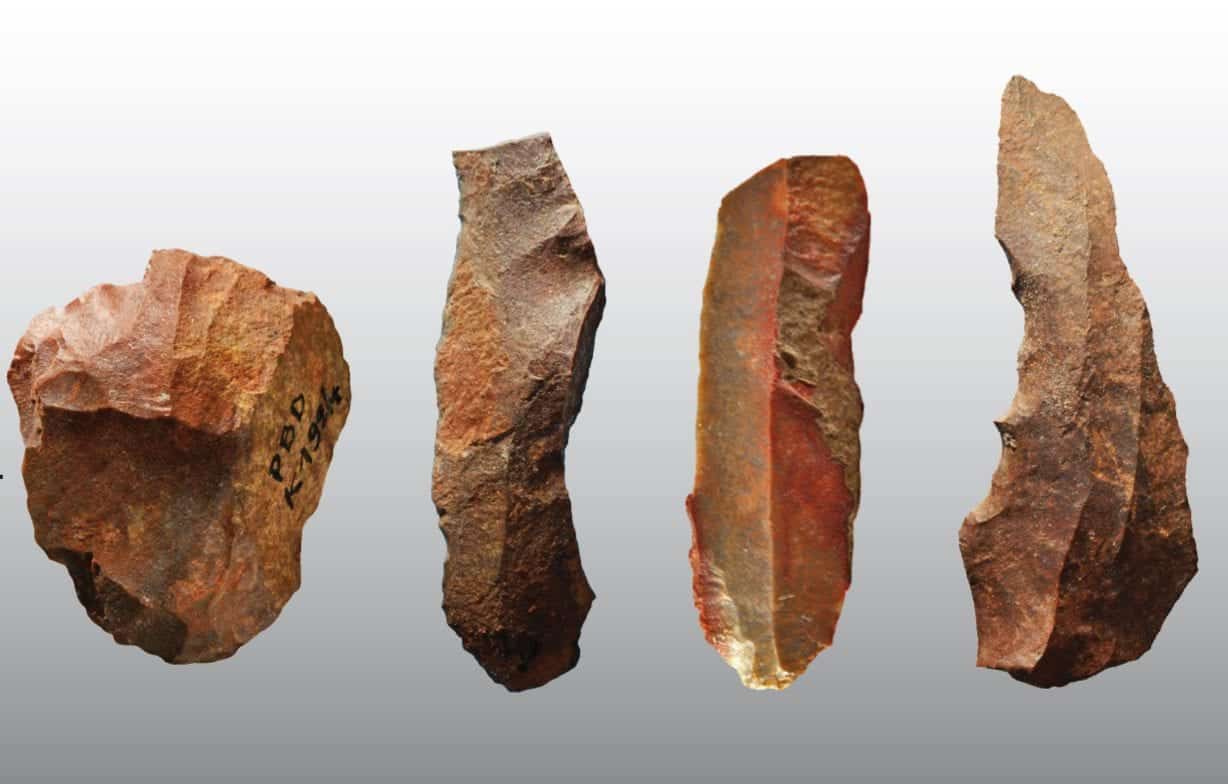
According to a new study published in the open-access journal PLOS ONE, humans living in South Africa in the Middle Stone Age after 65,000 years ago deliberately heated silcrete, a hard, fine-grained, local rock used in stone tool manufacture, so that they could more easily obtain blades from the core material.
A major effect on hunting
These blades were then crescent shaped and glued into arrow heads. This era, known as the Howiesons Poort, has produced the first known evidence for the use of the bow and arrow.
“This is the first time anywhere that bows and arrows were used. This would have had a major effect on hunting practices as both spears and bow and arrow could be used to hunt animals,” says Professor Christopher Henshilwood.
He and Postdoctoral Fellow Karen van Niekerk, from the Department of Archaeology, History, Cultural Studies and Religion at the University of Bergen (UiB) in Norway, are among the co-authors of the study.
Creating early transformative technology
The heat treatment enabled early humans to produce tougher, harder tools – the first evidence of a transformative technology. However, the exact role of this important development in the Middle Stone Age technological repertoire was not previously clear.
Novel analytical research approach
Delagnes, Henshilwood, van Niekerk and the rest of the research team, from South Africa and Germany, used a novel non-destructive approach to analyse the heating technique used in the production of silcrete artefacts at the Klipdrift Shelter, a recently discovered Middle Stone Age site located on the southern Cape of South Africa, including unheated and heat-treated comparable silcrete samples from 31 locations around the site. The site was discovered by Henshilwood and van Niekerk and first excavated in 2011.
“Based on the development of a non-destructive method using geological heated and unheated comparative reference samples, we have shown that more than 90 per cent of the silcrete used for the production of blades has been intentionally heated,” says Henshilwood.
“Heating was applied, non-randomly, at an early stage of core exploitation and was sometimes preceded by an initial knapping stage. As a consequence, the whole operational chain, from core preparation to blade production and tool manufacturing, benefited from the advantages of the heating process,” explains van Niekerk.
The hardening, toughening effect of the heating step would therefore have impacted all subsequent stages of silcrete tool production and use.
Heat treatment: a major asset
The authors suggest that silcrete heat treatment at the Klipdrift Shelter may provide the first direct evidence of the intentional and extensive use of fire applied to a whole lithic chain of production. Along with other fire-based activities, intentional heat treatment was a major asset for Middle Stone Age humans in southern Africa, and has no known contemporaneous equivalent elsewhere.
“The advantages of the heating process are multiple: by reducing the material’s fracture toughness and increasing its hardness, less force was needed to detach blades after heat treatment, resulting in better control and precision during percussion,” explains Henshilwood.
“An additional advantage relates to the heat-induced fracturing of the silcrete blocks at an early stage of core exploitation,” adds van Niekerk.
Three main benefits
According to the researchers this resulted in three main benefits:
1 The elimination of internal heterogeneities (iron oxide inclusions), which could have caused the incidental breakage of the core at an advanced stage of reduction.
2 The production of angular fragments with suitable angles and surfaces that can be directly exploited for knapping without further preparation.
3 Fewer constraints on the selection of the volumes to be heat-treated.
“The heat-induced fractures we observed are indicative of a fast heating process using open fires, an hypothesis which is strengthened by the presence of tempering residues, deposited through direct contact of the heated material with glowing embers,” says van Niekerk.
“This heating process marks the emergence of fire engineering as a response to a variety of needs that largely transcend hominin basic subsistence requirements, although it did not require highly specialized technical skills and was likely performed as part of on-site domestic activities,” says Henshilwood.




