
Date:

Earlier Stone Age artefacts found in Northern Cape of South Africa

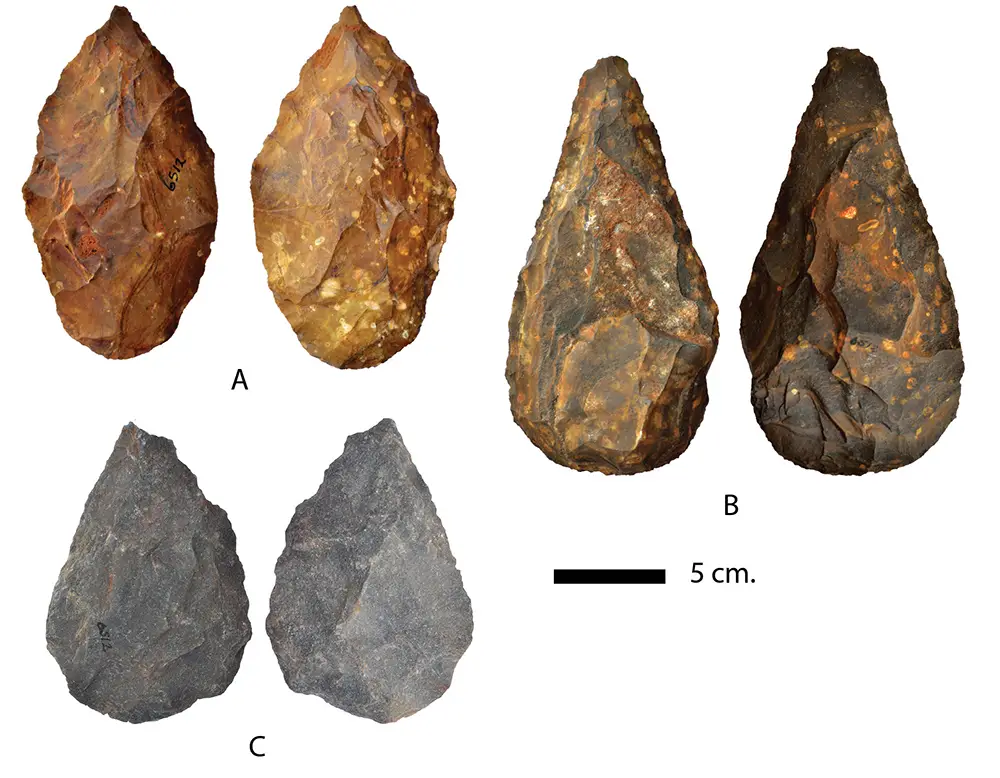
Excavations at an archaeological site at Kathu in the Northern Cape province of South America have provided tens of thousands of Earlier Stone Age artefacts, including items such as hand axes. These artefacts were unearthed by archaeologists from the University of Cape Town (UCT), South Africa and the University of Toronto, in collaboration with the McGregor Museum in Kimberley, South Africa.

The archaeologists’ research on the Kathu Townlands site, one of the richest early prehistoric archaeological sites in South America, was published in the journal PLOS ONE on 24th July 2014. It has been estimated that the site is between 700,000 and one million years old.
- Advertisement -
Hand axes collection: University of Toronto

Steven James Walker from the Department of Archaeology at UCT, lead author of the journal paper, says: “The site is amazing and it is threatened. We’ve been working well with developers as well as the South African Heritage Resources Agency to preserve it, but the town of Kathu is rapidly expanding around the site. It might get cut off on all sides by development and this would be regrettable.”

Today, Kathu functions as a major mining centre. Walker says that archaeologists are presented with the unique challenge, finding strategies to work cooperatively with developers, because the extensive prehistoric site is located in the middle of a zone of intensive development.

The Kathu Townlands site is one component of a collection of prehistoric sites known as the Kathu Complex. Other sites in the complex include Kathu Plan 1, which has produced fossils of animals such as elephants and hippos, as well as the earliest known evidence of tools used as spears from a level dated half a million years ago.

Michael Chazan, Director of the Archaeology Centre at the University of Toronto, emphasizes the challenges laid out to scientists posed by the density of the traces of early human activity in this area.

- Advertisement -

“We need to imagine a landscape around Kathu that supported large populations of human ancestors, as well as large animals like hippos. All indications suggest that Kathu was much wetter, maybe more like the Okavango than the Kalahari. There is no question that the Kathu Complex presents unique opportunities to investigate the evolution of human ancestors in Southern Africa.”


Contributing Source: University of Toronto

Header Image Source: University of Toronto



- Advertisement -

Stay Updated: Follow us on iOS, Android, Google News, Facebook, Instagram, Twitter, Threads, TikTok, LinkedIn, and our newsletter

spot_img
Mark Milligan
Mark Milligan
Mark Milligan is a multi-award-winning journalist and the Managing Editor at HeritageDaily. His background is in archaeology and computer science, having written over 8,000 articles across several online publications. Mark is a member of the Association of British Science Writers (ABSW), the World Federation of Science Journalists, and in 2023 was the recipient of the British Citizen Award for Education, the BCA Medal of Honour, and the UK Prime Minister's Points of Light Award.
spot_img
spot_img

Mobile Application

spot_img

Related Articles

Jewel “worthy of a duke” unearthed at Castle Kolno

Researchers from the Institute of Archaeology at the University of Wroclaw have unearthed a jewel “worthy of a duke” at Castle Kolno, located between the Stobrawa and Budkowiczanka rivers in Stare Kolnie, Poland.

Preserved 3rd century mosaic excavated in Iznik

Excavations in the İznik district of northwestern Türkiye have uncovered a preserved mosaic floor dating from the 3rd century AD.

Time capsule of medieval artefacts unearthed in Łasztownia excavation

Archaeologists have unearthed a time capsule of medieval artefacts on the island of Łasztownia in Szczecin, Poland.

Mask reliefs unearthed during Castabala excavations

Archaeologists have unearthed a new series of mask reliefs during excavations in the ancient city of Castabala, Turkey.

Bronze Age proto-city discovered on the Kazakh Steppe

Archaeologists have discovered a late Bronze-Age proto-city on the Kazakh Steppe in north-eastern Kazakhstan.

Altamura Man resolves long-standing debate over Neanderthal evolution

A preserved Neanderthal fossil is providing new insights into how this ancient human species adapted to the cold climates of Ice Age Europe.

Evidence of lost Celtiberian city beneath Borobia 

The rediscovery of a funerary stele has provided new evidence of a lost Celtiberian City beneath the municipality of Borobia in the province of Soria, Spain.

Viking Age grave unearthed in Bjugn stuns archaeologists

A routine day of metal detecting led into one of Norway’s most captivating archaeological discoveries in years.