
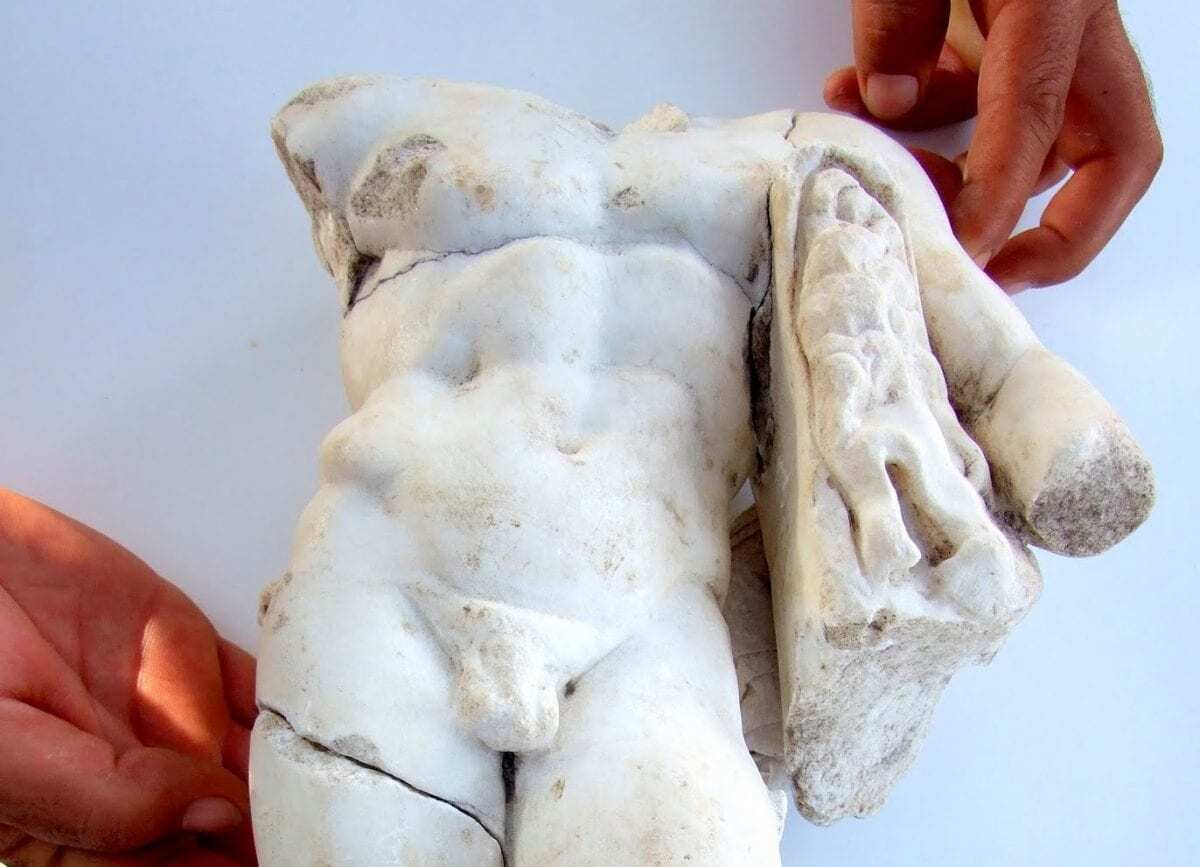
Archaeologists from the Israeli Antiquities Authority have discovered a rare marble statue of Hercules whilst excavating the site of Horvat Tarbenet.
The statue dates from the 2nd century and has been hand carved from marble.
According to Dr. Walid Atrash of the Israel Antiquities Authority, “This is a rare discovery. The statue, which probably stood in a niche, was part of the decoration of a bathhouse pool that was exposed during the course of the excavations. It is c. 0.5 m tall, is made of smoothed white marble and is of exceptional artistic quality. Hercules is depicted in three dimension, as a naked figure standing on a base. His bulging muscles stand out prominently, he is leaning on a club to his left, on the upper part of which hangs the skin of the Nemean lion, which according to Greek mythology Hercules slew as the first of his twelve labors”.
The hero Hercules, of Greek and Roman mythology, was born in Thebes. He is the son of the god Zeus and the mortal Alcmene, a woman from Electryon. Hercules is considered the strongest man in the world, a symbol of power, courage and superhuman strength; one of the most famous legendary heroes of ancient Greece who battled the forces of the netherworld on behalf of the Olympian gods. Hercules is described as hot tempered, and he often times acted impetuously and with uncontrollable rage. Greek mythology has it that Zeus’ wife, Hera, expressed her jealousy and fierce hatred of Hercules from the day he was born because he was the product of her husband’s infidelity.
While he was just a baby Hera placed two poisonous snakes in his bed, but he managed to overpower them. Later, in a fit of madness brought on by Hera, Hercules killed his three sons and his wife Megara, whilst she attempted to protect the smallest of them. In order to atone for his terrible sin, the Oracle of Delphi ordered Hercules to go to Eurystheus, king of Mycenae, and perform whatever the king commanded him to do.
Among the king’s commands were twelve superhuman feats known as the ‘Labors of Hercules’. Depictions of the labors of Hercules are among the most common themes in ancient art and the statue that was discovered portrays Hercules’ first task.
Horvat Tarbenet is located in the Jezreel Valley, three kilometers northeast of Kefar Barukh, and four kilometers northwest of Afula. Tarbenet was a Jewish settlement in the third century CE, which is mentioned in the Jerusalem Talmud (Megilla 4, 5). The story is told of a local teacher who would teach the Ten Commandments very quickly, so rapidly that his students could not understand him. The townspeople asked the teacher to take a break between each passage so they could follow him. The teacher refused because “the sages forbade one from stopping while reading the words of Moses”. The teacher’s refusal even received the backing of Rabbi Hanina. The teacher continued to teach as he did until the residents fired him.
In an archaeological excavation conducted at the site remains were discovered, among them dwellings, a built well and an installation that included a large pool which was probably part of a Roman bathhouse. Benches were found on two sides of the pools. The well, which is 2.90 m in diameter and in excess of 4 m deep, had a saqiye type pumping installation constructed above its opening. A drainage channel that extended as far as the pool was built alongside the well.
It seems that the well and channel were meant to supply water for the pool. After the pool was no longer being used it was filled in with a layer of earth that contained numerous potsherds, an abundance of broken glass vessels and the marble fragment of the statue of Hercules. The complex that was discovered apparently underwent a number of changes and it is dated to the Roman and Byzantine periods, until the beginning of the Early Islamic period.
At the beginning of the last century the legendary Valley Railway linked Haifa with Damascus. Recently the Israel National Roads Company commenced work renewing the rail line with the necessary changes in its route. The new Valley Railway, which is c. 60 kilometers long, will carry passengers and freight between Haifa, Afula and Bet She’an. In certain places the new track will pass alongside the route of the historic Valley Railway.
Header Image – IAA




